Ocean Noise Reduction – Global
Saving marine life could be as easy as turning down the volumeMore than 80% of European citizens support action on underwater noise
More than 80% of European citizens support action on underwater noise
20 May 2026
New survey shows strong backing for marine protection and ship speed reduction
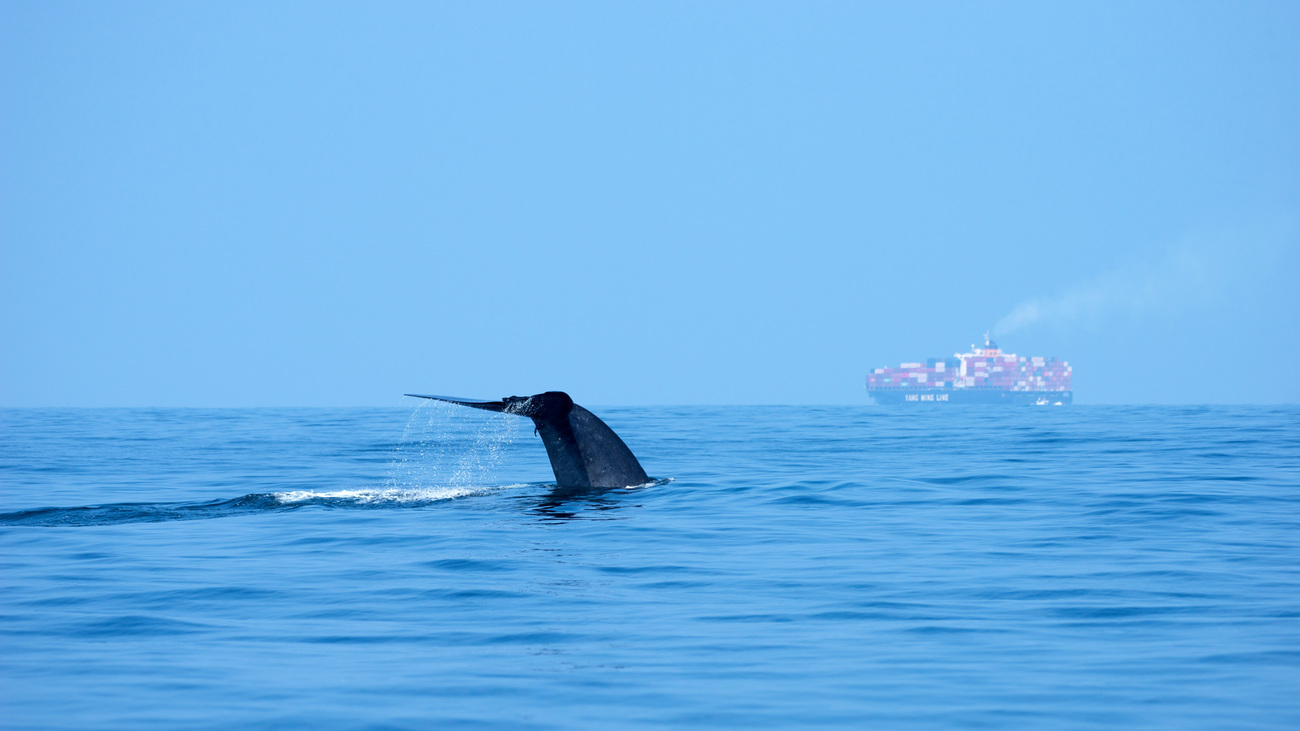
Blue whale fluking near a cargo ship. Photo: Christian Loader / © IFAW
(Brussels, 20 May 2026) – As crucial EU legislation on marine protection undergoes revision, a new survey reveals that a large majority of European citizens support action to reduce underwater noise pollution due to its impacts on marine life.
The survey was conducted across five European countries by IPSOS for the International Fund for Animal Welfare (IFAW) and generously supported by KRESK 4 OCEANS in March 2026. It shows that 98% of interviewed Europeans consider protecting marine life to be important. Yet, underwater noise pollution remains largely overlooked, with only 14% of them identifying it as a threat to marine biodiversity.
Despite this lack of awareness, after the issue was explained, respondents expressed strong concern. When informed that noise from ships disrupts communication, navigation, and feeding behaviours for many marine species, 89% of interviewed Europeans said the problem must be addressed urgently.
This growing awareness translates into strong support for concrete action:
- 84% of the respondents support reducing ship speeds to protect marine life from underwater noise pollution.
- 78% believe regulations are necessary to ensure ships slow down, rather than relying on voluntary commitments.
The interviewed Europeans citizens would also be willing to accept some trade-offs in their own lives if it reduced underwater noise pollution. The survey found 69% of people would accept slightly longer delivery times for goods and parcels if it helped marine life.
“Blue Speeds”: a simple and effective solution
For IFAW, these findings confirm the urgent need to implement “Blue Speeds” a reduction of approximately 10% in current ship speeds. This is one of the most straightforward and effective ways to reduce underwater noise pollution from shipping.
Globally, such a measure could immediately reduce underwater noise by up to 40%, while halving the risk of collisions with large whales and reducing greenhouse gas emissions by 13% across the international shipping fleet.
“Underwater noise pollution is an invisible, but very real threat to ocean biodiversity. This poll shows that citizens strongly support measures to reduce ship speeds and are even willing to accept slightly longer delivery times to better protect whales and other marine animals from this pollutant,” said Aurore Morin, Marine Conservation Campaigner at IFAW.
“There is a great leadership opportunity for the EU here, as citizens wouldn’t see the implementation of measures as another regulatory burden. In fact, according to this poll, it would make them feel hopeful and proud!”, add Aurore Morin.
A key moment for action in Europe
The survey comes at a pivotal time with the European Union strengthening its ocean protection policies and reviewing the Marine Strategy Framework Directive (MSFD).
Although the Directive aims to achieve “good environmental status” for European seas, this target was not reached in 2020, the original deadline year to achieve this objective. Among the areas where progress has been most limited is the reduction of underwater noise pollution, half of which is generated by maritime transport.
The work of the revision of the MSFD is being closely orchestrated with the development of the future Ocean Act. On 23 April, the Commission launched a public consultation to help shape the European Ocean Act, a key legislative proposal under the European Ocean Pact, set for adoption in 2026.
The survey findings highlight strong public support across Europe for taking action against underwater noise pollution, including through effective and practical measures such as reducing ship speeds. IFAW calls on national governments and the EU institutions to take this on board in the development of the future Ocean Act and to integrate mandatory ship speed reduction in an ambitious revision of the MSFD, ensuring stronger protection of our marine life.
Survey Ipsos bva for IFAW, European survey about underwater noise, conducted from February 11 to 26, 2026, in five European countries (France, Germany, the Netherlands, Spain, and Sweden) among representative samples of 1000 respondents aged 18 years old and over in each country.
END
Note to Editors:
Press contacts:
Jürgen Noack, jnoack.contractor@ifaw.org
Camille Vicet, +33 6 26 38 38 78, cvicet@ifaw.org
Related content
Press releases
Global whale summit marks milestone as whaling nations continue to block progress
Read morePress releases
From harpoons to ship strikes, global whale summit tackles the threats facing whales
Read moreBlog
How underwater noise pollution threatens marine life in the Western Indian Ocean
Read moreEvery problem has a solution, every solution needs support.
The problems we face are urgent, complicated and resistant to change. Real solutions demand creativity, hard work and involvement from people like you.