Ocean Noise Reduction – Global
Saving marine life could be as easy as turning down the volumeNew science to safeguard whales at sea, predicting and reducing vessel strikes
New science to safeguard whales at sea, predicting and reducing vessel strikes
13 January 2026
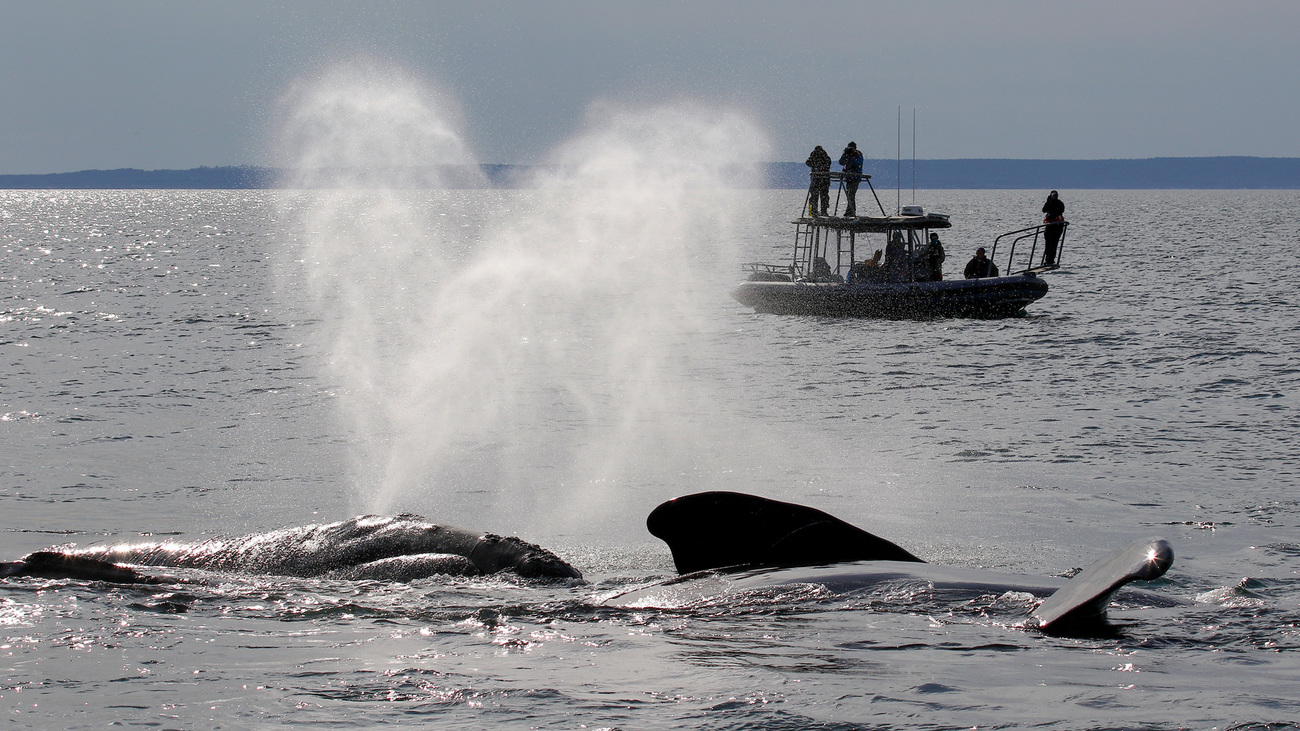
North Atlantic right whales surface and exhale near a vessel as seen from Song of the Whale in Cape Cod Bay. Photo: © Marine Conservation Research, NOAA/NMFS permit #21371-01.
(Yarmouth Port, MA – January 13, 2025) — A new conservation initiative will harness cutting edge science to help protect endangered baleen whales in one of the busiest marine corridors of the US East Coast.
IFAW, a global nonprofit working to rescue wildlife and safeguard populations, today announced a new grant from Allen Family Philanthropies to support research that forecasts high risk whale foraging activity in Massachusetts Bay and the Stellwagen Bank National Marine Sanctuary. This project will build science-based tools to more accurately predict when and where endangered whales are feeding so mariners and commercial vessels can reduce the risk of deadly collisions.
“Vessel strikes are one of the most serious immediate threats facing the critically endangered North Atlantic right whale, and sei whales also remain at risk as they navigate shifting food sources and crowded shipping lanes,” said Kathleen Collins, Senior Campaign Manager at IFAW. “By connecting what we know about whale foraging behavior with predictors like dimethyl sulfide and zooplankton abundance, this work fills essential data gaps and creates actionable information that can save lives.”
The research will use a combination of data sources to predict whale foraging “hotspots.” Critically endangered North Atlantic right whales and endangered sei whales will be temporarily tagged with non-invasive suction-cup tags to gather detailed information about their movement and feeding patterns. At the same time, researchers will measure the presence of zooplankton—the whales’ primary prey—and levels of dimethyl sulfide (DMS), a chemical released when zooplankton are eaten. DMS is known to attract whales and can serve as an indicator of active feeding zones.
By integrating these data, scientists will develop dynamic models that forecast when and where foraging is likely to occur. These forecasts will then be shared with mariners via the WhaleAlert mobile app, which provides real-time whale sightings and acoustic detections, and through the Automatic Identification System (AIS), which transmits alerts directly to commercial vessels.
“Projects like this, focused on evidence-based science that informs real world conservation action and fills critical knowledge and data gaps, ultimately enable greater impact in protecting species and ecosystems,” said Yuta Masuda, director of science for Allen Family Philanthropies. “IFAW’s unique program is exciting and demonstrates the collaboration and creativity that is needed between researchers, scientists, and conservation leaders to solve the complex environmental challenges we face.”
North Atlantic right whales number only about 380 individuals, and despite some recent modest increases in population estimates, the species remains on the edge of extinction without transformative action to reduce human caused deaths and injuries.
Studies like this one aim not just to fill scientific gaps but to turn data into decision ready tools for mariners, coastal communities, shipping industries, and policymakers. By improving our ability to forecast whale presence and behavior, this work supports safer seas for whales and people alike.
“This project builds on IFAW’s long-standing commitment to innovative, science-based marine conservation,” said Collins. “It represents a powerful example of how science and technology can be used in real time to reduce harm and help vulnerable species recover.”
This research is one of nine projects receiving funding under the third year of the Partnership to Advance Conservation Science and Practice (PACSP) program, a joint effort between Allen Family Philanthropies and the U.S. National Science Foundation. These projects focus on a range of species and ecosystems, and outcomes will have far-reaching implications for biodiversity and conservation, policy, and the economy.
//ENDS
High resolution images can be downloaded and shared with permissions at https://spaces.hightail.com/space/h5m5pItnV9
Press contact:
Stacey Hedman
Senior Communications Director, IFAW
m: +1 508 737 2558
e: shedman@ifaw.org
About IFAW (International Fund for Animal Welfare)
IFAW is a global non-profit helping animals and people thrive together. We are experts and everyday people, working across seas, oceans, and in more than 40 countries around the world. We rescue, rehabilitate, and release animals, and we restore and protect their natural habitats. The problems we’re up against are urgent and complicated. To solve them, we match fresh thinking with bold action. We partner with local communities, governments, non-governmental organisations, and businesses. Together, we pioneer new and innovative ways to help all species flourish. See how at ifaw.org
About Allen Family Philanthropies
Founded in 1988 by Jody Allen and the late Paul G. Allen, co-founder of Microsoft, Allen Family Philanthropies (formerly known as the Paul G. Allen Family Foundation) invests in communities across the Pacific Northwest and beyond to strengthen arts and culture, empower the next generation of changemakers, and support a global network of partners working to advance biodiversity and human well-being. Learn more at www.allenphilanthropies.org.
Related content
Our work can’t get done without you. Please give what you can to help animals thrive.