Wildlife Crime
UK Government responds to wild animals as pets petition, but significant gaps remain
UK Government responds to wild animals as pets petition, but significant gaps remain
2 November 2026
We welcomed the UK Government's response to a petition calling for stronger laws to protect wild animals kept and traded as pets, but significant gaps remain. Despite existing animal welfare and licensing laws, concerns persist about whether wild species should be kept as pets and whether animals entering the UK trade have been legally sourced. IFAW is calling for stronger protections, including a Positive List of species suitable for keeping as pets and legislation to prevent illegally sourced wildlife from entering the UK market.

A serval cat in a cage shows its teeth.
Reaching 10,000 signatures ensured that the petition received an official government response, and we're grateful to everyone who signed and helped shine a spotlight on the thousands of wild animals being kept and traded as pets across the UK.
The Government's response outlines several pieces of existing legislation that it believes protect wild animals, including the Animal Welfare Act 2006, the Dangerous Wild Animals Act 1976, primate licensing regulations, and licensing requirements for pet sellers. While these measures provide some protections, they do not address the fundamental concerns at the heart of the petition.
Simply put, existing laws focus on how wild animals are kept once they are already in captivity. They do very little to address whether those animals should be kept as pets in the first place, how they entered the trade, or whether they were legally sourced from their country of origin.
Welfare laws alone are not enough
The Government points to the Animal Welfare Act 2006, which makes it an offence to cause unnecessary suffering or fail to meet an animal's welfare needs. These protections are important, but applying them to wild animals presents significant challenges.
Many wild species have highly specialised behavioural, social, environmental, and dietary needs that are difficult, and sometimes impossible, to replicate in a domestic setting. Harm may develop gradually or be difficult to recognise, making enforcement challenging even where an animal's welfare is compromised. The question should not simply be whether an animal is suffering enough to trigger enforcement action. It should also be whether that animal's needs can realistically be met in a home at all.
This is why IFAW supports the introduction of a Positive List, a system that would permit only species demonstrated to be suitable for keeping as pets based on scientific evidence about their welfare needs and the risks they may pose to people, biodiversity, and animal health.
Such an approach would help shift the focus from responding to suffering towards preventing it.
Closing loopholes that can enable wildlife trafficking
The Government also highlighted the Dangerous Wild Animals Act 1976 (DWAA), which requires licences to keep certain species considered dangerous to public safety. However, the Act was never designed to address wildlife trafficking, conservation impacts, or animal welfare beyond basic licensing requirements.
In fact, some animals that can legally be kept in the UK may be protected in their native countries or subject to restrictions on collection from the wild. Where species are not covered by international trade controls, such as those established under the Convention on International Trade in Endangered Species of Wild Fauna and Flora (CITES), tracing their origins can be especially difficult. This creates a potential gap between the laws protecting wildlife in its country of origin and those governing its subsequent trade and possession in the UK.
IFAW continues to call for legislation that would make it illegal to import, possess, transport, buy, or sell wildlife obtained or traded in violation of relevant laws in its country of origin. Similar approaches already exist in several countries and help ensure that consumer markets do not inadvertently fuel the illegal removal of wildlife from natural ecosystems. A comparable framework in the UK would help close existing gaps and ensure we are not creating a market for wildlife taken illegally overseas.
Protecting wild animals should not depend solely on what happens after they arrive in the UK. It should also involve ensuring that they were legally sourced in the first place.
Why licensing does not guarantee suitable conditions
The Government's response also refers to licensing requirements for pet sellers, including standards for housing, food, bedding, and general animal care.
While these requirements are important, a licence to sell an animal does not necessarily establish that the species is suitable for life as a pet. Nor does it resolve wider concerns about conservation impacts, disease risks, illegal sourcing, or long-term welfare.
Breeding practices raise additional questions. Some breeders deliberately select unusual colours or physical characteristics, while others produce hybrids involving wild and domestic animals to increase commercial appeal. Experience from domestic animal breeding has shown that selecting for unusual appearances can unintentionally lead to serious health and welfare problems, including skeletal deformities, neurological disorders, respiratory difficulties, and other inherited conditions.
When wild species enter these breeding systems, there is a risk that similar welfare concerns are reproduced or intensified. Hybrids can also retain behavioural traits from their wild parents, which make them unsuitable or even dangerous to keep in domestic settings, as illustrated by breeds such as the “Savannah cat”.
Recognising these concerns, several European countries have introduced restrictions or prohibitions on the keeping and trade of certain hybrid animals. Yet there is little oversight of how such animals are being bred, what traits are being selected for, or what the long-term impacts may be on their health and wellbeing. These concerns reinforce the need for a regulatory system that considers the suitability of species and breeding practices before animals enter the pet trade, rather than relying solely on minimum care standards once they are being kept.
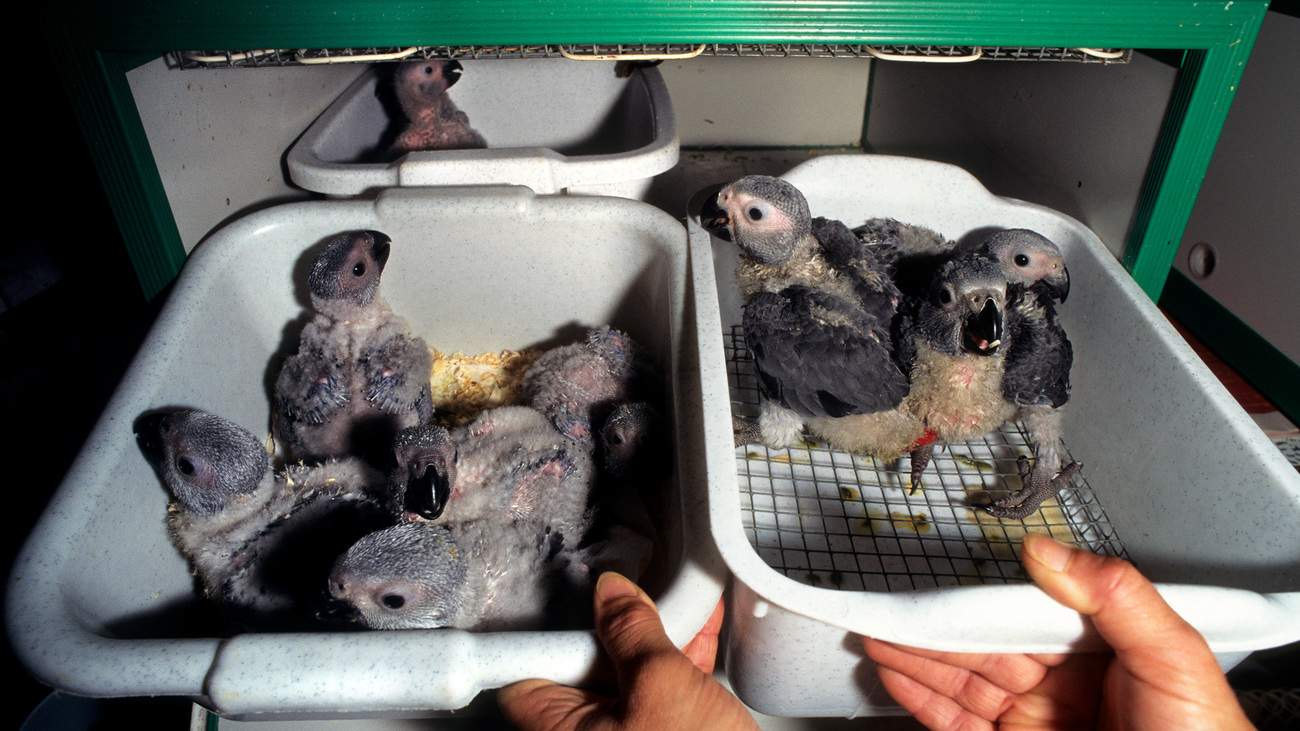
Grey parrot chicks in trays at commercial breeding facility, South Africa. Photo: © www.naturepl.com
What needs to change in the UK's wild pet trade laws
IFAW welcomes the Government’s recognition that animal welfare and effective enforcement matter. However, we believe that the current legal framework remains fragmented and does not adequately address the risks associated with keeping and trading wild animals as pets.
Existing laws were developed at different times to address different problems. Together, they leave gaps affecting animal welfare, biodiversity, public health, and the legal sourcing of wildlife. The growth of online marketplaces and social media has made effective oversight even more important.
IFAW continues to call for two key reforms:
- A Positive List for wild animals kept as pets. This would limit legal pet ownership to species whose welfare needs can be met in captivity and that pose no unacceptable risks to people, biodiversity, or animal health.
- A UK legislation prohibiting the import, possession, transport, purchase, or sale, of wildlife obtained or traded in violation of relevant laws in its country of origin.
Together, these measures would help move the UK towards a more preventative approach, protecting animals before they enter unsuitable situations and reducing opportunities for illegal wildlife trade.
Help us reach 100,000 signatures
Together, we've already achieved something significant. More than 10,000 people signed the petition, forcing this issue onto the Government's agenda and securing an official response. That is a powerful demonstration of public concern about the welfare, conservation, and biosecurity risks associated with the wild pet trade. But our work is not finished.
The Government's response highlights just how much more need to be done. While existing laws provide some protections, they do not address the fundamental gaps that allow many wild animals to be legally traded, bred, and kept despite serious welfare and conservation concerns.
The next milestone is 100,000 signatures. Reaching that threshold means the petition could be considered for debate in Parliament, creating a vital opportunity for lawmakers to scrutinise the current system and consider meaningful reform.
If you've already signed, thank you. Please consider sharing the petition with friends, family, and colleagues. If you haven't yet signed, now is the time. Together, we can help ensure that our homes do not become the final destination for the world's most vulnerable wildlife.
Related content
Every problem has a solution, every solution needs support.
The problems we face are urgent, complicated and resistant to change. Real solutions demand creativity, hard work and involvement from people like you.