Wildlife Crime
Stopping wildlife trafficking through Ethiopia’s busiest airport
Stopping wildlife trafficking through Ethiopia’s busiest airport
24 November 2026
Specialised training at Addis Ababa’s Bole International Airport is helping enforcement officers identify trafficked wildlife, strengthen investigations, and disrupt international criminal networks.
Front-line airport staff, police, customs, intelligence, and wildlife authority officers recently participated in specialised training in Addis Ababa as Ethiopia steps up efforts to stop wildlife trafficking through Bole International Airport, one of Africa’s busiest aviation hubs.
The training focused on closing skills and knowledge gaps that traffickers exploit to move wildlife products, including ivory, rhino horn, and pangolin scales, as well as live animals such as cheetahs and African grey parrots, through Ethiopia to markets in the Middle East, Southeast Asia, Europe, and the US.
In collaboration with the Ethiopian Wildlife Conservation Authority (EWCA), IFAW convened the training, bringing together airport personnel, police, customs and border enforcement agencies, Ministry of Justice representatives, and European enforcement officers from Portugal, Spain, and the Netherlands.
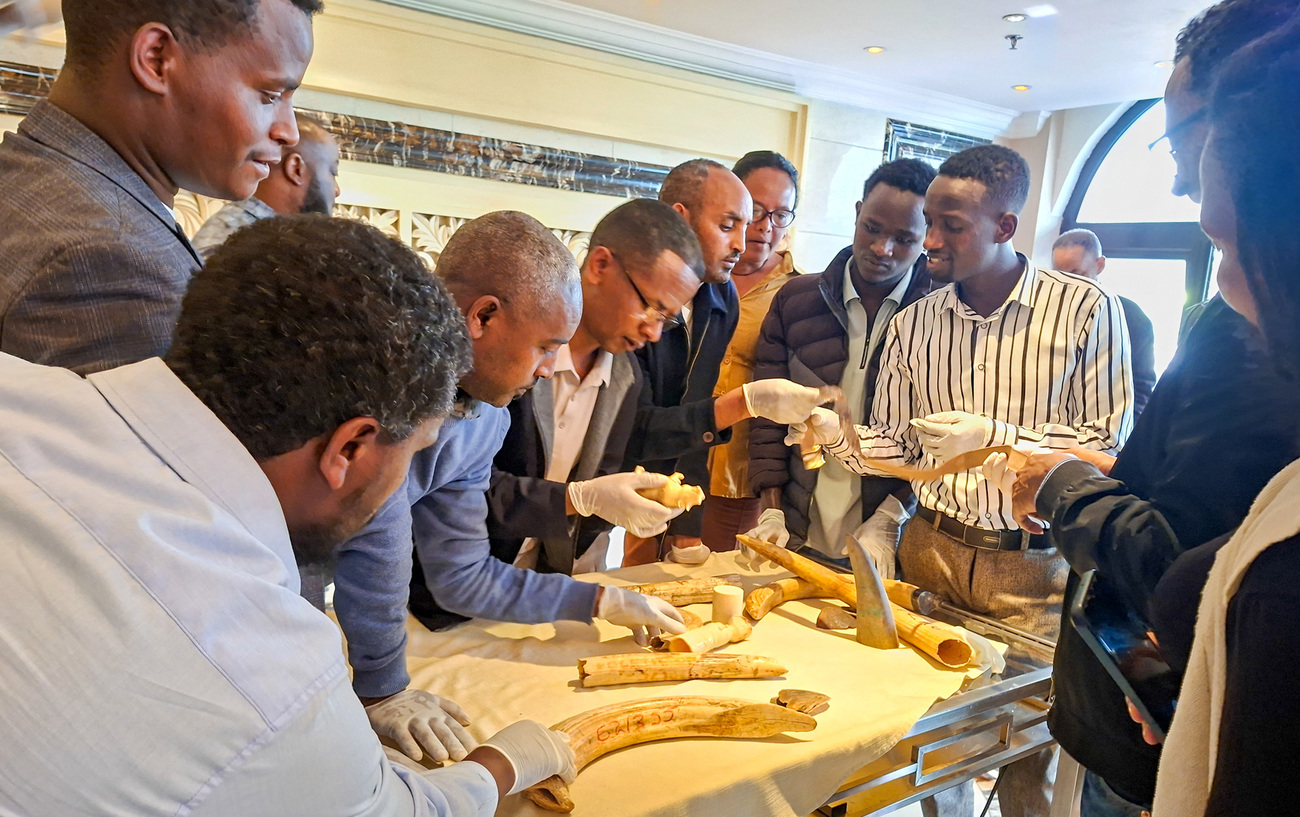
Trainees inspect ivory tusks and carved trinkets during specialised wildlife trafficking detection training in Addis Ababa, Ethiopia. Photo: Sisay Sahlu / © IFAW
IFAW is supporting Ethiopian authorities with species identification, passenger profiling, CITES permit verification, intelligence gathering, the care of confiscated live animals, and cooperation between agencies to help disrupt the organised criminal networks behind illegal wildlife trafficking.
Ivory trafficking through Bole Airport
Elephant ivory is a major wildlife product intercepted at Bole Airport. Figures cited during the training showed that 419 of the 427 passengers arrested at the airport between 2013 and 2017 were carrying ivory.
A 2025 African Wildlife Foundation report indicates that Bole’s canine team searched 512 passenger flights and 529 cargo flights and carried out 44,900 luggage searches. Those efforts produced 15 finds, including the interception of 1,661 kg of ivory.
The data also indicate that wildlife crimes in Ethiopia have a conviction rate of about 42 per cent, with poor evidence handling identified as one reason suspects escape prosecution.
Mekonen Chali, a customs administration coordinator at Bole Airport, said traffickers continually change their tactics and that skills gaps persist despite numerous seizures. He stressed that sustained training of front-line personnel is essential and should involve different sectors rather than individual institutions working alone.
A police officer attending the training, who spoke on condition of anonymity, said Ethiopia should draw on international experience to strengthen enforcement. This should extend beyond prevention to criminal investigations, intelligence gathering, and ensuring offenders are held legally accountable.
Tackling wildlife trafficking as organised crime
Christian Plowman, a former UK police officer and head of wildlife cybercrime programmes at IFAW, said the scale and seriousness of wildlife trafficking are widely underestimated.
“It is not a small problem,” Plowman said. “It is exactly the same level of problem as drug trafficking, firearms trafficking, human trafficking.”
He explained that public attention tends to focus on drugs and firearms when organised crime is discussed, despite the substantial profits criminals can make from illegal wildlife trade.
“There is no demand for these products inside Ethiopia. Bole is simply a transit hub,” Plowman said.
He described how ivory, rhino horn, and live animals, including cheetahs, lions, African grey parrots, and other bird species, are moved through Addis Ababa to consumer markets.
Plowman emphasised that Ethiopia already has capable agencies and established wildlife laws. The challenge is strengthening understanding of the scale of wildlife trafficking and treating it with the same seriousness as other forms of organised crime.
Daniel Pauwlos, a senior expert in wildlife and wildlife products control at EWCA, called for stronger coordination between customs, the Federal Police, immigration authorities, defence agencies, the courts, and the Ministry of Justice.
He said trafficking networks exploit major transport infrastructure, as well as unmonitored routes along Ethiopia’s borders with six neighbouring countries. EWCA also works with IFAW’s Middle East and East Africa offices to reduce demand for live cheetahs in Middle Eastern markets.
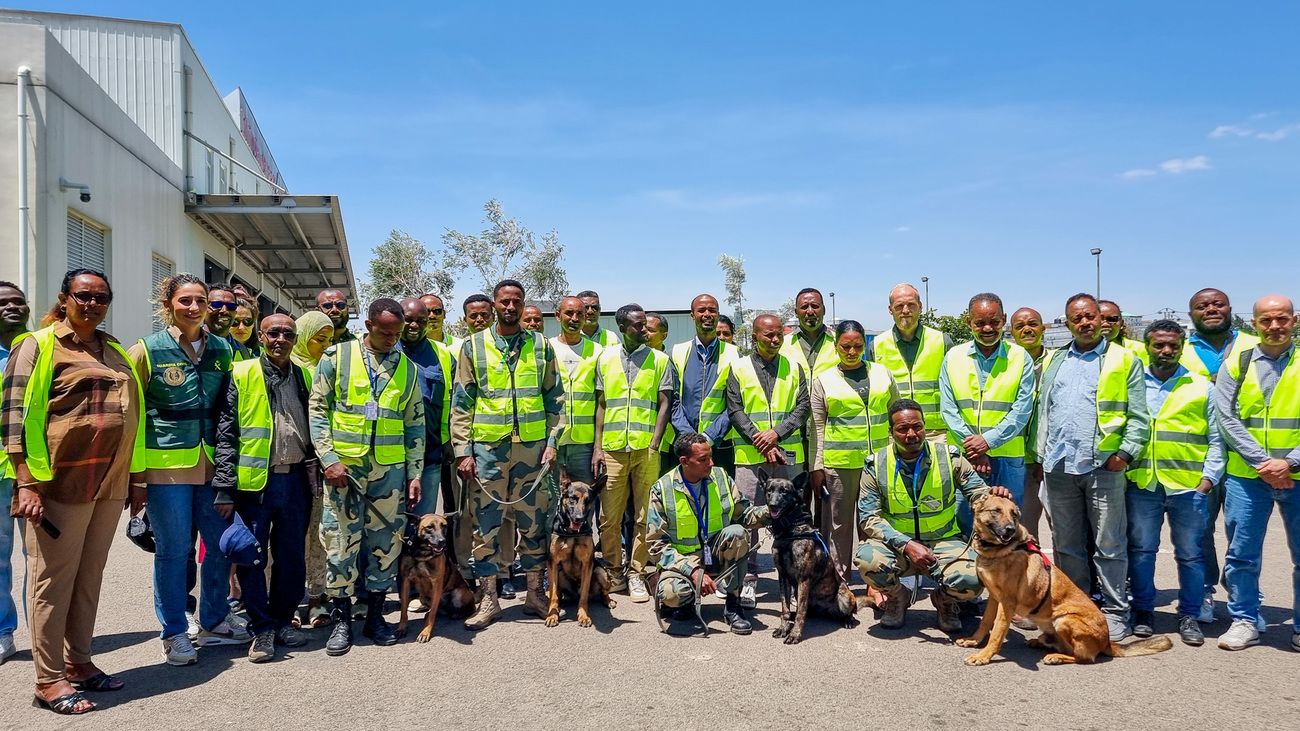
Wildlife trafficking enforcement trainees and sniffer dogs gather for a group photograph in Addis Ababa, Ethiopia. Photo: Sisay Sahlu / © IFAW
Training officers to detect illegal wildlife trade
Moses Olinga, IFAW’s programme manager for Uganda and the Horn of Africa, said Bole’s role as a major connecting hub makes front-line airport personnel critical to disrupting wildlife trafficking.
“We are building their capacity in species identification so officers can recognise wildlife products and live animals moving through the airport,” Olinga said. “We are also strengthening passenger profiling because this problem goes well beyond wildlife.”
As a major connecting hub for African air travel, Bole handles passengers and cargo moving between multiple international destinations. Olinga noted that wildlife crime can intersect with other forms of transnational organised crime, including money laundering, human trafficking, and drug trafficking.
International trade in protected wildlife species is regulated under the Convention on International Trade in Endangered Species of Wild Fauna and Flora (CITES). However, front-line personnel can face difficulties identifying species and distinguishing genuine permits from fraudulent ones.
The training highlighted gaps in species identification and permit verification. During a visit to Bole’s cargo section, participants also flagged several permits for further scrutiny.
Conservationists and crime specialists remain concerned that penalties for illegal wildlife trafficking in Ethiopia are relatively low compared with those in Kenya and Uganda. Offenders can receive small fines, which may provide little deterrent to well-funded traffickers.
“Custodial sentences combined with tracing and seizing criminal assets would provide a stronger deterrent,” said one delegate.
Ethiopia moves towards stronger wildlife crime penalties
Nakachew Birelew, EWCA’s public relations and communication executive, acknowledged that existing wildlife laws impose relatively minor fines. He said Ethiopia has revised its national wildlife policy with the aim of introducing stricter, proportionate penalties, although the proposed changes have not yet taken effect.
He explained that Ethiopia’s national parks face pressures including deforestation, habitat destruction, illegal hunting, and wildlife trafficking, with elephants heavily targeted for ivory. Traffickers also exploit Ethiopia, particularly Bole International Airport, as a transit point for wildlife products originating elsewhere in Africa.
Bianca Becherer, an IFAW programme manager, said the international nature of wildlife trafficking requires a coordinated response across borders. The training brought three European enforcement officers together with Ethiopian counterparts for the first time to strengthen cooperation and share expertise.
She noted that Ethiopia’s strategic position in the Horn of Africa makes Bole particularly important to efforts to disrupt illegal wildlife trade, which frequently involves organised criminal networks.
Through its wildlife crime prevention and enforcement programme, IFAW works with governments, law enforcement agencies, conservation organisations, and local communities to strengthen the detection, investigation, and prosecution of wildlife crime across Africa. The training at Bole Airport is part of that effort, helping authorities share expertise and improve coordination across borders to protect wildlife from illegal trade.
Related content
Every problem has a solution, every solution needs support.
The problems we face are urgent, complicated and resistant to change. Real solutions demand creativity, hard work and involvement from people like you.