Centre for Wildlife Rehabilitation and Conservation - India
Near Kaziranga National Park, animals are being threatened by a single highwayNurturing hope for an orphaned hoolock gibbon
Nurturing hope for an orphaned hoolock gibbon
22 May 2026
When a baby western hoolock gibbon arrived at IFAW-WTI’s Centre for Wildlife Rehabilitation and Conservation (CWRC) near Kaziranga National Park on 11 April 2026, she was only a few weeks old.
Rescued from Kohora in Assam’s Golaghat district, the infant was found clinging to her mother, who had died from electrocution. At just three to four weeks old, the young ape was orphaned and entirely dependent on human care for survival.
She was immediately transferred to CWRC’s neonatal intensive care unit, where veterinarians and animal caregivers began providing constant support, including warmth, specialised nutrition, and close monitoring.
A month later, there are encouraging signs. The baby gibbon has gained 160 grams and now weighs 670 grams. She has also started exploring her surroundings with growing confidence, instinctively attempting to climb and swing from branches, behaviours that will one day be critical for life in the forest canopy.
Her caregivers have begun introducing solid foods, including figs, bamboo shoots, and Bauhinia leaves, helping her gradually transition towards a more natural diet.
Because gibbons are highly social animals, the team has also provided a soft ape plush toy for comfort. She is often seen clinging to it while resting or carrying it around her enclosure.
Care measured in months and years
Rehabilitating an orphaned primate is a slow process. For young gibbons, physical development is only one part of recovery. They must also build the coordination, confidence, and natural behaviours needed to survive independently in the wild.
At CWRC, caregivers are carefully managing each stage of that process while limiting unnecessary human imprinting wherever possible.
Her rescue itself was remarkably fortunate. Caregivers say the infant narrowly escaped electrocution when her mother died instantly.
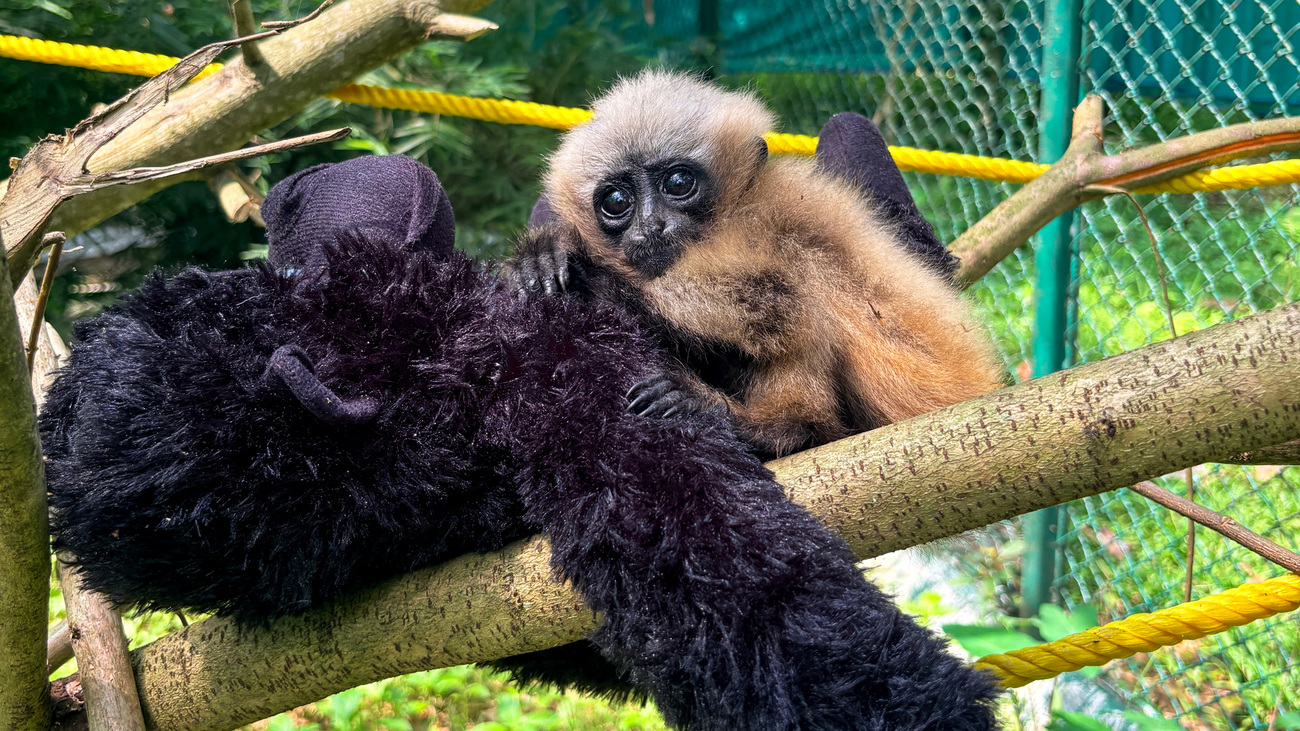
The young western hoolock gibbon clings to a soft ape plush toy for comfort while resting or moving around her enclosure. Photo: © IFAW-WTI
India’s only ape species
Hoolock gibbons hold a unique place in India’s biodiversity as the country’s only ape species. Highly adapted to life in the treetops, they move through forests using brachiation, swinging from branch to branch with their long arms in search of food and shelter.
But forests across north-east India are becoming increasingly fragmented, making survival more difficult for species that depend on continuous canopy cover. Electrocution, habitat loss, and human disturbance remain significant threats to hoolock gibbons, despite legal protection under India’s Wild Life (Protection) Act, 1972.
For now, the young gibbon’s world is small: regular feeds, careful monitoring, short climbs, and the gradual development of strength and confidence.
With time, and continued expert care, the hope is that it will not stay that way forever.
Related content
Every problem has a solution, every solution needs support.
The problems we face are urgent, complicated and resistant to change. Real solutions demand creativity, hard work and involvement from people like you.