Marine Conservation
Surge in shipping traffic sparks new drive to protect whales from deadly collisions
Surge in shipping traffic sparks new drive to protect whales from deadly collisions
18 November 2026
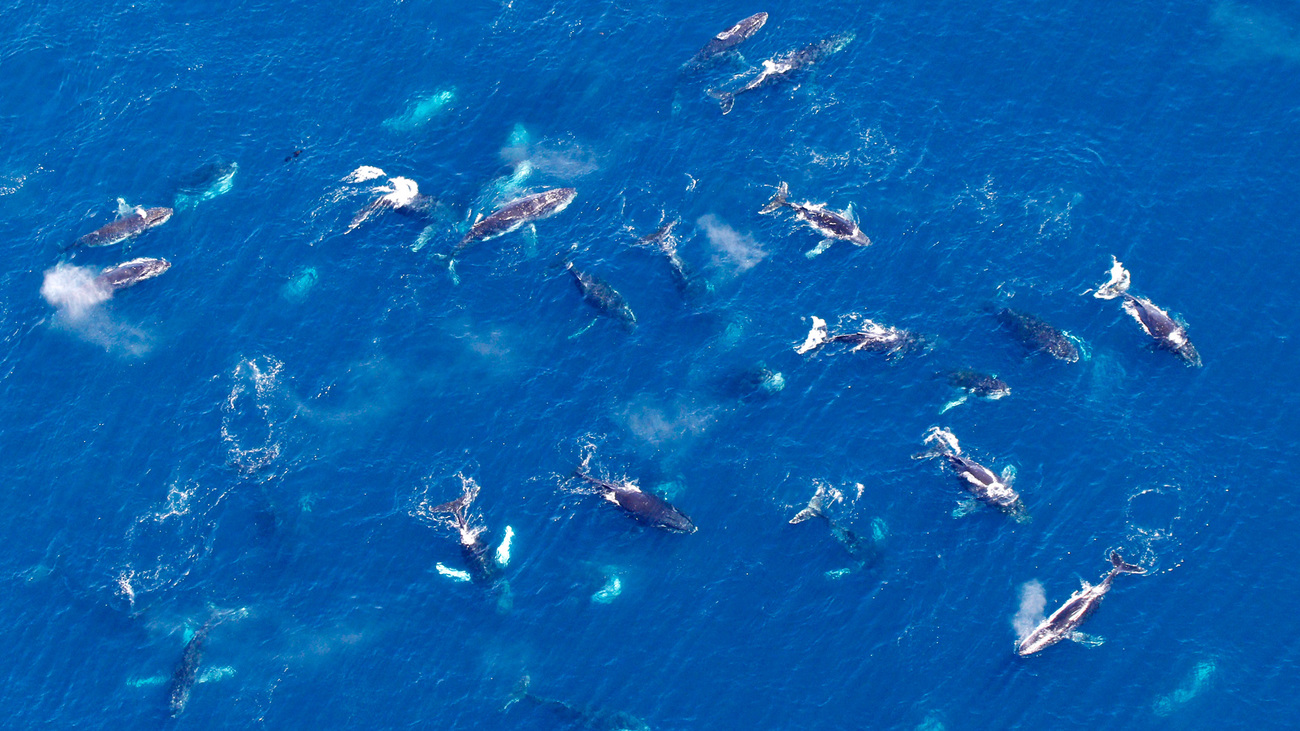
A “supergroup” of humpback whales, photographed along the coastline of South Africa. Photo: © Ken Findlay
(Cape Town, South Africa – 18 November, 2026) - Science and conservation experts have joined forces to protect whales from increased shipping traffic around the coast of South Africa, one of the world's busiest maritime routes.
The “Navigating Safer Seas for Whales and Shipping” project launched by the African Whale and Shipping Management (AWSM) Programme is led by the University of Pretoria's Mammal Research Institute (MRI) Whale Unit, AfriSeas Solutions and the OCEAN Action Network.
Geopolitical and security threats in the Middle East have diverted more international ships around the Cape of Good Hope, significantly increasing traffic through waters used by several whale species. Since 2023, fast-moving container and tanker traffic has increased four-fold compared to pre-crisis levels.
"We are at a critical point where recovering whale populations are increasingly sharing space with growing ocean industries and infrastructure,” says Professor Els Vermeulen, Chief Scientist at the Mammal Research Institute (MRI) Whale Unit.
“This partnership provides an opportunity to move beyond isolated efforts and build the collaborative, evidence-based approach needed to understand emerging risks and develop practical solutions to ensure that whales can thrive long into the future."
Developed in collaboration with IFAW, the International Whaling Commission’s (IWC) Vessel Strike Expert Panel and South Africa's Department of Forestry, Fisheries and the Environment, the initiative addresses concerns over the convergence of shipping routes and critical whale habitats off the Western Cape.
South Africa's southwestern coastal waters support a diversity of whales and dolphins, including several species that migrate through or feed in areas intersected by major shipping routes.
Acoustic surveys have recorded blue and fin whales in offshore waters during winter, while the coastal waters of the Western Cape provide important breeding habitat for southern right whales and seasonal feeding grounds for “supergroups” of humpback whales.
Much of this habitat overlaps with shipping approaches to Cape Town and Saldanha Bay, as well as the wider Cape Sea Route.
Ship strikes are a significant conservation concern because collisions between ships and whales can cause severe injuries or death. Risk is particularly high when large vessels travel through areas where whales are feeding, resting or migrating.
Recent strandings along the Western Cape coastline of South Africa show injuries likely to have been caused by strikes, including extensive trauma and propeller wounds.
The full extent of ship strike mortality in South African waters remains poorly understood, demonstrating the need for improved monitoring, research and reporting.
Ken Findlay, biologist and ocean consultant at AfriSeas, says whales had made a remarkable recovery from three centuries of deadly whaling. “Making sure that recovery continues into the future requires there are no new pressures to impact population growth.”
“We must act now. By working with maritime authorities, researchers, conservation organisations and shipping operators, the AWSM project will identify measures to protect whales by managing the risk of ship strike along South Africa's coastline,” said Findlay.
Ends
Media notes:
Navigating Safer Seas for Whales and Shipping builds on international discussions about reducing ship strike risk, including at a ship strike workshop held at the International Maritime Organization headquarters in January 2026, as well as the IWC Scientific Committee meeting in May.
An important priority will be strengthening cooperation among researchers, vessel operators, port authorities, and conservation partners, ensuring that scientific findings guide decisions about shipping activity in sensitive marine habitats.
The programme invites shipping companies, maritime authorities, researchers and other interested stakeholders to contribute expertise, data and practical solutions.
Media contact:
Christina Pretorius
Communications Director, Africa
m: +27 82 330 2558
e: cpretorius@ifaw.org
Related content
Every problem has a solution, every solution needs support.
The problems we face are urgent, complicated and resistant to change. Real solutions demand creativity, hard work and involvement from people like you.