Commercial Whaling Opposition - Global
We’re shifting the global mindset and protecting whales for the futureHow modern science changed the way we study whales
How modern science changed the way we study whales
21 July 2026
This article is the final part of a three-part series marking the 40th anniversary of the commercial whaling moratorium.
Read part one: 40 years after the whaling ban, whales still need protection
Read part two: Commercial whaling remains cruel and unnecessary
It is early morning aboard Song of the Whale. The research sailing vessel, built by IFAW, moves quietly through the waves. On deck, the crew listens, watches, and records what they observe. Beneath the surface, hydrophones capture the sounds of whales. Above the water, individual whales are identified, positions mapped, and movements documented.
“The Song of the Whale team is a close-knit group with a shared goal: raising awareness about the threats facing different whale species,” says skipper Richard McLanaghan. Here, knowledge is gained through observation and by studying living whales.
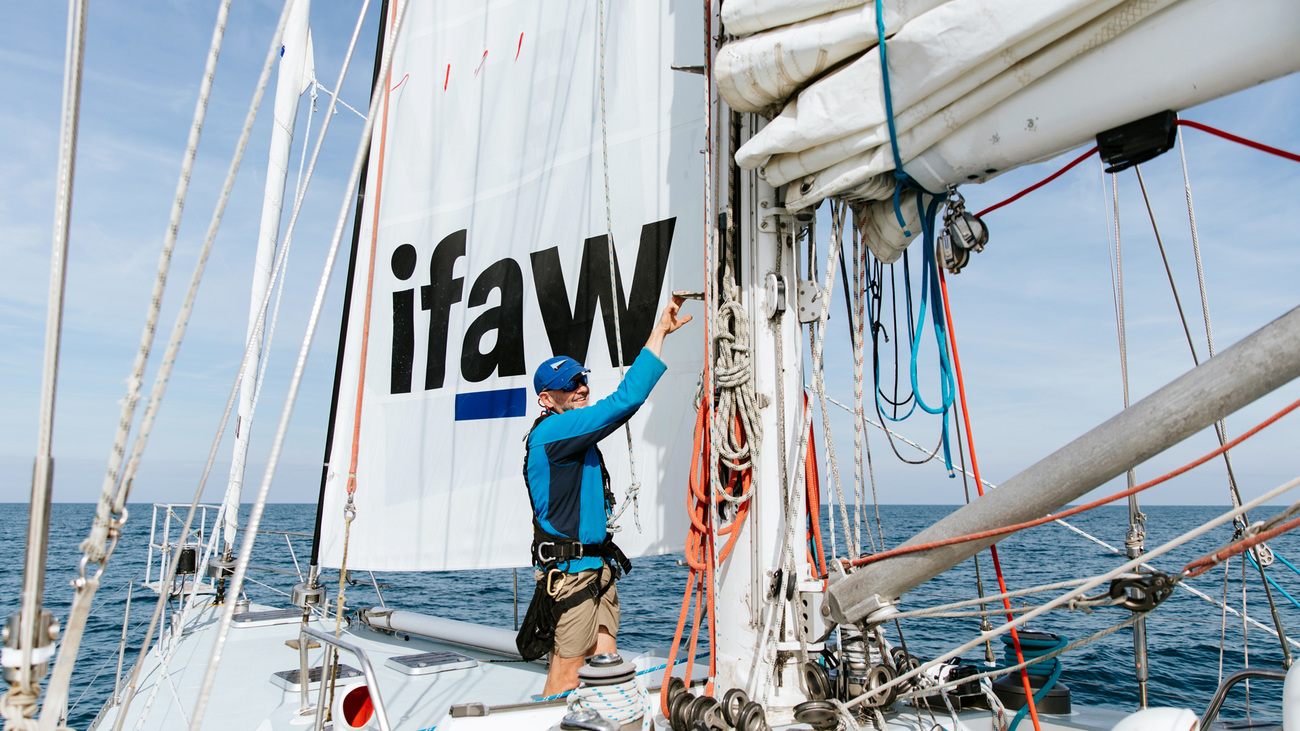
On board the Song of the Whale research vessel off the east coast of the United States. Photo: Andrea Spence / © IFAW
Today, scientists can answer critical questions about whale populations, behaviour, health, communication, and migration without killing the animals they study. But that was not always accepted. For decades, whaling nations insisted that whales had to be killed to study them. Under the banner of science, whales continued to be hunted despite the commercial whaling moratorium and the creation of protected areas.
The loophole in the whaling moratorium
When the International Whaling Commission (IWC) adopted the moratorium on commercial whaling in 1982, it included one exception: countries could continue killing whales for scientific purposes.
That exception quickly became a loophole. Japan, in particular, used the exemption for decades to continue whaling, including in the Southern Ocean—an internationally protected whale sanctuary. Iceland also used the provision at times, though on a much smaller scale.
Officially, whales were killed in the name of science. But the whale meat was later sold commercially, while DNA analyses also revealed that protected whale species were entering markets.
Whaling countries also argued that whales consumed too many fish and should be culled to protect global fisheries. IFAW helped challenge this claim by supporting independent scientific research and expert reviews that demonstrated the complexity of marine food webs and the lack of evidence that reducing whale populations would benefit fisheries.
Fish consumed by whales would not simply become available to commercial fisheries if whale populations were reduced. In fact, disrupting complex marine ecosystems by culling whales could have unintended consequences for fish stocks. Meanwhile, overfishing and other human pressures remain the primary drivers of declining fish populations.
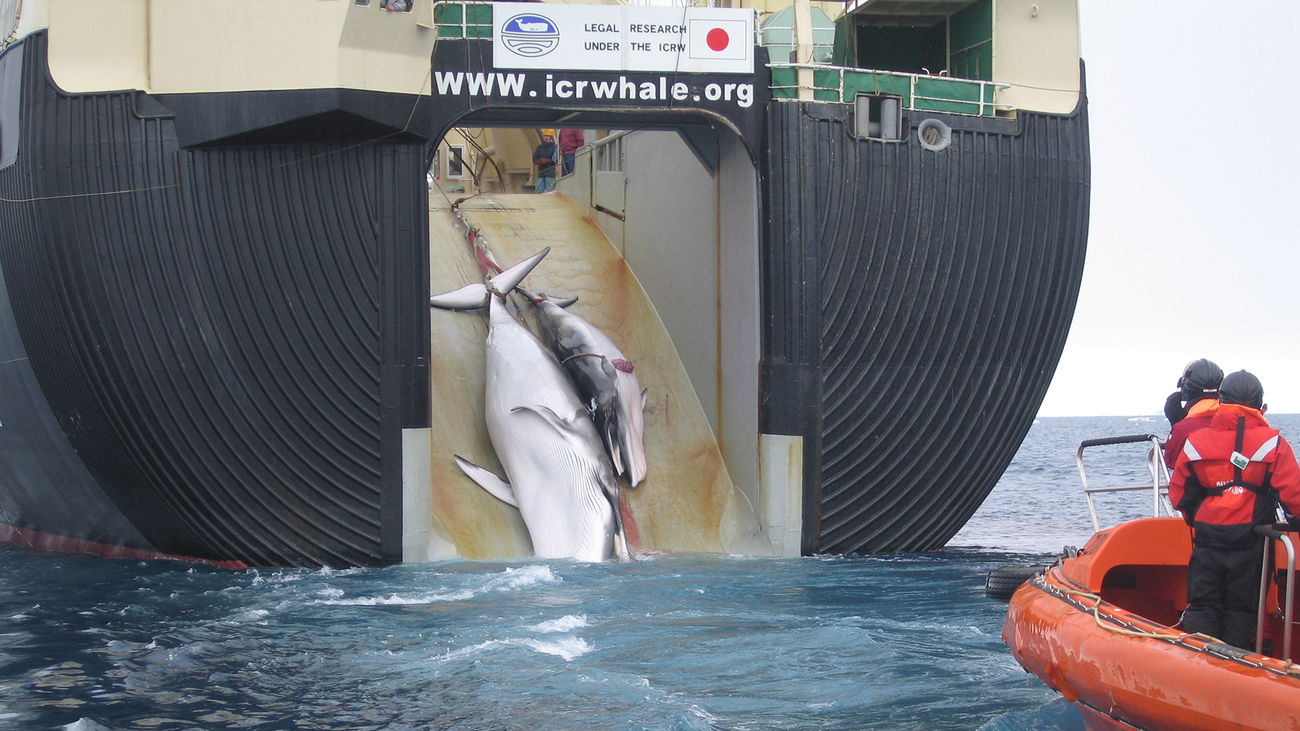
Adult and calf fin whales are dragged aboard the Nisshin Maru, a Japanese whaling vessel, 2008. Photo: © Australian Customs and Border Protection Service, CC-BY-3.0-AU
Today, there is much wider recognition of the positive role whales play in healthy oceans. Their movements, feeding, and nutrient cycling contribute to ocean productivity and support marine ecosystems.
A legal turning point
The weakness of the argument for so-called scientific whaling came under international scrutiny in 2014 before the International Court of Justice.
Australia brought a case challenging Japan’s Antarctic whaling programme, and IFAW helped support preparations through legal consultations with international experts and by documenting the history of scientific whaling.
After years of proceedings, the International Court of Justice ruled in 2014 that Japan’s whaling programme was “not for purposes of scientific research.” The ruling was clear and had immediate consequences: Japan stopped whaling in the Southern Ocean.
“For us, that was a turning point,” says Andreas Dinkelmeyer, campaign manager at IFAW. “For the first time, it was recognised at the highest international level that so-called scientific whaling had no real scientific basis.”
The decision reinforced what advances in whale research were already demonstrating. Scientists did not need to kill whales to understand them.
Studying living whales
Today, scientists use a growing range of non-lethal methods to study whales, including acoustic monitoring, photo identification, genetic sampling, and long-term observation. These methods provide insights into whale behaviour, communication, population health, distribution, and migration. They also offer a far more complete understanding of living whales over time than studies based on dead animals ever could.
IFAW helped drive this shift early on.
With the Song of the Whale, IFAW demonstrated how non-lethal whale research could work in practice. Designed to operate quietly. and minimise disturbance to animals, the research vessel can conduct acoustic surveys at night and operate in challenging conditions. This allows scientists to follow whales over longer periods of time, document their movements, identify important habitats, and gather evidence that can inform conservation decisions.
For McLanaghan, the work is inseparable from the goal of protecting whales.
“I feel very committed to what we do. I believe we make a small but important contribution. Our research helps us better understand how to protect whales such as critically endangered North Atlantic right whales. That’s exactly why I do this work.”
Early expeditions by the Song of the Whale, including in the Azores, helped demonstrate the potential of non-lethal research at a time when some governments continued to argue that whale had to be killed to understand them.
The shift towards studying living whales was part of a broader transformation. As scientists developed better ways to learn from whales without killing them, coastal communities were also demonstrating that living whales could support livelihoods and local economies.
More valuable alive than dead
In many coastal regions today such as Iceland, the Caribbean, and the Azores, living whales support tourism, research, and education, generating income without the need to kill them.
IFAW played an active role in supporting this transition. Through research, workshops, and collaboration with local partners, IFAW helped establish responsible whale watching as a sustainable alternative to whaling. Within the IWC, IFAW also works to promote whale watching not simply as a tourism activity, but as an issue with broader conservation, scientific, and economic value.
IFAW supported both the development of whale watching programmes and efforts to ensure their long-term sustainability. Governments, NGOs, and tourism operators worked together to develop standards designed to protect whales while supporting the communities whose livelihoods increasingly depended on living animals.
The economic impact was significant. Within a decade, global revenue generated by whale watching doubled from around US$1 billion to $2 billion annually.
More important than the numbers was the broader shift in perspective. Whales were increasingly recognised not simply as resources to be consumed, but as living animals, vital participants in marine ecosystems, and a source of economic opportunity for coastal communities.
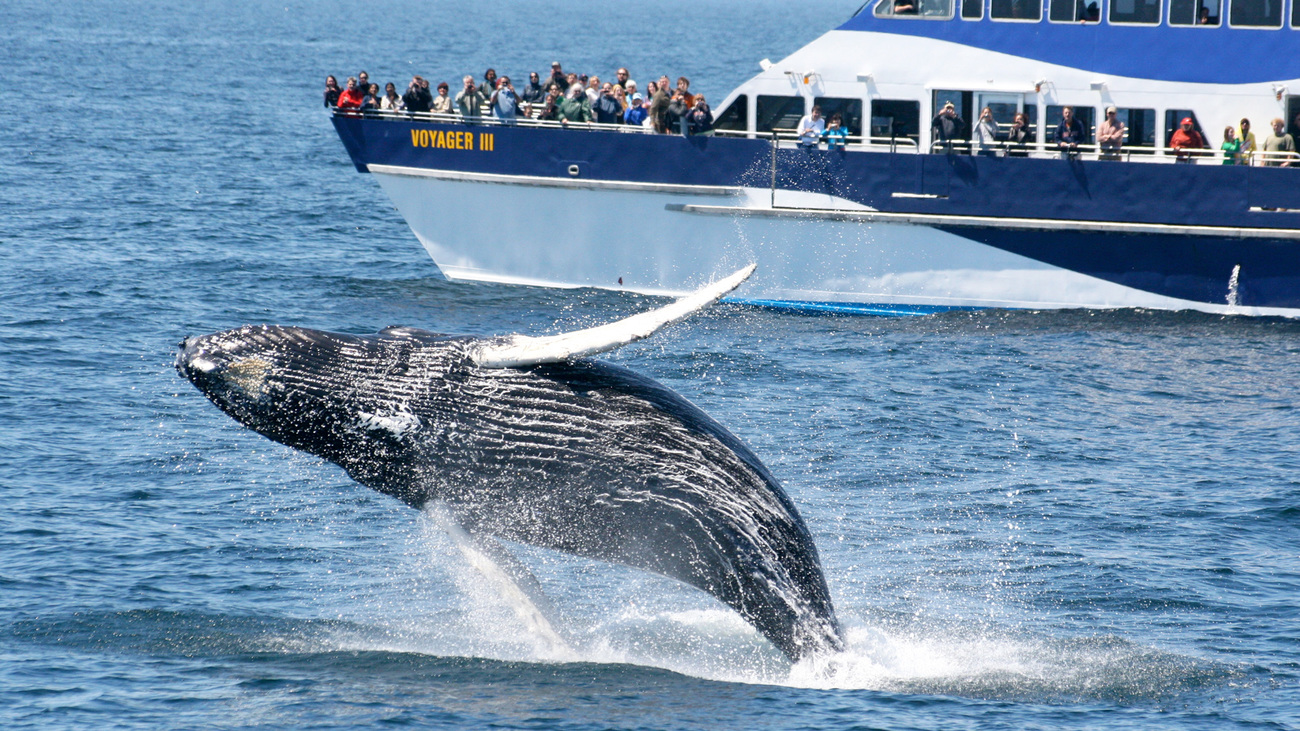
A humpback whale breaches in front of the Voyager III whale watch vessel cruising through Stellwagen Bank National Marine Sanctuary. Photo: © WCNE-Whale Center of New England
From managing whaling to protecting whales
The role of the IWC itself has also evolved. IFAW efforts have helped shift the focus away from whaling and towards whale conservation. Working closely with Mexico, IFAW supported a proposal to establish the IWC Conservation Committee. Today, the Committee provides a mechanism for the IWC to address modern threats such as vessel strikes, entanglement, ocean noise, marine debris, and other challenges facing whales in a changing ocean.
The transition is still ongoing, but it reflects a fundamental change in how whales are understood, no longer as resources to be managed for exploitation, but as individual animals and vital parts of marine ecosystems that need protection.
Science does not need a harpoon
Forty years after the commercial whaling moratorium came into effect, one thing has become clear. Whales do not need to be killed for scientists to understand them.
“The arguments used to justify commercial whaling have long been debunked, including those behind so-called scientific whaling,” says Andreas Dinkelmeyer. “Today, we have the knowledge and tools to study and protect whales without harming them—yet they continue to face significant human-driven pressures. IFAW’s work to address these threats continues, 40 years on from the commercial whaling ban.”
Forty years ago, the moratorium gave many whale populations a chance to recover. The evidence gathered since has exposed the cruelty of continued commercial whaling, while also dismantling the argument that whales must be killed in the name of science.
Today, aboard Song of the Whale and across seas and the ocean, researchers continue to demonstrate a different way forward by studying living whales, understanding the threats they face, and using that knowledge to protect them.
Related content
Every problem has a solution, every solution needs support.
The problems we face are urgent, complicated and resistant to change. Real solutions demand creativity, hard work and involvement from people like you.