Beijing Raptor Rescue Center - China
Birds of prey are falling prey in ChinaHow an injured Eurasian eagle-owl returned to the wild
How an injured Eurasian eagle-owl returned to the wild
September 24, 2026
After losing a toe and spending eight months in rehabilitation, an injured Eurasian eagle-owl in Beijing was finally ready to hunt, fly, and live independently in the wild again.
On a freezing evening in December 2025, an injured Eurasian eagle-owl was found grounded in Beijing’s Daxing District. The owl was alert, its bright orange eyes taking in its surroundings, but it was clear that something was wrong.
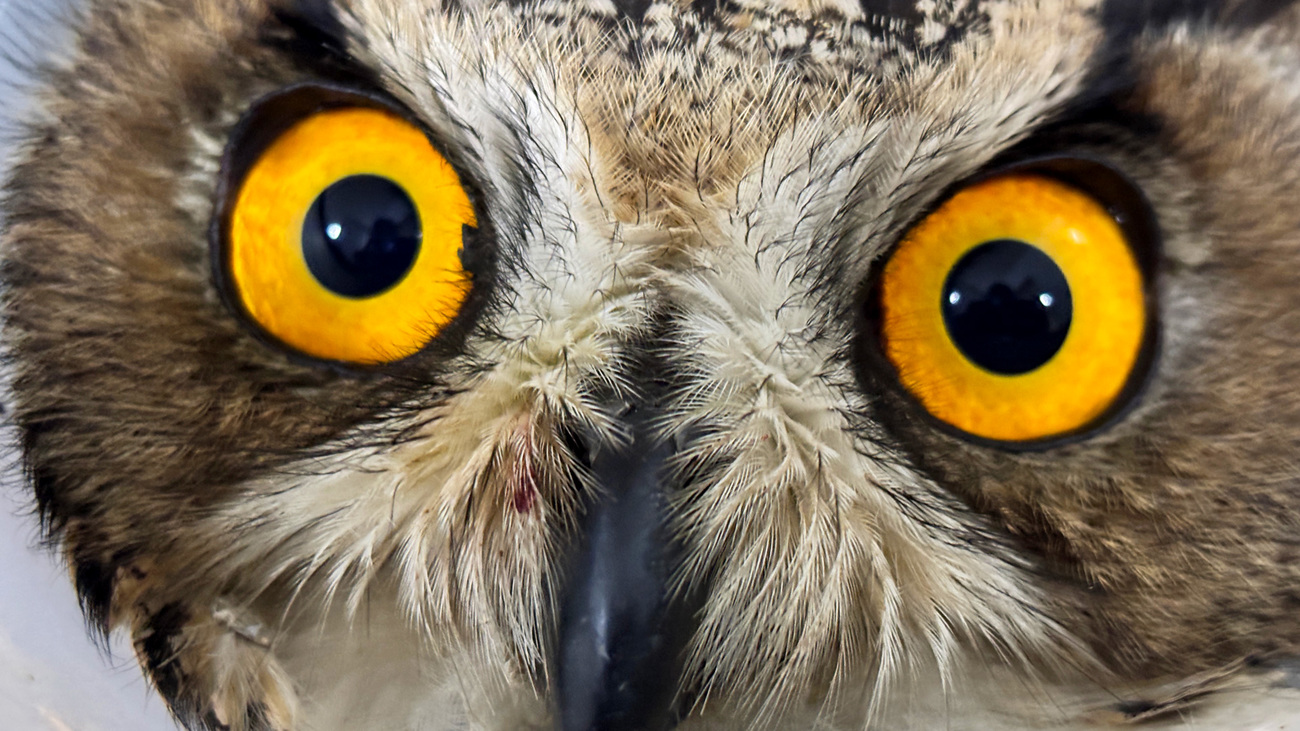
The injured Eurasian eagle-owl receives specialized care at IFAW’s Beijing Raptor Rescue Center during its eight-month rehabilitation. Photo: © IFAW
The person who found the owl contacted IFAW’s Beijing Raptor Rescue Center (BRRC), and on 7 December, it arrived in the care of the rehabilitation team. During the owl’s initial examination, the team quickly identified a serious problem. One of its toes had begun to die, while the other foot had a wound of its own.
Getting this owl back to the wild would take eight months of specialized treatment, two surgeries, and a rehabilitation team willing to rethink its approach when a stubborn wound refused to heal.
A long road to recovery
Eurasian eagle-owls are the largest owl species found in Beijing. Powerful predators capable of taking prey as large as foxes and medium-sized raptors, they rely on their feet and talons to grip and immobilize prey. For an injured eagle-owl, healthy, functioning feet can make the difference between recovering from an injury and being able to return to life in the wild.
Every raptor admitted to BRRC receives a comprehensive examination. Rehabilitators assess the bird’s weight and body condition, conduct blood tests, and examine its feathers, skeleton, wounds, and potential parasites. Together, these findings help the team understand the condition of each individual animal and determine the best course of treatment.
For this eagle-owl, the examination confirmed that the end of the third toe on its right foot was necrotic, while its left foot also had a crusted wound. The team cleaned and dressed the wound on the left foot and surgically removed the dead tissue from the right toe before suturing the site. Both feet were bandaged, and the owl received medication to support its recovery.
Keeping those bandages in place proved difficult. The owl repeatedly used its beak to tear them apart, exposing the wounds, and reinforcing the dressings made little difference. The team eventually fitted the owl with a protective collar that prevented it from reaching its feet, but even then, the right foot did not heal as expected.
New X-rays revealed why. The infection had spread to the joint next to the amputated portion of the toe, and the owl underwent a second surgery to remove the infected section of bone. Following the procedure, the right foot gradually began to heal.
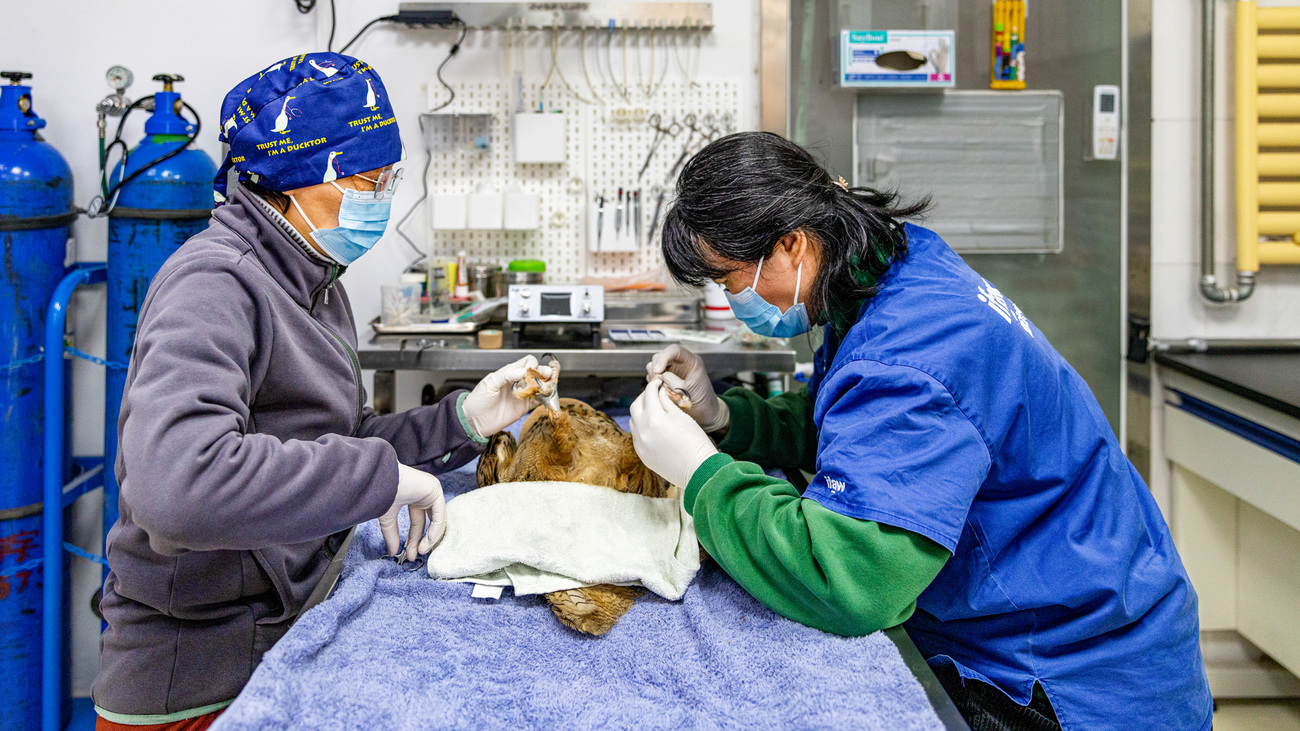
The injured Eurasian eagle-owl in surgery at IFAW’s Beijing Raptor Rescue Center during its eight-month rehabilitation. Photo: © IFAW
Finding a solution for a stubborn wound
The wound on the owl’s left foot presented a different challenge. Whenever rehabilitators changed the dressing, the wound appeared clean and had a healthy blood supply. Blood tests and X-rays revealed no obvious underlying problem, yet despite continued treatment, it simply would not close.
The team began looking beyond the wound itself for an explanation. Stress was one possibility. Like many wild animals in rehabilitation, the eagle-owl remained highly alert to its unfamiliar surroundings, and prolonged stress can interfere with healing.
There was also a physical explanation to consider. With the owl recovering from the loss of a toe on its right foot, rehabilitators suspected it was shifting more of its weight onto its left foot, putting additional pressure on the wound and potentially preventing it from healing.
So the team adapted its approach. Instead of relying only on conventional dressings, gauze, and cotton padding, rehabilitators placed a ring of foam beneath the bandage, leaving an opening directly beneath the wound. The simple adjustment relieved pressure on the injured area whenever the owl stood. They also increased the time between dressing changes to reduce unnecessary disturbance.
Slowly, the wound began to close.
Wildlife rehabilitation rarely follows a predictable path. Animals cannot tell us where something hurts or why a treatment is not working, so successful rehabilitation depends on expertise, careful observation, and a willingness to adapt treatment to the needs of each individual animal. For this owl, looking beyond the injury itself ultimately helped the team find the solution it needed.
More than surviving
At BRRC, healing an injury is only part of rehabilitation. Whenever possible, the goal is to return a wild animal to the wild, equipped to survive independently.
Before a raptor can be released, the team evaluates both its physical condition and its behavior. Previous injuries must be resolved, and the bird must be in good body condition, with healthy plumage and strong flight. Its vision and hearing must also be suitable for survival in the wild.
For owls, flight must also be quiet enough to allow them to hunt effectively. Behavior matters just as much. A releasable raptor must retain its natural wariness of people and cannot have become dependent on humans for food or comfortable enough around people to compromise its chances of survival.
At its final examination, the Eurasian eagle-owl met those requirements. It weighed 1,572 grams, its wounds had healed, its physical condition was sound, and it had retained the natural wariness it needed for life in the wild.
There was still an important question to answer. Could an eagle-owl missing part of a toe still hunt successfully?
Can an eagle-owl hunt with a missing toe?
A raptor’s feet are highly specialized. Eurasian eagle-owls rely on the arrangement of their toes and a tendon-locking mechanism to grip and immobilize prey. Although this owl had lost the third toe on its right foot, its first toe remained intact and, together with the two remaining toes, could still create an effective grip.
Experience also mattered. This was an adult Eurasian eagle-owl that had already lived and hunted successfully in the wild, with the skills and instincts developed through that experience. Losing a toe had changed its foot, but the rehabilitation team determined that it had not taken away its ability to function as a wild predator.
Eight months after it arrived at BRRC, the owl was ready to return home.
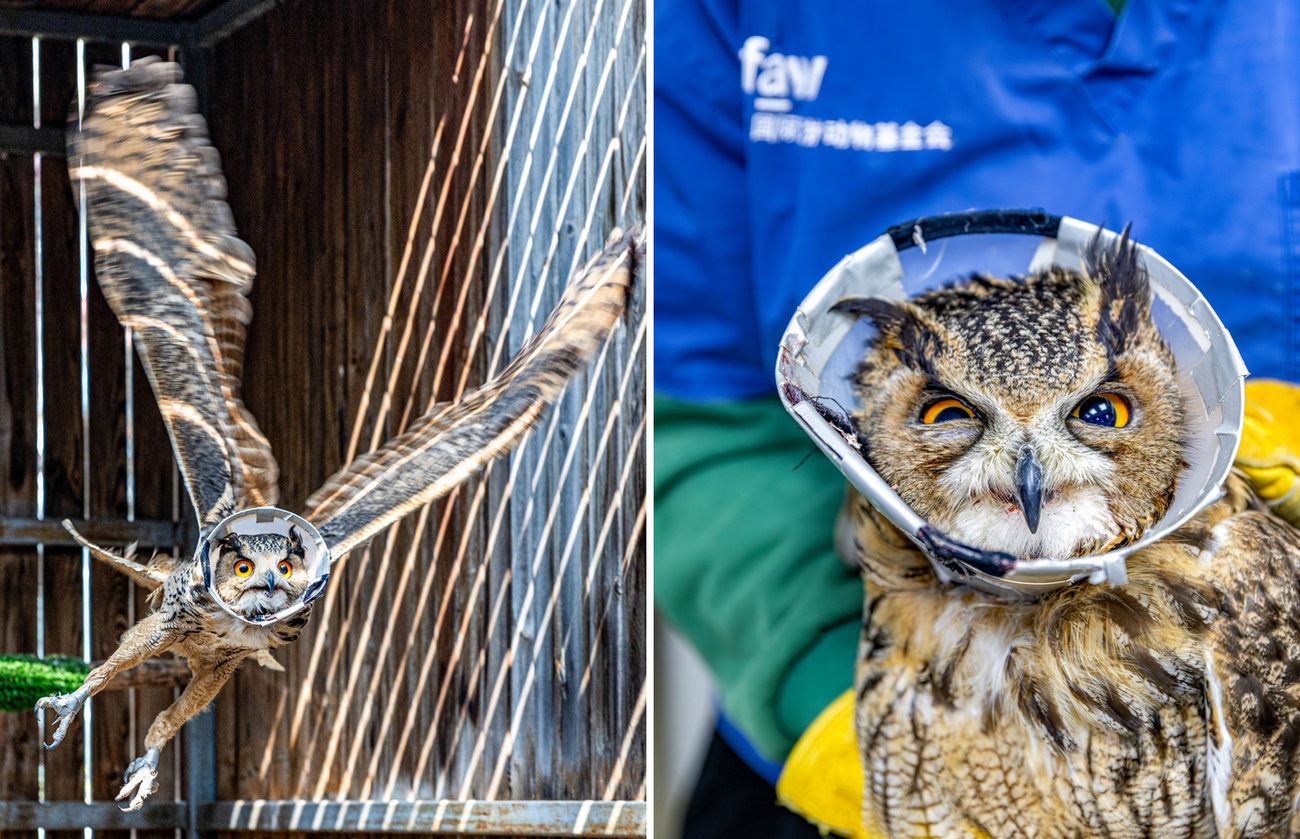
The injured Eurasian eagle-owl receives specialised care at IFAW’s Beijing Raptor Rescue Center during its eight-month rehabilitation. Photo: © IFAW
Returning a wild owl to the wild
Since its founding, IFAW’s Beijing Raptor Rescue Center has admitted 6,611 raptors, including 277 Eurasian eagle-owls, and successfully released 3,504 raptors back into the wild. Roughly one in three birds admitted to the center arrived because of physical injury.
Behind those numbers are thousands of individual animals, each with a different story and different rehabilitation needs. BRRC combines diagnostics, veterinary treatment, surgery, rehabilitation, and careful pre-release evaluation to give injured and displaced raptors the best possible chance of returning to the wild.
For this eagle-owl, that meant doing far more than treating the injuries it arrived with. When infection spread, the team operated again. When the wound on its other foot refused to heal, they reconsidered what might be causing it and changed their approach. At every stage, the question was not simply whether the owl could recover, but whether it could once again live independently as a wild animal.
On 16 August 2026, the team brought the Eurasian eagle-owl to the mountains near Beijing’s Ming Tombs. The site had been carefully selected, away from the heavier vehicle and pedestrian traffic of central Beijing, with surrounding mountains and abundant wildlife providing suitable habitat for an eagle-owl. The timing mattered, too, as these largely nocturnal birds naturally become more active as daylight fades.
Eight months after it was found injured and unable to fly free, the owl was once again surrounded by the sights, sounds, and smells of its natural habitat. It took in its surroundings, oriented itself, and then flew.
It returned to the wild missing part of one toe, but with what mattered most intact—the strength, skills, instincts, and independence to live as a wild Eurasian eagle-owl once again.
Related content
every problem has a solution, every solution needs support.
The problems we face are urgent, complicated, and resistant to change. Real solutions demand creativity, hard work, and involvement from people like you.