Wildlife Crime
The hidden cost of viral primate videos
The hidden cost of viral primate videos
May 21, 2026
A photo of a baby monkey in a nappy clinging to a person. A bottle-feeding video. A clip of a primate dressed in children’s clothes, behaving in ways that feel playful or almost human. On social media, this kind of content can seem harmless, even heartwarming, but it rarely tells the full story.
What appears to be cute, entertaining content often conceals a very different reality: wild animals separated from their mothers, removed from natural environments, and placed into situations that do not meet their most basic social or physical needs. The context behind the camera is missing, and without it, what we see online can be deeply misleading.

Barbary macaque in its distinctive Cedar Atlas habitat. Photo: George Turner / © IFAW
AZA, IFAW, and WWF’s new report on the online primate trade in the United States shows just how widespread this content has become. In just six weeks, researchers documented more than 1,130 posts advertising at least 1,600 live primates for sale across social media platforms. While the scale is significant, what matters just as much is how easily content that appears lighthearted or “cute” can mask the realities of wildlife exploitation.
You can explore the full findings by downloading the report.
It starts with what people see
For many people, the process begins long before they ever search for a primate. Social media is designed to capture attention in seconds, and content featuring young primates is particularly effective. Their small size, expressive faces, and close interaction with humans can trigger immediate emotional responses—curiosity, affection, and a sense of familiarity.
What is not visible in these moments is the context behind the content.
Behind many of these videos are practices and conditions that are incompatible with the animals’ welfare: early separation from mothers, stressful capture and transport, and lives shaped by complex social and environmental needs that cannot be met in a domestic setting. In some cases, animals are physically altered, including through the painful removal of teeth to reduce perceived risk to humans. This reality is rarely reflected in the content presented online.
Without this context, viewers are left to interpret what they see at face value. A calm animal is assumed to be well cared for. An apparently affectionate interaction is assumed to be appropriate.
Over time, repeated exposure to this type of content can contribute to normalization—shifting perceptions of primates from wild animals with highly specialized needs to animals that appear suitable for human companionship.

Close up of a Barbary macaque in its distinctive Cedar Atlas habitat. Photo: George Turner / © IFAW
When visibility becomes interest
Exposure to this content can also shape online behavior.
Search terms such as “baby monkey adoption” or “monkey for sale” return a substantial number of results across social media and online platforms. At this stage, perception plays a significant role in how information is interpreted. The visibility of listings can create a sense of legitimacy, while terminology such as “adoption” or “rehoming” (often involving payment) can frame the transaction as ethical or benign.
In many cases, sellers reinforce this framing by presenting themselves as caretakers seeking responsible homes, rather than participants in a commercial wildlife trade.
Emotional drivers further shape decision-making. The appeal of forming a bond with a highly intelligent animal, or acquiring something perceived as rare or unusual, can be compelling. This is often compounded by urgency tactics, such as claims of limited availability, which can encourage rapid decisions without full consideration of long-term welfare implications.
Across these interactions, a consistent gap remains: limited transparency around the origin of the animal and the suitability of the buyer to meet its long-term needs.
The reality behind ownership
The conditions required to meet primates’ needs are extensive, long-term, and impossible to achieve outside of qualified, expert-led animal care facilities.
Primates can live for several decades and require specialized diets, complex environmental enrichment, expert veterinary care, and ongoing social interaction with their own species. These requirements cannot be adequately replicated in a domestic environment.
As primates mature, their physical strength, behavioral complexity, and social needs increase. Situations that may initially appear manageable can become increasingly difficult, resulting in welfare risks for both the animal and the caregiver.
By the time these challenges emerge, the consequences are often already severe.
Beyond individual cases, each purchase contributes to broader demand that drives the continued extraction of animals from the wild or breeding in unsuitable conditions. The impacts extend to individual welfare, population-level pressure in the wild, and associated risks including disease transmission, ecological disruption, and enforcement burdens. When animals are confiscated or surrendered, long-term care is frequently transferred to sanctuaries and rescue centers, which operate with significant resource constraints while providing lifelong specialized support.
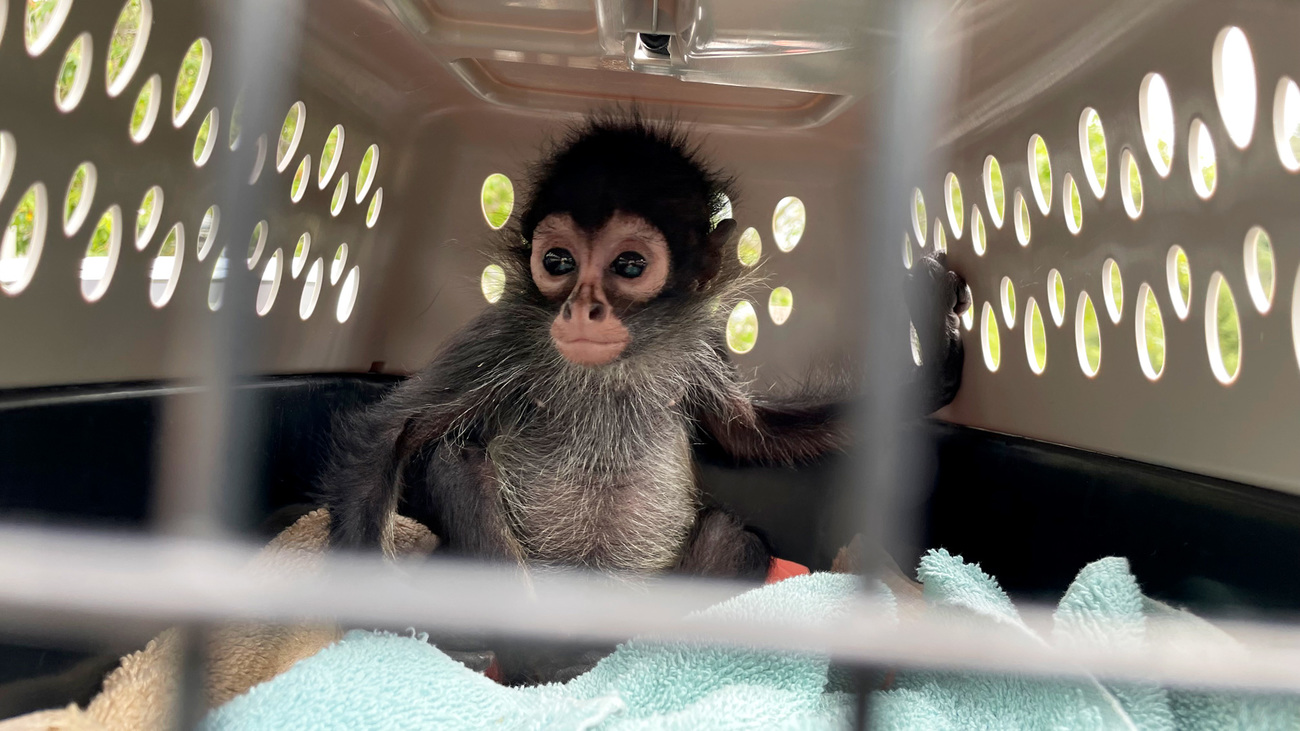
A rescued baby is transported in a secure carrier. Photo: © California Department of Fish and Wildlife
Where change is possible
People do not move from watching wildlife content online to purchasing an exotic pet overnight. There are multiple points along that journey where perceptions, decisions, and behaviors can be influenced.
Online platforms influence what users see and how content is framed. Search systems can either facilitate access to wildlife trade or provide information that reflects legal and welfare realities. Public awareness also plays a critical role in shaping interpretation, particularly in distinguishing between entertainment content and the realities of wildlife exploitation.
Strengthening understanding of these dynamics is key to reducing demand. Addressing the misconceptions and normalized perceptions that underpin interest in primates as pets is essential to preventing harm at source.
This is where coordinated action across communications, public policy, and digital platform governance becomes critical.
IFAW’s latest report highlights both the scale of the online primate trade in the United States and the risks it presents to animals, people, and ecosystems. Importantly, it also underscores an opportunity: by addressing demand and perception at their source, it is possible to reduce harm and ensure that primates remain where they belong – in the wild.
Related content
every problem has a solution, every solution needs support.
The problems we face are urgent, complicated, and resistant to change. Real solutions demand creativity, hard work, and involvement from people like you.