Policy Conventions & Agreements - Global
Protection for wildlife & habitats is preserved in global agreementsProtecting migratory species drives climate action at CMS COP15
Protecting migratory species drives climate action at CMS COP15
March 20, 2026
In March 2026, governments from around the world will gather in Campo Grande, Brazil, for the 15th meeting of the Conference of the Parties to the Convention on the Conservation of Migratory Species of Wild Animals (CMS COP15). At stake is the future of species that cross borders and oceans, and the ecosystems that sustain us all.
IFAW will be on the ground with a clear message: protecting migratory species is not only about preventing extinction. It is also one of the smartest, most cost-effective climate solutions available today.
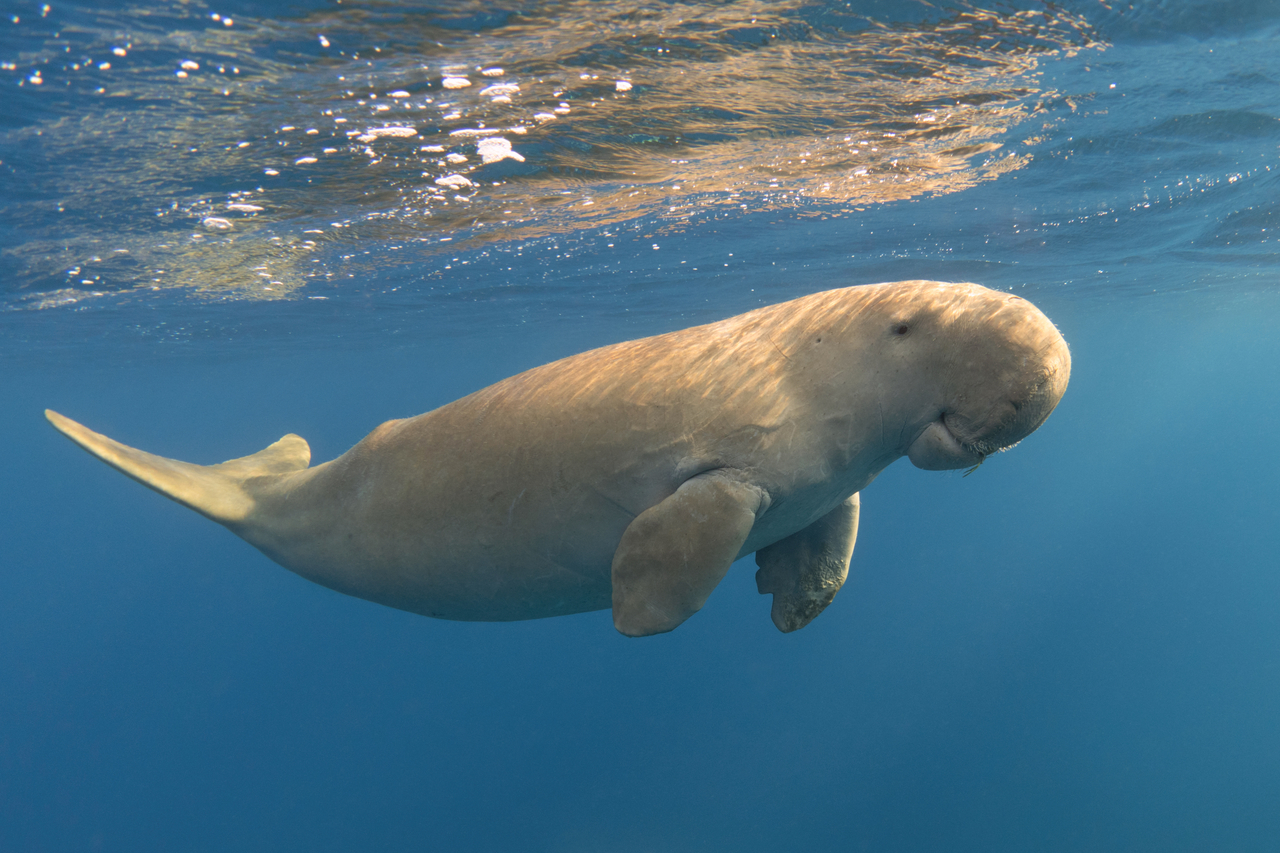
A dugong swimming underwater. © vkilikov - stock.adobe.com © vkilikov - stock.adobe.com
From victims of climate change to climate allies
Climate change is one of the greatest threats facing migratory species. As our COP15 policy briefing highlights, nearly half of CMS-listed species are now in decline, a trajectory that is worsening. But migratory animals are not just victims of climate change. They can also be powerful allies in tackling it.
Coastal seagrass ecosystems are a compelling example. Seagrasses occupy only a tiny fraction of the global ocean, yet they punch far above their weight in storing carbon. These underwater meadows capture carbon from the atmosphere and lock it away in their sediments for centuries. This “blue carbon” makes seagrass protection and restoration a critical nature-based climate solution.
What is often missing from the story is the role of marine animals themselves.
Dugongs: engineers of carbon-rich seagrass
In Bahraini waters, dugongs play an important role in shaping the health and productivity of seagrass meadows. By grazing, moving, and fertilising the seabed, they stimulate regrowth and influence how carbon is captured and stored in these ecosystems.
IFAW worked with leading scientists from the Yale School of the Environment and Bahraini scientists to study the impact of dugongs on carbon capture and storage by seagrasses. The research shows that when dugongs are present, the climate benefits of seagrass ecosystems increase dramatically. Carbon capture by seagrass more than doubles, while the amount of carbon stored in sediments nearly triples compared to a scenario without dugongs.
Across this area, seagrass meadows supported by dugongs are estimated to capture around 149,000 metric tonnes of carbon each year, equivalent to approximately 546,000 metric tonnes of CO₂.
“Protecting dugongs isn’t just about saving a species,” says Catherine Bell, IFAW’s Director of International Policy. “Where dugongs thrive, seagrass meadows flourish—and these ecosystems become even more powerful carbon sinks when dugongs are present. In just 145 km² of seagrass habitat, dugong-supported meadows can lock away over half a million tonnes of CO₂ each year, delivering a climate benefit comparable to taking roughly 120,000 cars off the road annually. Protecting dugongs is not only about conserving an iconic marine mammal, it is about strengthening one of nature’s most effective climate solutions.”
When set against Bahrain’s national emissions reporting, this level of CO₂ capture is comparable to the annual emissions of several significant sectors, including the chemical industry, agriculture, and wastewater treatment. It also represents roughly 10–30% of emissions from large sectors such as transport, oil and gas production, and aviation.
In other words, conserving migratory marine mammals can materially contribute to national climate commitments.
Why this matters at CMS
At CMS COP15, Parties will consider how to better integrate climate change into migratory species conservation, including through amendments to Resolution 12.21 on climate change.
IFAW strongly supports strengthening the evidence base around the ecosystem services provided by migratory species. Case studies like the dugongs in Bahrain show that wildlife conservation and climate mitigation are not competing agendas. They are mutually reinforcing.
We are urging Parties to:
- Strongly support the Scientific Council’s proposed amendment to request case studies on migratory species and the ecosystem services they provide to strengthen the evidence base around ecosystem services.
- Recognise and integrate the climate benefits of migratory species into national biodiversity strategies and Nationally Determined Contributions under the UN Framework Convention on Climate Change.
- Invest in protecting and restoring blue carbon ecosystems such as seagrass, mangroves, and saltmarshes.
- Safeguard the migratory animals that help maintain and enhance these ecosystems.
Beyond blue carbon: a broader agenda for migratory species
Our delegation will also advocate for strong action across a range of urgent issues outlined in our COP15 policy briefing.
These include:
- Eliminating bycatch of CMS-listed species.
- Reducing vessel strikes and underwater noise.
- Taking a precautionary approach to deep-sea mining and refrain from these activities until there is sufficient knowledge about the impact.
- Protecting seamounts and their importance to migratory species, acting as fixed reference points and safe havens for animals to take refuge on long-distance migrations
- Strengthening ecological connectivity so animals can move safely between feeding, breeding, and resting grounds.
- Supporting community-led conservation, recognising that animals and people thrive together.
From sharks to giant otters and cheetahs, many of the listing proposals at COP15 represent critical opportunities to halt decline and drive coordinated international action. But the dugong example underscores a broader shift we must make.
Too often, wildlife is framed as a beneficiary of climate policy. The reality is more powerful: wildlife is critical climate infrastructure. Migratory species help regulate ecosystems, move nutrients across landscapes and oceans, and enhance the resilience of habitats that store vast amounts of carbon.
A moment for leadership
CMS COP15 is a moment for governments to show leadership. By aligning migratory species conservation with climate and biodiversity commitments, Parties can deliver multiple wins at once: healthier ecosystems, more resilient communities, and measurable climate mitigation.
For supporters and partners, this is also a reminder that individual action matters. When you support the protection of a single dugong, a single shark, or a single migratory bird, you are contributing to something much larger—the stability of entire ecosystems and the climate systems they support.
At IFAW, our vision is simple: a world where animals and people thrive together. The science is increasingly clear that achieving this vision is not only morally right—it’s strategically smart.
As governments gather in Brazil, we will be there to ensure that migratory species are recognised not only as symbols of our natural heritage, but as essential allies in building a safer, more sustainable future.
On-site at CMS COP15? Please join for IFAW’s side event on Monday March 23rd (13:45-14:30) titled Climate Change and Migratory Species: From Victims to Allies. This event will explore how climate change impacts migratory species and how their conservation can contribute to climate solutions. It will include presentations from the COP appointed Councilor for Climate Change as well as a number of Parties providing case studies and expert insight to identify actions that CMS Parties can take to strengthen species resilience and integrate migratory species into climate strategies.
Experts available on site at CMS COP15:
IFAW senior director of policy, Matt Collis
IFAW director of international policy, Catherine Bell
IFAW senior program manager, international policy, Barbara Slee
IFAW Latin America regional representative, Joaquin de la Torre Ponce

An adult cheetah in the Tanzanian bush, 2011. © IFAW/B. Hollweg © IFAW/B. Hollweg
Related content
Every problem has a solution, every solution needs support.
The problems we face are urgent, complicated, and resistant to change. Real solutions demand creativity, hard work, and involvement from people like you.
DonateIFAW affiliates are registered as tax-exempt nonprofit organizations in several countries. Depending on where you reside, your donation may qualify for a tax deduction or benefit. See the pull-down menu at the bottom right of this page to see how IFAW operates in your country.