Centre for Wildlife Rehabilitation and Conservation - India
Near Kaziranga National Park, animals are being threatened by a single highwayHow two rescued rhinos are helping shape the future of conservation in India
How two rescued rhinos are helping shape the future of conservation in India
22 January 2026
It’s easy to think of wildlife rescue as a single moment—the dramatic dash to save an animal in distress. But the real story begins after the floodwaters recede. It unfolds slowly, in quiet forests and behind the gates of places like the Centre for Wildlife Rehabilitation and Conservation (CWRC), where two rhinos named Chandra and Kanai spent the past few years preparing for something extraordinary: a return to the wild.
Earlier this week, these two young greater one-horned rhinos stepped into pre-release enclosures inside Kaziranga National Park in Assam, India. For the first time in their lives, they’re learning how to live as wild rhinos. If all goes well, they’ll soon roam freely through the park’s vast grasslands and wetlands—part of a population that was nearly lost a century ago and is now making a remarkable comeback.
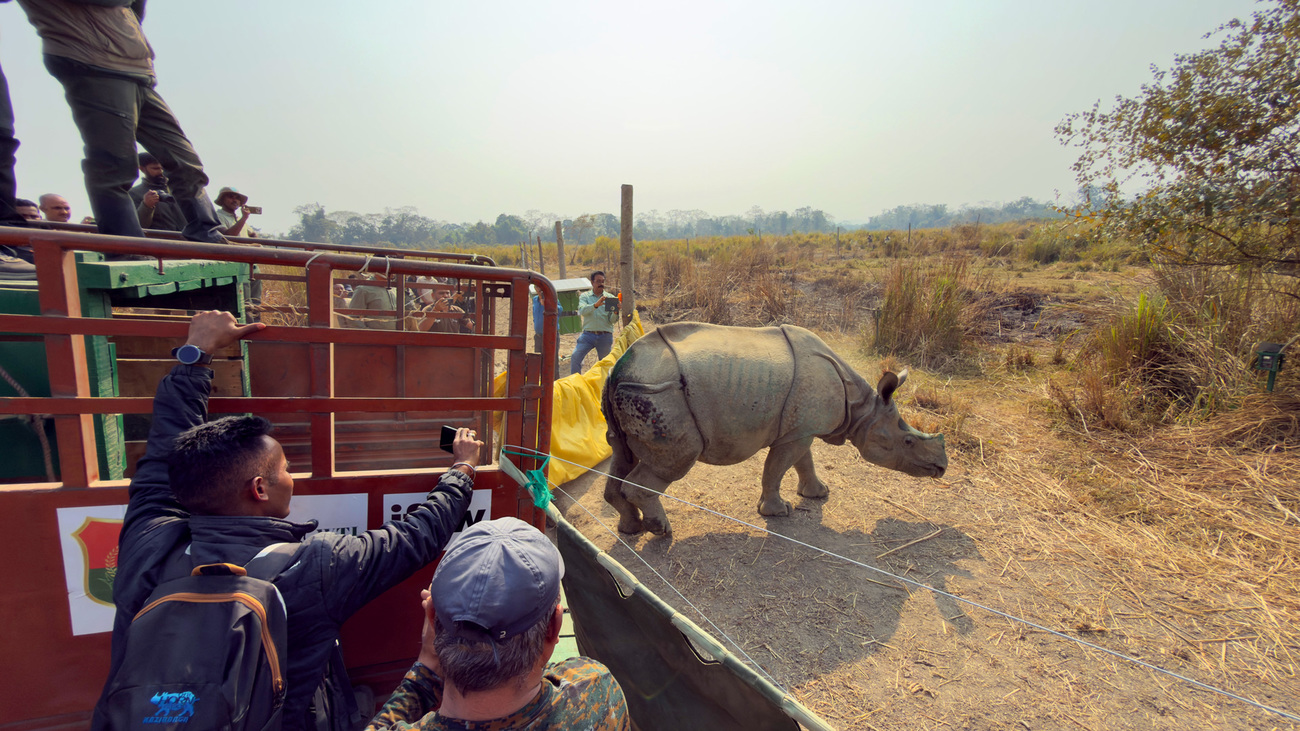
Kanai exits the transport crate into the pre-release enclosure. Photo: © Rishi Nandanan
But before all that, Chandra and Kanai were just two rhino calves stranded by floods.
Chandra was rescued in August 2020 after being found alone, likely separated from his mother during Assam’s annual monsoon. At just a month old, he was too young to survive on his own.
Despite attempts to reunite him with his mother, no adult rhinos could be found nearby. He was brought to CWRC—an emergency wildlife care centre established by the Assam Forest Department, Wildlife Trust of India, and IFAW.
From the start, Chandra was cautious and reserved. He bonded closely with just one animal keeper, Mr Hareshwar Das, whose quiet presence helped him gain confidence over time. Even when struggling with chronic gastroenteritis, Chandra accepted treatment calmly—something rarely seen in young rhinos.
A year later, another calf arrived.
Kanai was rescued on the same date, 2 August, in 2021. Playful and alert, he earned his name—an affectionate reference to Lord Krishna—on the day of the deity’s birth. Where Chandra was measured, Kanai was exuberant. He once slipped into a swollen stream inside the enclosure during monsoon rains. Observed from a safe distance, he struggled to find his footing—but eventually swam to safety. Shaken, he ran straight to Chandra for comfort, a moment of vulnerability that revealed the strong social bond between them.
These small but powerful interactions between animals and keepers, between rhino companions are what define long-term rehabilitation at CWRC. Because preparing an orphaned animal for the wild takes more than food and shelter. It requires time, trust, and an understanding that no two animals are the same.
That long-term view is key, says Dr Rathin Barman, Director and Chief, Strategy & Liaison (N.E. India) at WTI:
“The rehabilitation of a rescued rhino from CWRC back to Kaziranga marks a complete circle in conservation—from rescue to recovery to reintegration into the wild. It reflects what science-based rehabilitation and strong institutional partnerships can achieve for species conservation. IFAW-WTI’s partnership with the Assam Forest Department is almost 25 years now, and I am hopeful that this partnership will deliver more in the field of wildlife conservation in India.”
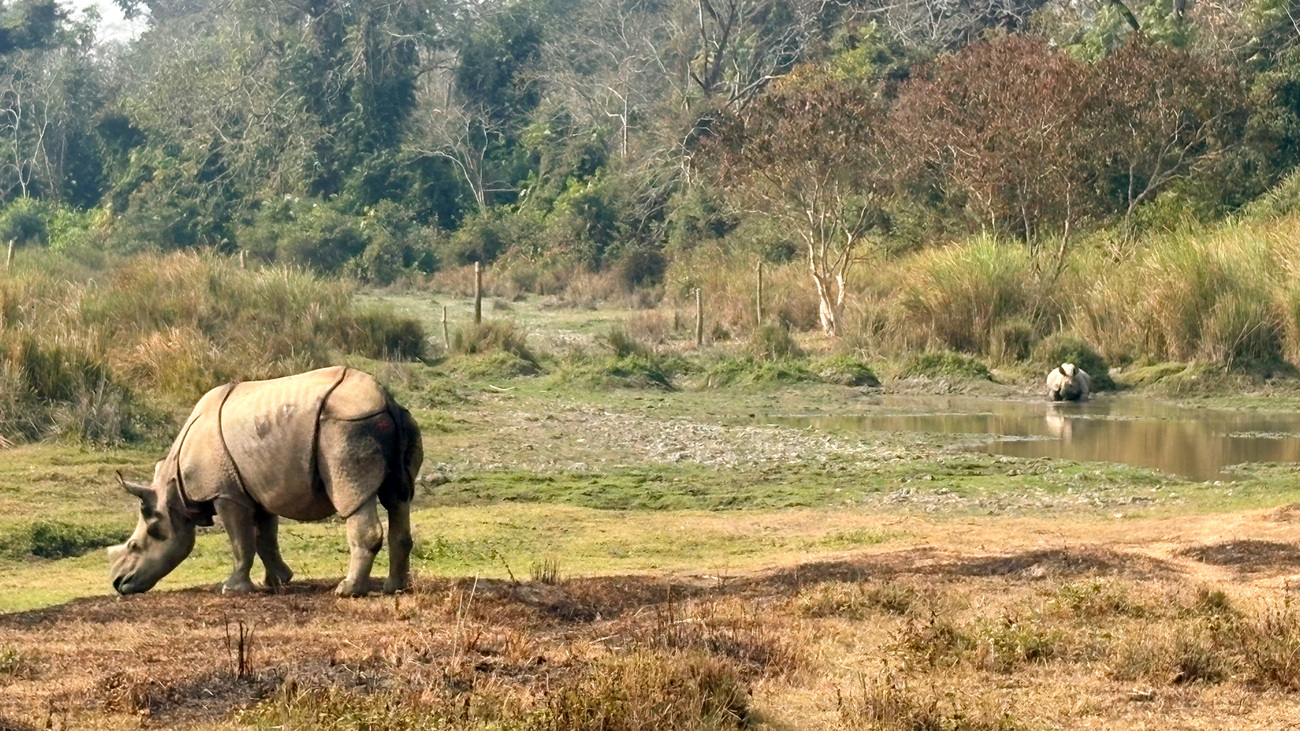
Kanai and Chandra exploring the pre-release enclosure. Photo: Mehedi Hassan / IFAW-WTI
Since 2000, CWRC has rescued more than 9,500 animals—returning 63% of them to the wild. That includes 25 hand-raised rhinos like Chandra and Kanai.
Some were released to Kaziranga. Many others were reintroduced to Manas National Park, where the rhino population had been wiped out by the 1990s. Today, Manas is home to more than 50 rhinos—over half of them connected to CWRC’s releases. Some have given birth in the wild. A few, like the trailblazing rhino Ganga, are now grandmothers.
“We are immensely proud of Chandra and Kanai, whose journey from vulnerable calves to candidates for wild release exemplifies what sustained, science-based conservation can achieve,” said Neil Greenwood, Program Director at IFAW. “Their progress reflects the dedication of veterinarians, keepers, forest officials and our partners at WTI. This translocation not only restores two individuals to their ancestral home but also reinforces our shared commitment to safeguarding this species against ongoing threats.”
This is what wildlife rescue can become: not just survival, but renewal. A single rhino saved from the floods might one day raise calves of her own in the wild. A frightened orphan can grow into a symbol of hope for a species on the edge.
The future for India’s rhinos is still fragile. Poaching, habitat loss, and seasonal flooding remain serious threats. But in every calf raised with care, in every safe corridor established, and in every ranger, vet, and keeper working behind the scenes, we see what’s possible when compassion meets action.
Because in the end, this work isn’t just about rescuing animals—it’s about giving them a future worth returning to.
Related content
Our work can’t get done without you. Please give what you can to help animals thrive.