Updates
Renewed flooding in Nepal leaves communities and animals facing further challenges
Read moreIvory trafficking case exposes gaps in Africa’s wildlife law enforcement
By Edward Indakwa
On 22 July 2016, a Kenyan court sentenced Feisal Mohammed Ali—described as an “ivory smuggling kingpin”—to 20 years in prison and a KSh 20 million (US$150,000) fine for dealing in 314 pieces of ivory. Weighing more than two tonnes, the ivory was estimated to have come from around 120 elephants.
The judgment made global headlines. Kenya Wildlife Service (KWS) hailed it as proof of the country’s firm commitment to tackling transnational wildlife crime and strengthening legal deterrents to poaching and trafficking.
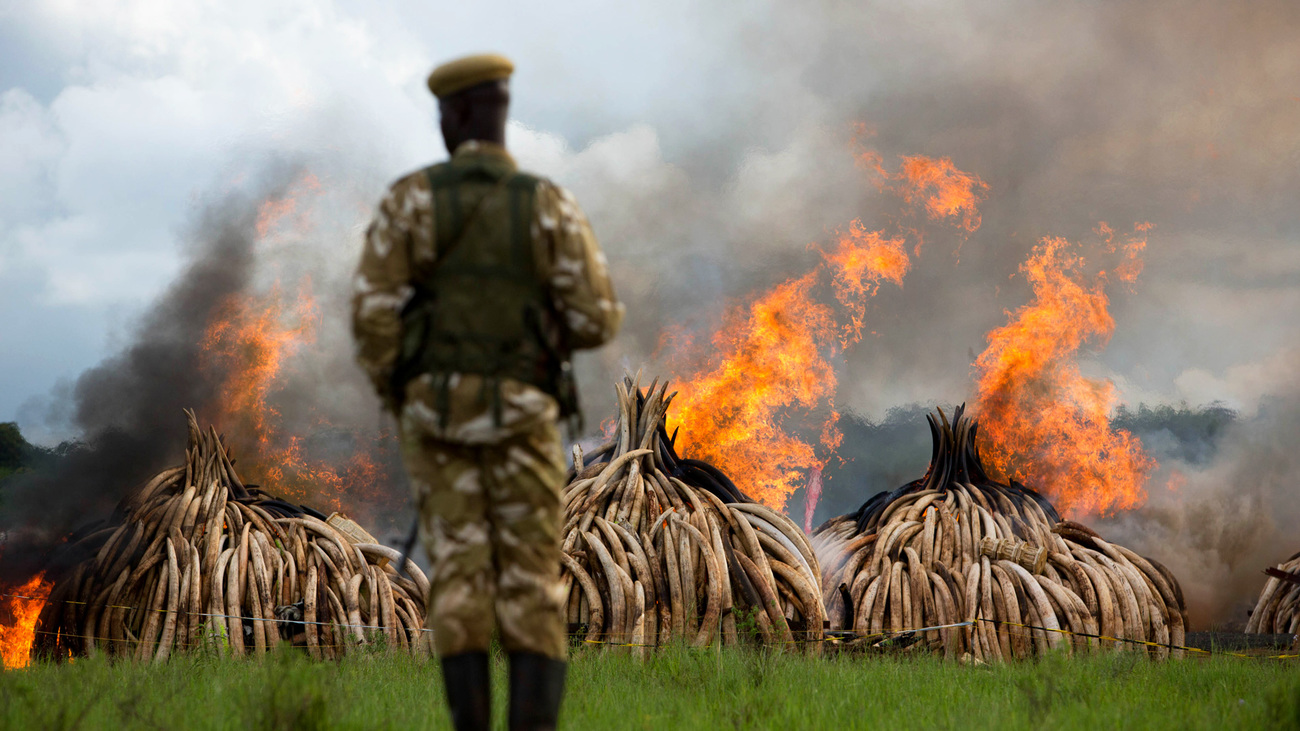
The case was celebrated across conservation circles. For a moment, it appeared to mark a turning point in the fight against organised wildlife crime—until August 2018, when Feisal walked out of prison a free man after a successful appeal.
In September 2025—seven years after his acquittal— Feisal was rearrested and charged with trading in two rhino horns worth KSh 8.2 million (US$63,000). His return to the courtroom raised new questions about the capacity of African governments to investigate and prosecute wildlife crimes effectively and reinforced the need for consistent vigilance against traffickers.
Across the continent, challenges like delayed trials, weak enforcement, and low conviction rates remain common. Namibia, for example, a 2020 Wildlife Crime Report revealed that only 54% all suspects arrested in 2015 had their cases resolved five years later.
In Nigeria, an investigation by Mongabay described a “systematic failure” to hold traffickers accountable. Between 2010 and 2021, authorities intercepted 63 illegal wildlife shipments, but only 11 led to court cases. None resulted in jail time. Feisal’s release was due to several missteps. According to Kenya Law, reports, police—not KWS officers trained in wildlife crime—handled the investigation. Evidence was incomplete, key witnesses weren’t called, and the court found legal errors in the original judgment and sentencing. In short: the prosecution failed to prove that Feisal knew about or controlled the seized ivory.
Kenya remains one of Africa’s leaders in wildlife law enforcement, with strong laws and penalties. But this case shows that even good laws can fail without the right training, coordination, and resources.
“Corruption is the greatest weakness in our law enforcement processes. It manifests right from investigations to the decision to charge suspects, and even during prosecution and conviction,” said Didi Wamukoya, African Wildlife Foundation’s Director for Counter Wildlife Trafficking, in a 2024 interview with The East African.
Beyond corruption, many countries also face limited budgets, understaffed agencies, and courts that may not fully understand how wildlife crime impacts communities and ecosystems.
“The Feisal case shows why countries need to strengthen cooperation between national and regional agencies and improve how they share information,” says Moses Olinga, IFAW’s Programme Manager for Uganda and lead of the East Africa Wildlife Crime Intervention Hub. “We’ve already seen how this can work through joint patrols and better enforcement at the Port of Mombasa.”
Since 2010, IFAW East Africa has supported over 30 national and regional training workshops, equipping more than 800 frontline and managerial law enforcement officers from customs, wildlife authorities, police, immigration, airports, forestry departments, and the military. Participants have come from Kenya, Uganda, Ethiopia, Djibouti, South Sudan, Malawi, Tanzania, the Democratic Republic of Congo, Burundi, and Rwanda.
It’s all part of IFAW’s broader Room to Roam vision— not just connecting habitats for animals but also connecting people and institutions across borders. Strong law enforcement and cross-border collaboration help ensure elephants, rhinos, and other wildlife can move freely and safely across Africa’s landscapes.
Together, these systems help create a future where elephants, rhinos, and other wildlife have true room to roam—and where justice protects not only species, but the people and communities who share their space.
Every problem has a solution, every solution needs support.
The problems we face are urgent, complicated, and resistant to change. Real solutions demand creativity, hard work and involvement from people like you.
Unfortunately, the browser you use is outdated and does not allow you to display the site correctly. Please install any of the modern browsers, for example:
Google Chrome Firefox Safari