Wildlife Crime
IFAW statement on alleged trafficking of Galápagos marine iguanas in Ecuador
IFAW statement on alleged trafficking of Galápagos marine iguanas in Ecuador
May 21, 2026
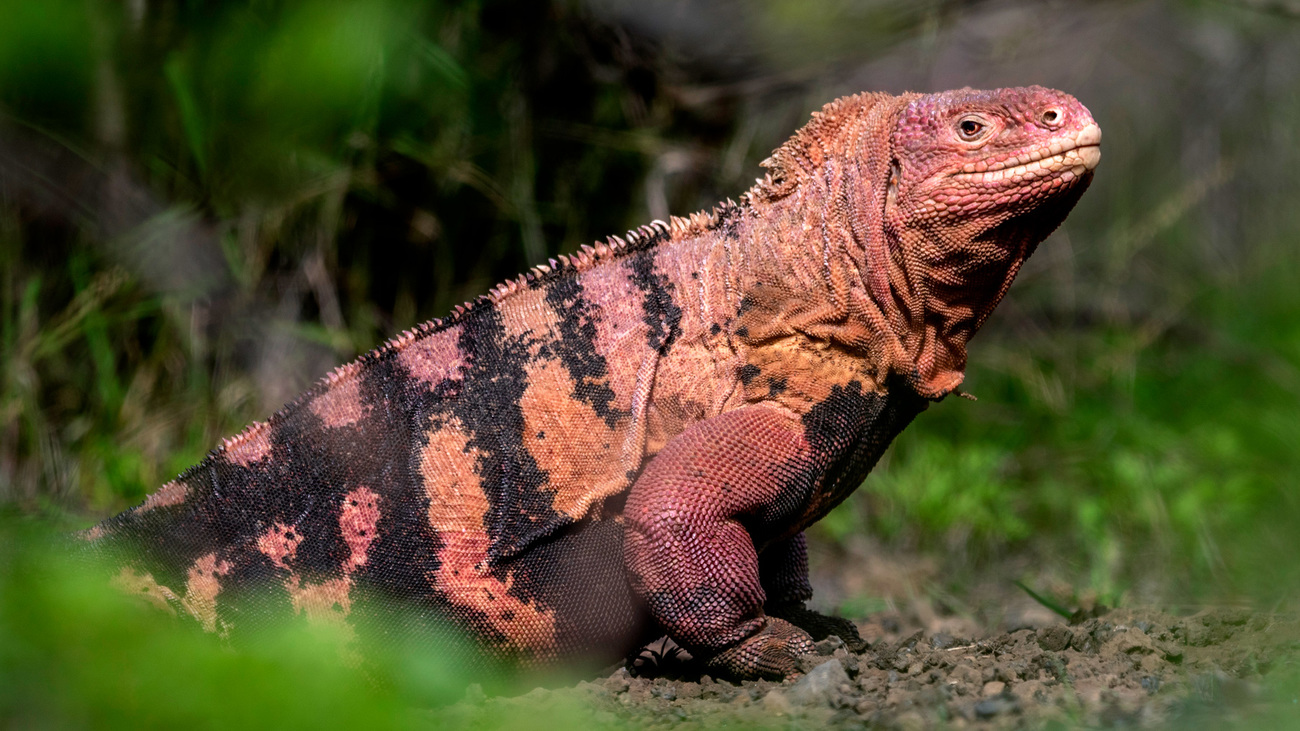
Galapagos pink iguana (Conolophus marthae), Isabela Island, Galapagos National Park, Galapagos Islands. Photo: Lucas Bustamante / © www.naturepl.com
IFAW welcomes the swift action taken this week by Ecuadorian police and environmental authorities following the alleged trafficking of Galápagos marine iguanas through Guayaquil airport.
According to Ecuadorian authorities and multiple media reports, 12 juvenile marine iguanas were discovered concealed in luggage on 19 May at Joaquín de Olmedo Airport in Guayaquil, reportedly destined for Asia. One animal was reportedly found dead, while others were described as being in poor condition. Authorities are now investigating potential trafficking routes and how the animals were transported from the Galápagos Islands.
Reports of two additional recent incidents involving juvenile marine iguanas in the Guayaquil area between 11–19 May are also deeply concerning and may indicate a broader wildlife trafficking operation.
“Galápagos marine iguanas exist nowhere else on Earth, and traffickers target them precisely because of their rarity and value in the illegal exotic pet trade,” said Barbara Slee, Senior Campaign Manager of International Policy at IFAW. “According to authorities, some of the iguanas were transported with their limbs tied, causing immense suffering and potentially long-term injuries. Wildlife trafficking is not only a conservation crime, but also an animal welfare crisis affecting individual animals every day.”
“These animals pay with their lives, and fragile ecosystems like the Galápagos also suffer the consequences,” Slee added.
The seizure comes just months after Galápagos marine and land iguanas were uplisted to Appendix I at the Convention on International Trade in Endangered Species of Wild Fauna and Flora (CITES) CoP20 in December 2025. The listing, which entered into force on 5 March 2026, provides the highest level of protection under international wildlife trade rules. The proposal was strongly supported by IFAW.
Evidence indicates that wild-caught iguanas are being laundered into international trade under false captive-breeding claims. Their offspring may then be issued CITES permits even where the legality of the original breeding stock has not been adequately verified. This highlights how weaknesses in the implementation of the CITES permitting system can be exploited to legitimise trafficked specimens and their descendants within international trade.
“This seizure is a credit to the Ecuadorian authorities involved and sends an important signal to wildlife traffickers that enforcement efforts are intensifying,” said Christian Plowman, Wildlife Cybercrime Program Manager at IFAW. “However, this case is significant not only because of the animals seized, but because of what it likely represents—a coordinated trafficking operation capable of moving protected animals from one of the world’s most remote and strictly protected ecosystems to an international airport. That level of organisation does not emerge overnight.”
“The speed at which traffickers appear to have adapted following the Appendix I uplisting demonstrates why intelligence sharing, cross-border cooperation, and rigorous enforcement are essential to tackling wildlife crime,” Plowman added.
IFAW commends Ecuadorian authorities for their enforcement efforts and urges continued vigilance and cross-border cooperation to combat wildlife trafficking networks targeting rare and endemic species.
Press contact:
Stacey Hedman, IFAW US, +1 508 737 2558, shedman@ifaw.org
Kirsty Warren, IFAW UK, +44 7809 269747, kwarren@ifaw.org
Related content
Every problem has a solution, every solution needs support.
The problems we face are urgent, complicated, and resistant to change. Real solutions demand creativity, hard work, and involvement from people like you.
DonateIFAW affiliates are registered as tax-exempt nonprofit organizations in several countries. Depending on where you reside, your donation may qualify for a tax deduction or benefit. See the pull-down menu at the bottom right of this page to see how IFAW operates in your country.