Disrupting Wildlife Cybercrime – Global
Wildlife crime is a matter of supply and demandMost ivory offered online in the European Union lacks evidence of legality
Most ivory offered online in the European Union lacks evidence of legality
November 24, 2026
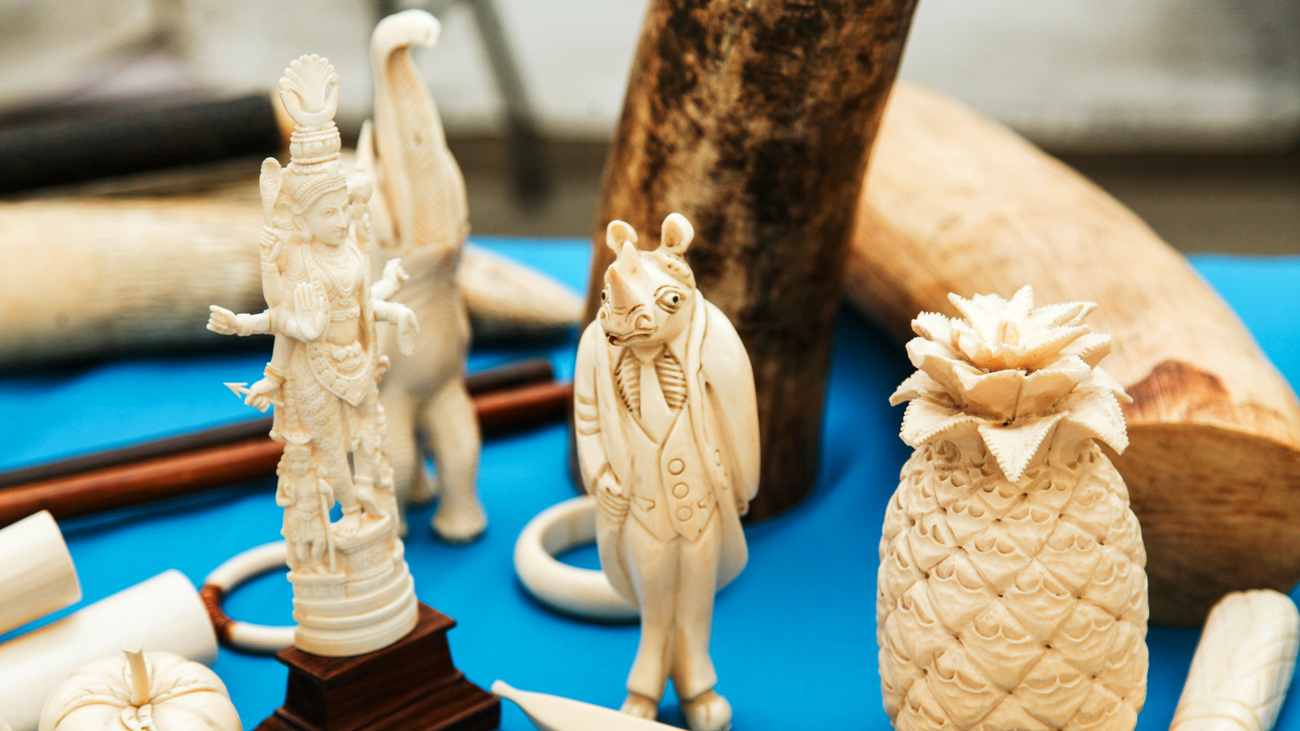
Ivory objects before destruction. Photo: Elisabeth Perotin / © IFAW
New research in seven EU Member States: 72% of the ivory offered online comes without a verifiable certificate
Brussels / Munich, 24 November 2026 — The vast majority of ivory listed for sale online reviewed by new research in the European Union offers no proof that it is legal. The EU generally prohibits trade in ivory, however an exemption for antique ivory objects provides a loophole for continued trade, if not closely scrutinised.
A joint investigation by the International Fund for Animal Welfare (IFAW) and Pro Wildlife examined whether evidence of legality and certificates issued by competent authorities were present for ivory items offered for sale across seven EU Member States.
No certificate, or none that can be checked
Of the 122 online offers investigated, 88, or 72%, provided no certificate that could be verified. Only 34 listings, or 28%, included a certificate number or document that allowed at least some verification.
“It is alarming that, even years after the EU tightened its ivory regulations, the majority of ivory offered comes with no verifiable evidence of legality”, said Daniela Freyer, Head of Policy at Pro Wildlife. “Our findings show that exemptions for alleged antiques can still be exploited to sell illegal ivory in the EU market”.
The antique loophole: pre-1947 claims without proof
In almost half of the cases investigated, sellers claimed that ivory had been produced before 1947—the cut-off date up to which genuine antique ivory may be sold, provided that a certificate has been issued by the competent authorities. In many of these cases, this claim was not backed up by concrete evidence.
When independent experts assessed the age of 54 carved ivory objects offered in four of the seven countries (Belgium, Germany, Portugal and Spain), 52 of them, or 96%, were judged to have been made after 1947. Some objects even showed signs of being artificially aged, with staining, fake patina, and tool marks from modern drills and possibly computer-controlled carving machines.
Conflicts of interest and a patchwork of national rules
The findings also raise concerns about the expertise and potential conflicts of interest of the expert assessments on which certificates by authorities are based: in several Member States these may come from actors connected to the art market, such as dealers or auction house specialists. In addition, different standards in Member States and certificates being used across borders make it difficult to verify them. Researchers also found raw elephant ivory being offered for sale, even though commercial trade in any raw ivory is suspended throughout the EU.
Call for binding EU rules
“These findings show that the EU exceptions still allowing the sale of antique worked ivory have structural weaknesses,” said Ilaria Di Silvestre, Director of Policy and Advocacy, Europe at IFAW. “We call on the European Commission and EU governments to turn the currently patchy requirements into binding law: a permanent ban on raw ivory trade, clear rules on who is authorised to certify ivory and on the information that must be provided before ivory is offered online, a public list of independent experts in each Member State, and a system that allows one country to promptly and easily verify a certificate issued by another.”
ENDS
Notes to editors
- The research reviewed 122 online listings for ivory and ivory-containing objects across Belgium, France, Germany, the Netherlands, Poland, Portugal and Spain between April and June 2026.
- Two independent experts in ivory artefact evaluation carried out the research and, in four countries, an additional independent assessment of the objects' likely age, based on the photographs and descriptions in the listings.
- The full report “Blind spots in the EU ivory trade” is available at https://www.ifaw.org/international/resources/blind-spots-eu-ivory-trade-report.
Media contacts
Jürgen Noack, Communications Consultant, IFAW,
jnoack.contractor@ifaw.org; +32 470 48 49 05
Leonie Teisner, Communications Manager, Pro Wildlife,
leonie.teisner@prowildlife.de; +49 89 9042 990 42
About the International Fund for Animal Welfare (IFAW)
IFAW is a global non-profit helping animals and people thrive together. We are experts and everyday people, working across seas, oceans, and in more than 40 countries around the world. We rescue, rehabilitate, and release animals, and we restore and protect their natural habitats. The problems we’re up against are urgent and complicated. To solve them, we match fresh thinking with bold action. We partner with local communities, governments, non-governmental organisations, and businesses. Together, we pioneer new and innovative ways to help all species flourish. See how at ifaw.org.
About Pro Wildlife
Pro Wildlife is a non-profit organization working worldwide to protect wild animals and their habitats. Founded in 1999 in Germany, we draw on scientific evidence to advocate for stronger laws and more effective protection measures, to safeguard biodiversity, and to end the suffering of wild animals. In many countries, we support projects that help wildlife in need, preserve habitats and promote coexistence between people and wild animals. Learn more at www.prowildlife.de
Related content
Our work can’t get done without you. Please give what you can to help animals thrive.