Read more
Marine mammal rescue leaders unite to strengthen dolphin stranding response across the northeast
Marine mammal rescue leaders unite to strengthen dolphin stranding response across the northeast
March 5, 2026
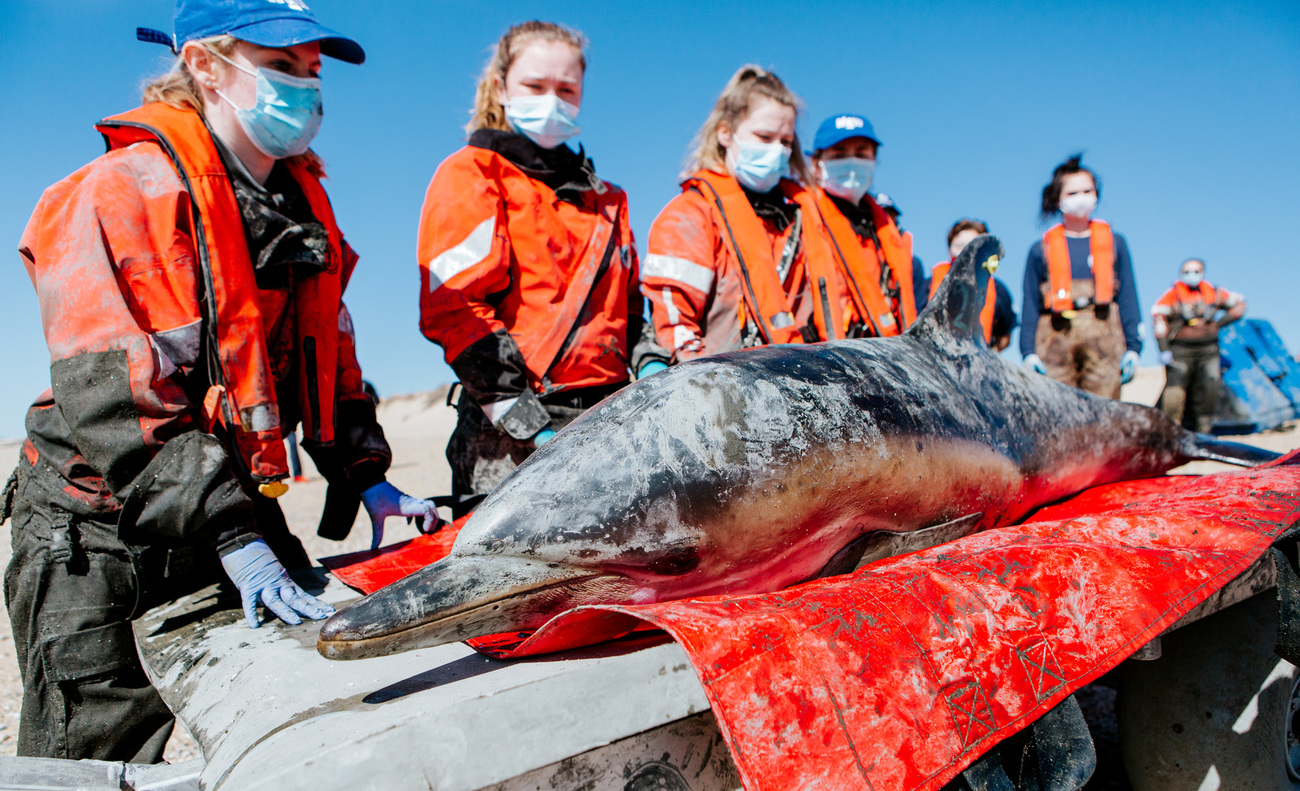
A common dolphin is transported by cart to the release beach after being cleared by a health assessment. Photo: Andrea Spence / © IFAW, Activities conducted under a federal stranding agreement between IFAW and NMFS under the MMPA.
(Yarmouth Port, MA – March 5, 2026) – Marine mammal experts from across the greater Atlantic region converge on Cape Cod this week to strengthen their capacity to respond when dolphins or other marine mammals strand along the northeast coastline.
“This workshop is designed to bring responders together before the next call about a dolphin in distress comes in,” said Kira Kasper, Stranding Biologist at IFAW. “It gives our regional partners the opportunity to share knowledge, practice critical techniques, and build the confidence they need to respond effectively in the field. Ultimately, it’s about improving outcomes for every stranded animal.”
The two-day Cetacean Stranding Response Workshop, taking place this March 4-5, 2026 at IFAW’s International Operations Center in Yarmouth Port, will focus on enhancing live cetacean stranding response capacity through shared knowledge, techniques, and hands-on practice. Attendees will receive training in response safety, personal protective equipment, scene operations, health assessments, clinical care, welfare considerations, response options, and disposition decision-making.
The agenda includes hands-on sessions for IFAW’s partners to practice blood drawing and tagging, in addition to discussions and presentations on all aspects of a stranding response, including response safety procedures, site assessment, handling and transporting animals, conducting health assessments, providing supportive care, selecting release sites, and many other procedures involved.
Twenty-nine marine biologists, technicians, veterinarians, and stranding coordinators from a variety of stranding response groups and network partners, were selected to participate in this workshop.
“We hope participants leave feeling confident and competent in their ability to respond to the next cetacean stranding in their region,” said Brian Sharp, Director of Marine Mammal Rescue at IFAW. “By strengthening collaboration and sharing practical experience, we can enhance response capacity throughout the northeast and improve survival rates for stranded marine mammals.”
Participants will also visit IFAW’s Rescue Operations Center, Dolphin Rescue Center—an intensive care unit for short term cetacean rehabilitation—and the team's Mobile Dolphin Rescue Clinic transport vehicle.
IFAW has been responding to marine mammal strandings for over 27 years on Cape Cod, a location that experiences the most frequent live dolphin strandings in the world.
This workshop is being conducted through IFAW’s Academy of Rescue and Conservation, which seeks to share knowledge among rescue professionals globally. It is an important step in creating a framework of knowledge and support to guide responders and enhance capacity to respond to marine mammal strandings throughout the northeast United States.
The Cetacean Stranding Response workshop is made possible with funding support from NOAA's John H. Prescott Marine Mammal Rescue Assistance grant program.
//ENDS
Visual editors: general images may be downloaded and shared here: https://spaces.hightail.com/space/xtsM0EPL10
Press contacts:
Stacey Hedman
Senior Communications Director, IFAW
m: +1 508 737 2558
e: shedman@ifaw.org
Elizabeth Cerda
Communications Officer, Academy of Rescue and Conservation, IFAW
e: ecerda@ifaw.org
Related content
Our work can’t get done without you. Please give what you can to help animals thrive.