Marine Conservation
Dugongs could dramatically boost ocean carbon storage, new study finds
Dugongs could dramatically boost ocean carbon storage, new study finds
June 3, 2026
Research highlights major role of marine wildlife in tackling climate change
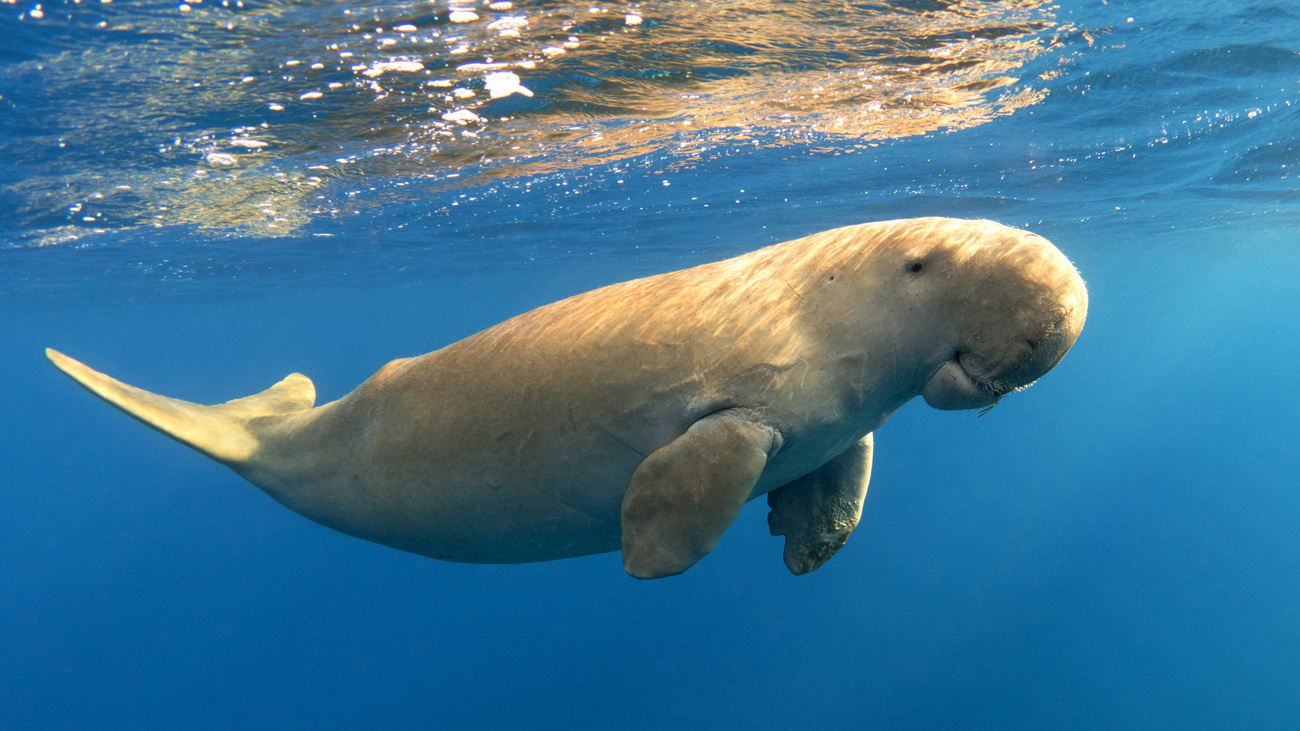
Dugong swimming underwater.
(3 June 2026 – Janabiyah, Bahrain) – A new scientific study finds that dugongs, large marine mammals often called “sea cows”, may significantly boost carbon storage in seagrass ecosystems, providing additional evidence that wildlife is a key actor in climate mitigation.
Published in Frontiers in Marine Science, the research—Integrating megafauna into blue carbon strategies: dugongs could enhance seagrass carbon storage—models the ecological impact of dugongs in Bahrain’s seagrass meadows, one of the world’s most important dugong habitats. The findings suggest the presence of dugongs could increase seagrass carbon capture by more than two times compared to ecosystems without them.
Researchers estimate that Bahrain’s seagrass ecosystems could capture approximately 546,000 tonnes of CO₂ annually when healthy dugong populations are present.
The study was led by Professor Oswald Schmitz of the Yale School of the Environment and Dr. Reem AlMealla of NUWAT, in collaboration with the International Fund for Animal Welfare (IFAW) and the Global Rewilding Alliance (GRA). The study adds to the growing science of Animating the Carbon Cycle that shows nature recovery is a credible solution for the dual climate and biodiversity crises. It also marks the first use in a marine environment of the Yale-GRA model to quantify the role played by wild animals in climate change mitigation. “Seagrass ecosystems are already recognised as important blue carbon habitats, but our research shows the animals living within these systems can substantially enhance their climate benefits,” said Professor Oswald Schmitz, lead author and Professor of Population and Community Ecology at the Yale School of the Environment.
“Dugongs influence seagrass growth, nutrient cycling, and sediment processes in ways that can increase long-term carbon storage. This means conserving marine wildlife is not only a biodiversity issue, but also a climate solution.”
Seagrasses capture and store carbon both in plant biomass and in the sediments beneath them, often for centuries. The study estimates that sediment carbon stocks in the Bahraini study area may hold approximately 5.4 million tonnes of CO₂ equivalent.
Bahrain hosts one of the largest dugong aggregations outside Australia, with extensive seagrass beds providing critical habitat for the species. Researchers say protecting these ecosystems could deliver benefits for biodiversity, climate mitigation, and coastal resilience simultaneously.
“Bahrain’s waters exist in the hottest sea on earth, with temperatures ranging between 16 and 36 C annually, yet these ecosystems continue to support globally significant dugong populations and extensive habitats,” said Dr. Reem AlMealla, co-author and founder of NUWAT, Bahrain’s first ecological research think tank.
“That makes this research especially important. If ecological relationships between wildlife and blue carbon systems can persist under such extreme conditions, they may offer valuable insight into the future resilience of marine ecosystems under climate change.”
The study shows that protecting wildlife is not only about conserving species, but also about safeguarding nature’s interconnected systems that allow ecosystems to function at their highest potential and help humanity mitigate and adapt to climate change. “Including wildlife as part of climate solutions is therefore an opportunity to align marine conservation with climate action and sustainable development,” added AlMealla.
The researchers warn that degradation of seagrass habitats and declines in dugong populations could reduce the ocean’s natural ability to store carbon. Modelling suggests carbon capture capacity could fall substantially if dugongs disappear from these ecosystems. “This research helps demonstrate something conservationists have long understood—wild animals are not separate from healthy ecosystems, they help power them,” said Matt Collis, Senior Director of Policy at IFAW.
“When we protect species like dugongs, we are also protecting natural systems that store carbon, support biodiversity, and strengthen resilience for coastal communities. Climate and conservation goals are deeply connected.”
The Global Rewilding Alliance, a network of over 300 rewilding organisations in more than 150 countries, is putting these findings into action.
“This research further strengthens growing body of evidence that reweaving the web of life is not only the right thing to do, but it is a practical, hopeful and scalable response to many of the interconnected challenges facing communities all around the world,” said Alister Scott, Executive Director at the Global Rewilding Alliance.
“Dugongs, alongside many other weird and wonderful wild animals, are the guarantors of a stable planet. Our Alliance Partners are bringing them back.”
The authors say the findings could help inform future blue carbon strategies and encourage greater integration of wildlife into climate policy frameworks globally.
Notes to editors
- The study, Integrating megafauna into blue carbon strategies: dugongs could enhance seagrass carbon storage, was published in Frontiers in Marine Science on 26 May 2026.
- The research was conducted by Yale University and NUWAT, with support from the International Fund for Animal Welfare (IFAW), the Global Rewilding Alliance, and BNP Paribas.
- Dugongs are large herbivorous marine mammals closely related to manatees and are listed as Vulnerable on the IUCN Red List.
- Seagrass ecosystems are among the world’s most efficient natural carbon sinks and are increasingly recognised as important “blue carbon” habitats.
Media contacts
Stacey Hedman, IFAW, shedman@ifaw.org, +1 508.737.2558
May Scott, Global Rewilding Alliance, may@globalrewilding.earth, +44 7484 152013
About the Global Rewilding Alliance
The Alliance is a network of over 300 rewilding organisations working across all continents to rewild the land and sea. Together, they are currently helping to influence the rewilding of 2.2 million sq.km of land and 6 million sq.km of sea. Our mission is to connect, catalyse, and scale the global rewilding movement in order to mainstream rewilding in science, policy and practice.
About IFAW (International Fund for Animal Welfare)
IFAW is a global non-profit helping animals and people thrive together. We are experts and everyday people, working across seas, oceans, and in more than 40 countries around the world. We rescue, rehabilitate, and release animals, and we restore and protect their natural habitats. The problems we’re up against are urgent and complicated. To solve them, we match fresh thinking with bold action. We partner with local communities, governments, non-governmental organisations, and businesses. Together, we pioneer new and innovative ways to help all species flourish. See how at ifaw.org
Related content
Every problem has a solution, every solution needs support.
The problems we face are urgent, complicated, and resistant to change. Real solutions demand creativity, hard work, and involvement from people like you.
DonateIFAW affiliates are registered as tax-exempt nonprofit organizations in several countries. Depending on where you reside, your donation may qualify for a tax deduction or benefit. See the pull-down menu at the bottom right of this page to see how IFAW operates in your country.