Akram Eissa Darwich
What’s at stake for wildlife in the Strait of Hormuz
What’s at stake for wildlife in the Strait of Hormuz
Akram Eissa Darwich | May 14, 2026
When people think about the Strait of Hormuz, they usually think about oil tankers, geopolitics, and global trade. Few think about whales and other marine species. But they should.
Beneath one of the world’s most strategically contested waterways lies a highly distinctive and fragile marine ecosystem, one that supports species found nowhere else on Earth and that is now under growing threat as regional tensions escalate.
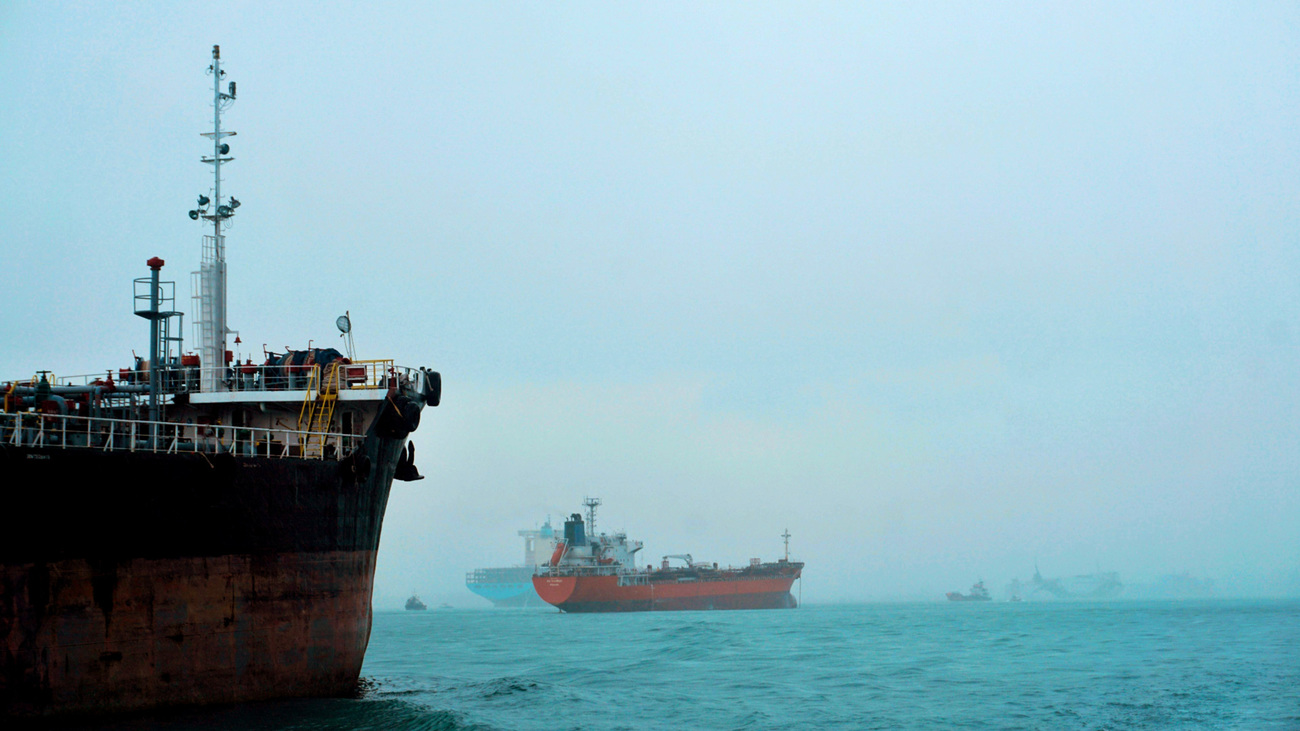
Cargo ships navigate a foggy ocean, highlighting global logistics and transportation. Photo: © Rian Daud7
The Strait of Hormuz forms a narrow ecological bridge between the deep, cooler waters of the Gulf of Oman and the shallow, warmer Arabian Gulf. Nutrient‑rich currents passing through the strait sustain plankton blooms, coral reefs, and seagrass beds that underpin the region’s marine life. Whale sharks migrate through these waters seasonally. Indo‑Pacific dolphins are resident year-round.
And then there is the Arabian Sea Humpback whale. This critically endangered population is unique—non‑migratory and almost entirely confined to the Arabian Sea and Gulf region. Scientists estimate that around 100 individuals remain.
Alongside them live roughly 7,000 dugongs, animals that depend entirely on healthy seagrass beds for survival. For both species, the Strait of Hormuz is not just a transit zone, it is essential habitat. They have nowhere else to go.
A pressure cooker, even without conflict
Even in times of relative calm, the Arabian Gulf is one of the most heavily stressed marine environments on the planet. Dense oil tanker traffic increases the risk of ship strikes, chronic noise pollution, and spills. Industrial activity and coastal development place constant pressure on already fragile ecosystems.
Heightened military activity compounds these risks rapidly. Naval traffic, sonar use, and explosions introduce intense and unfamiliar noise into the water—sounds that overlap with the frequencies whales and dolphins rely on to communicate, navigate, and find food. When that acoustic environment is disrupted, animals may stop feeding, abandon habitat, or become disoriented. For species like the Arabian humpback whale, which does not migrate, avoidance is not an option.
Oil pollution presents an additional, well‑documented danger. The Arabian Gulf is shallow and semi‑enclosed, with water renewal occurring only every two to five years. Pollutants do not disperse quickly; they accumulate. Oil slicks block sunlight from reaching seagrass beds, undermining the foundation of the ecosystem and directly threatening dugongs and other dependent species.
IFAW has seen the consequences of conflict‑related pollution before. During the 1990–1991 Gulf War, a deliberate oil release into the Arabian Gulf caused the deaths of up to 230,000 marine animals and seabirds, with ecological impacts that took decades to recover. Those same systems are now once again at risk.
Conflict and wildlife: a familiar pattern
For years, IFAW has documented how armed conflict intersects with animal welfare and conservation. The pattern is consistent and deeply concerning. Across decades of data on large mammal populations, both terrestrial and marine, wildlife tends to remain stable during periods of peace and decline sharply during war.
Conflict repeatedly emerges as one of the strongest predictors of population collapse, disrupting governance, enforcement, habitat protection, and the conditions that allow ecosystems to function.
Marine ecosystems are no exception. Previous conflicts in this region, including the Iran‑Iraq War of the 1980s, coincided with severe declines in river dolphins, otters, seabirds, and coastal species. At the same time, the Arabian Gulf represents a unique natural laboratory for understanding how marine life adapts to extreme heat and salinity, research that is now being interrupted at the very moment it is most urgently needed.
What this moment demands
Wildlife does not recognise borders or political disputes, but it bears the consequences of both. The escalating risks in the Strait of Hormuz are a stark reminder that animals are often the unseen casualties of human conflict, and that ecological harm is not inevitable collateral damage, but a lasting and preventable outcome.
As we engage with our partners across the region, part of our role is to ensure that the impacts of conflict and instability on biodiversity stay visible, not just as a global concern, but as a local one. In a region where pressures on ecosystems are already significant, it is easy for wildlife to become an afterthought during times of crisis. IFAW and partners will help convene forthcoming activities in Jordan and Oman that bring this issue front and centre, helping regional stakeholders recognise and respond to the threat that ongoing instability poses to the natural world around them.
The Strait of Hormuz is vital to global commerce. It is also vital to a fragile web of life that cannot recover from repeated shocks. Whether these species survive the current moment will depend on choices made far above the water's surface, but their consequences will be felt far below it.
This article is based on exchanges and collaboration between IFAW’s MENA staff and program leadership across the organisation.
Related content
Every problem has a solution, every solution needs support.
The problems we face are urgent, complicated, and resistant to change. Real solutions demand creativity, hard work, and involvement from people like you.
DonateIFAW affiliates are registered as tax-exempt nonprofit organizations in several countries. Depending on where you reside, your donation may qualify for a tax deduction or benefit. See the pull-down menu at the bottom right of this page to see how IFAW operates in your country.