Victor Murunga
Protecting Kenya’s Voi River is key to human–elephant coexistence
Protecting Kenya’s Voi River is key to human–elephant coexistence
Victor Murunga | January 26, 2026
The Voi River is more than a seasonal watercourse. It is the primary hydrological artery linking the mist-covered Taita Hills—one of Kenya’s critical water towers—to the semiarid plains of Tsavo East National Park. When the river flows, it sustains ecosystems, supports livelihoods, and anchors coexistence between people and wildlife. When it fails, the consequences ripple across landscapes and generations.
Recent consultations with the Kenya Wildlife Service (KWS) confirm a troubling reality: river volumes are declining, and water no longer reaches Tsavo East reliably. As the river dries downstream, elephants are forced to migrate upstream in search of water—bringing them into direct contact with surrounding communities. This dynamic is a core driver of human–wildlife conflict, the negative interactions between people and elephants that can result in crop destruction, property damage, human injury and loss of life, and retaliatory actions against wildlife.
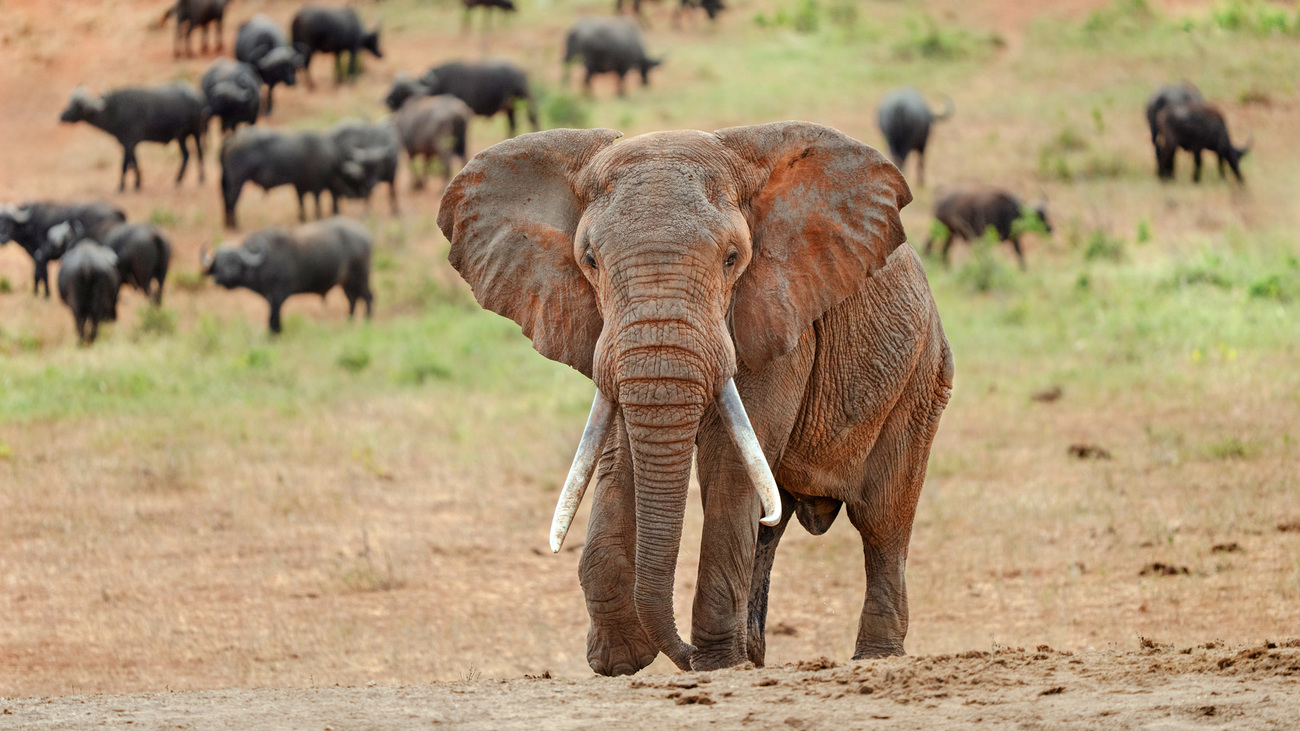
Elephant and buffalo in Tsavo East National Park, Kenya. Photo: © Donal Boyd
A degraded river system, a fractured corridor
The deterioration of the Voi River reflects deeper challenges identified in the Taita Taveta County Forest and Landscape Restoration Implementation Plan (FOLAREP) 2023–2032. Upstream, deforestation in the Taita Hills has weakened the landscape’s natural ability to retain and release water, reducing infiltration and groundwater recharge. Instead of steady base flows, rainfall now results in flash floods followed by long dry spells. Midstream, unregulated sand harvesting has destabilised the riverbed, lowered the water table, and intercepted the river’s flow before it can reach Tsavo East. The result is a broken ecological corridor.
But this isn’t only a story about water. It is a story about how changing environments shape the ways wildlife and people interact—often with tragic consequences. IFAW’s work around the world shows that human–elephant conflict often stems from shifting access to essential resources like water and habitat, forcing animals into areas where people live and farm.
Policy exists. What’s needed now is action.
Kenya has the legal and policy tools needed to reverse this trend. The amended Taita Taveta County Sand Harvesting Bill lays a strong regulatory foundation to protect riverbeds. FOLAREP offers a roadmap to rehabilitate over 226,000 hectares of degraded landscapes, including the Taita Hills water tower. What is urgently needed now is coordinated, on-the-ground implementation that translates these frameworks into impact.
An integrated watershed approach for coexistence
Downstream and midstream, restoring river functionality begins with enforcing sensible rules and fostering community ownership. Local people must understand and be part of implementing sand harvesting regulations, and county authorities need resources and support to enforce them fairly and consistently.
This approach will help stabilise riverbanks, protect aquifers, and allow water to reach Tsavo East unimpeded.
Upstream, the long-term solution lies in restoring the Taita Hills. Indigenous reforestation, soil and water conservation, and protection of remaining forest patches will help rebuild the landscape’s capacity to capture, store and gradually release water into the river system.
For elephants, this means reliable access to water within the park—reducing pressure to move into farmlands. For people, it means safer livelihoods and fewer negative encounters with wildlife. This vision aligns with IFAW’s community-focused work to build peaceful coexistence between people and elephants across Africa, recognising that both humans and wildlife thrive when space and resources are shared sustainably.
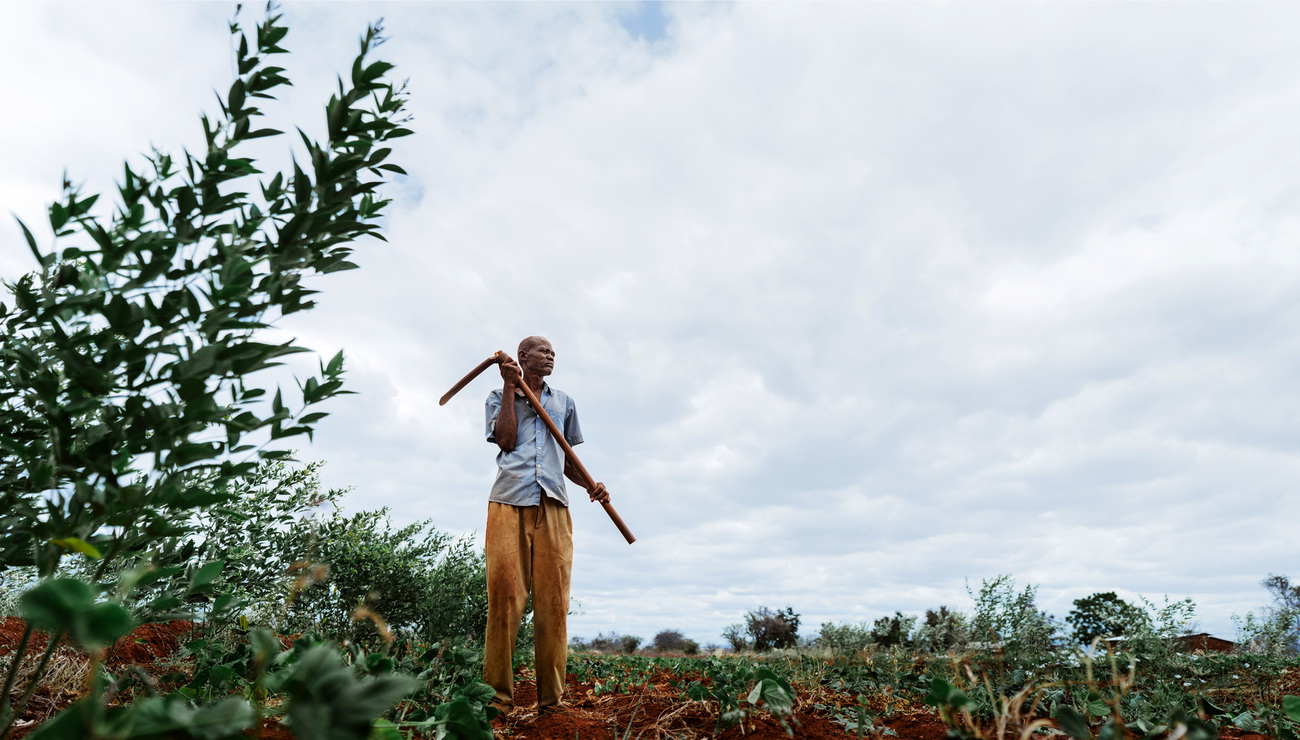
Christopher, a local farmer between Tsavo West and Tsavo East national parks who is part of the climate-smart agriculture project. Photo: © Donal Boyd
A call to collective leadership
County governments must lead implementation efforts, backed by national agencies such as KWS for technical guidance on human–wildlife coexistence. Community leaders and landowners must be empowered as stewards of the watershed—not treated as bystanders. Conservation organisations can help bridge the gap between policy and practice, bringing science, facilitation, and long-term commitment to landscapes like Tsavo. Donors have a pivotal role to play by investing in landscape scale solutions that address intertwined environmental and social challenges.
Restoring the Voi River is about more than water. It is about reconnecting landscapes, reducing conflict, and proving that coexistence is possible when ecosystems are allowed to function. For conservation leaders and donors seeking durable impact, this is the moment to step forward—before a river disappears, and with it, the fragile balance between people and wildlife in Tsavo.
Related content
Every problem has a solution, every solution needs support.
The problems we face are urgent, complicated, and resistant to change. Real solutions demand creativity, hard work, and involvement from people like you.
DonateIFAW affiliates are registered as tax-exempt nonprofit organizations in several countries. Depending on where you reside, your donation may qualify for a tax deduction or benefit. See the pull-down menu at the bottom right of this page to see how IFAW operates in your country.