Commercial Whaling Opposition - Global
We’re shifting the global mindset and protecting whales for the futureCommercial whaling remains cruel and unnecessary
Commercial whaling remains cruel and unnecessary
June 30, 2026
This article is part two of a three-part series marking the 40th anniversary of the commercial whaling moratorium.
Read part one: 40 years after the whaling ban, whales still need protection
Read part three: How modern science changed the way we study whales
A whale surfaces to breathe. Nearby, a whaling vessel changes course and begins to follow. For the whale, the experience that follows can last far longer than many people realise. Before a harpoon is ever fired, there is often pursuit, exhaustion, and stress.
And when the harpoon finally strikes, death is not always immediate. The whale will endure a death that lasts for many minutes, often far longer.
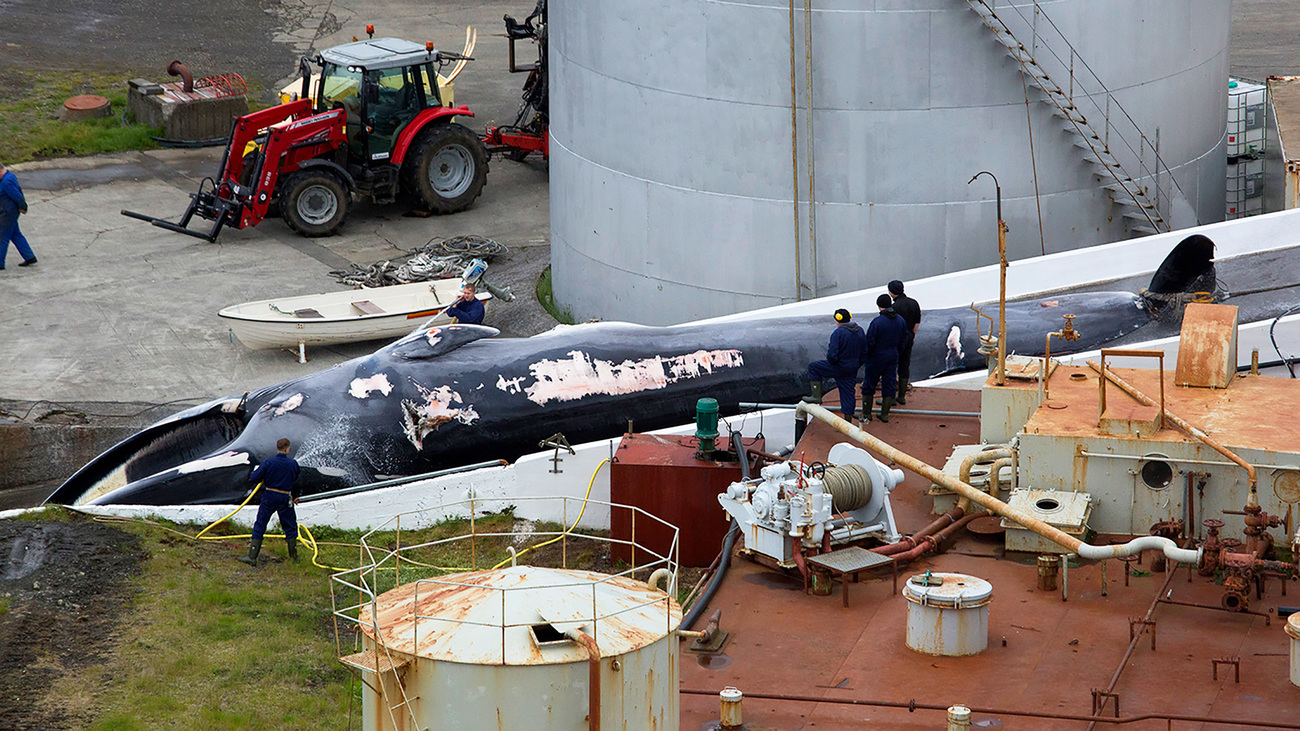
A fin whale being brought into a slaughterhouse after being hunted off Icelandic waters. Photo: © Roger Allen
More than 40 years after the International Whaling Commission (IWC) adopted a moratorium on commercial whaling, whales are still being killed commercially in three countries.
And despite modern developments, the methods used to hunt whales today continue to cause prolonged suffering and raise serious animal welfare concerns.
IFAW has opposed commercial whaling for decades because it is inherently cruel, causes immense suffering, and threatens the recovery of whale populations.
As Harry Lillie, a ship’s doctor who accompanied an Antarctic whaling expedition in the 1940s, famously observed: “The gunners themselves admit that if whales could scream, the industry would stop tomorrow, because nobody could stand it.”
Decades later, the evidence continues to support that assessment.
Why commercial whaling cannot be humane
Whales are among the largest animals on Earth. Their very biology which allows them to thrive in the ocean, also makes it extraordinarily difficult to kill them quickly. This includes layers of blubber, powerful muscle, dense bone, and the ability to hold their breath and remain underwater for long periods of time.
These are some of the key reasons why killing a whale instantly is so difficult and why the hunt is so cruel. Explosive harpoons are designed to penetrate deep into the body, detonate internally, and cause catastrophic injuries. In theory, the explosion is meant to kill the whale instantly or render it unconscious.
But the reality is often very different. Whalers fire from moving vessels while pursuing animals that may be travelling at speed. Harpoons do not always strike the ideal location. Some fail to detonate. Some whales require multiple harpoons before they die. In other cases, injured animals remain attached to vessels by harpoon lines for extended periods. Even when a whale appears motionless, it may still be conscious and capable of feeling pain.
“Whaling is cruel. There is no humane way to kill a whale at sea,” says Sharon Livermore, Program Director for Marine Conservation at IFAW. “No animal, regardless of how it is killed, should have to suffer for that long.”
What the evidence reveals about whaling at sea
For many years, information about the welfare impacts of commercial whaling came largely from the whaling nations themselves. Independent scrutiny was limited by the remoteness of whaling operations and the difficulty of observing hunts at sea.
To address this gap, IFAW stepped in and worked with scientists and Greenpeace to analyse helicopter footage of Antarctic whaling operations. The research documented how long it took whales to die after being struck by harpoons and provided some of the first independent assessments of modern whale killing methods in many years.
The findings showed that many animals did not die immediately and that some effectively suffocated to death. The research received international attention and became one of the first independent investigations in many years into the reality of modern whale killing practices.
Photographic evidence also helped bring the reality of whaling into public view. British photographer Mark Votier documented conditions aboard a Japanese whaling vessel, capturing images that showed wounded whales being subjected to prolonged suffering after harpooning. Together with Votier, IFAW helped bring those images to international attention and contribute to growing scrutiny of the industry's animal welfare record.
IFAW also helped expose the lack of transparency within the whaling industry. The remoteness of whaling operations meant that the killing of protected species often went undetected, with illegal whaling in some cases taking decades to uncover. Through a long-term scientific collaboration with the University of Auckland, IFAW supported pioneering DNA analyses of whale products sold in markets in Japan and South Korea. The research revealed that protected species were still being sold despite existing regulations. It also demonstrated how legal whaling can mask ongoing exploitation and helped bring groundbreaking molecular techniques into mainstream conservation.
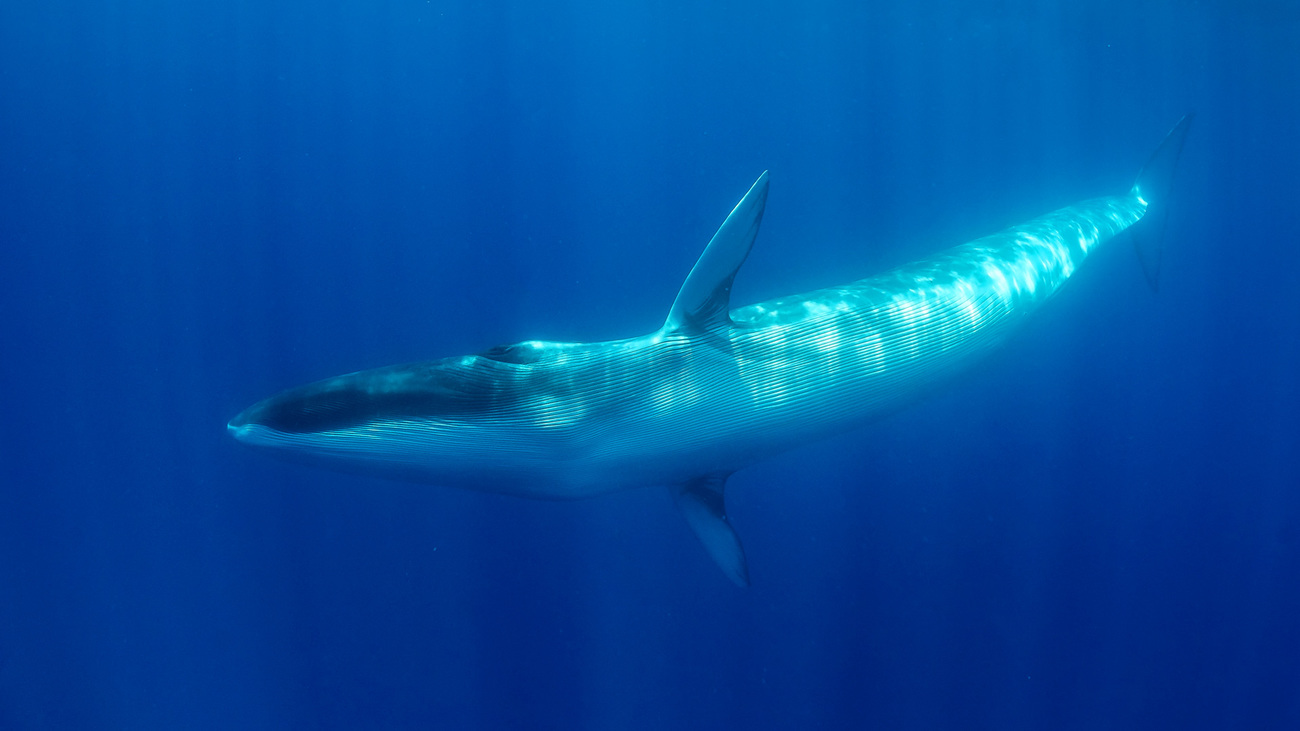
Fin whale turns to look at the camera, Atlantic Ocean, Pico Island, The Azores.
Progress remains fragile
Progress towards ending commercial whaling remains fragile, as Japan's recent actions demonstrate. In 2019, Japan withdrew from the IWC and resumed commercial whaling.
In 2024, the country expanded its programme to include fin whales, the second-largest animals on Earth after blue whales. The decision was particularly concerning because fin whale populations were heavily depleted by historic commercial whaling and have not fully recovered.
Japan's return to commercial whaling followed years of controversy surrounding its former scientific whaling programme. In 2014, the International Court of Justice ruled that that Japan’s whaling program was “not for purposes of scientific research.” IFAW played an important role in the case by convening legal experts and helping strengthen the arguments presented before the court. The ruling represented a significant moment for whale conservation.
Following the judgment, Japan suspended its Antarctic programme. Today, however, its annual catch quotas allow for the hunting of 59 fin whales, 25 sei whales, 187 Bryde's whales, and 142 minke whales.
Recent evidence from Iceland
Recent evidence from Iceland has further highlighted the serious welfare concerns associated with commercial whaling. A government review of the country's 2022 fin whale hunt found that more than 40% of whales died slowly and painfully. Among whales that did not die immediately, the average time to death was 11.5 minutes. Nearly one quarter required a second harpoon strike.
One whale reportedly took about two hours to die, while another escaped after being pursued for five hours with a harpoon lodged in its body. Even more disturbing, 73% of the 148 whales killed were female and eleven of these were pregnant, and one a nursing mother.
Findings such as these have reinforced concerns raised by animal welfare experts for decades.
"The facts are clear: commercial whaling is cruel, unnecessary, and must end," says Livermore. "Living whales are far more valuable for marine ecosystems and the whale watching industry than they are on a plate."
Forty years on, the cruelty remains
Four decades after the commercial whaling moratorium took effect, the fact remains that there is no humane way to kill a whale at sea. That alone is reason enough to finally end commercial whaling.
The images, data, and investigations of recent years show what is at stake: the lives of individual animals, the future of entire species, and the ecological balance of the oceans—vital to human survival as well.
That reality is one reason why IFAW continues to oppose commercial whaling and advocate for stronger protections for whales worldwide. The future of whale conservation depends not only on protecting populations and habitats, but also on recognising the welfare of individual animals. Forty years after the moratorium, that principle remains as important as ever.
Related content
Our work can’t get done without you. Please give what you can to help animals thrive.