Policy Conventions & Agreements - Global
Protection for wildlife & habitats is preserved in global agreementsGlobal leaders unite to clamp down on ‘exotic pet’ trade
Global leaders unite to clamp down on ‘exotic pet’ trade
3 December 2025
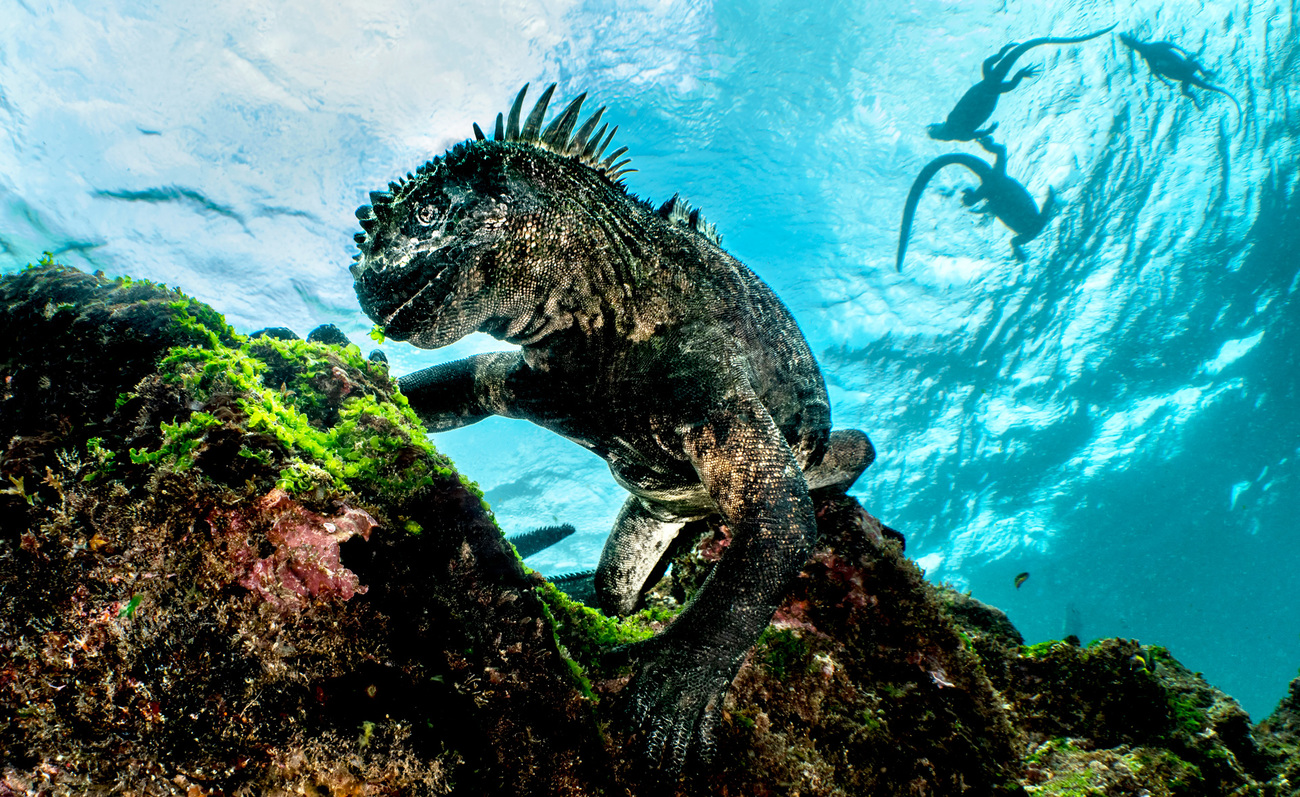
Marine iguana (Amblyrhynchus cristatus) feeding on green algae on seabed, with more iguanas on the surface behind, Cape Douglas, Fernandina Island, Galapagos Islands. Photo: Alex Mustard / © www.naturepl.com
3 December 2025—Wild animals have been given global protections as leaders at a UN summit agree to tighten the net on the unsustainable wildlife pet trade.
Of the 51 proposals received by the Convention on International Trade in Endangered Species of Wild Flora and Fauna (CITES) from government members, 12 of the proposals relate to wild animals traded as pets.
This covers over 80 species—including reptiles, primates, songbirds and sloths.
Historically, discussions have primarily focused on animals traded for their parts and derivatives, like ivory or horns. This conference solidifies a concerning growing trend for the demand of wild animals traded as pets, that jeopardises the future survival of wild populations.
The winners and losers from the 20th Conference of Parties (CoP20):
Winners:
- The proposal for two species of sloth—Linneaus’ and Hoffman’s sloths passed, and they are included on Appendix II.
- Golden-bellied mangabey is moved from Appendix II to Appendix I.
- Peregrine falcon remains on Appendix I, despite a bid to have them downlisted.
- Songbirds—great-billed seed-finch is moved from Appendix II to Appendix I and seed-finches are included on Appendix II.
- Hispanionlan giant galliwasp is moved from Appendix II to Appendix I. Mount Elliot leaf-tailed gecko and the ringed thin-tailed gecko are included on Appendix II.
- Bale mountains adder and the Ethiopian mountain adder are included in Appendix I.
- Home’s hinged tortoise is moved from Appendix II to Appendix I.
- Galapagos marine iguana is moved from Appendix II to Appendix I.
- Galapagos land iguana is moved from Appendix II to Appendix I.
Losers:
- Tarantulas—various species native to South America were rejected for their inclusion in Appendix II.
This means that 10 of the proposals to increase protections were adopted, one was rejected, and the one proposal to weaken protections was rejected.
The proposals have come amid mounting concern over unsustainable international trade practices—both legal and illegal— targeting rare and endemic species, and the impact on biodiversity. Conservationists from the International Fund for Animal Welfare (IFAW) have been working with governments to advise on current concerns and how to address them.
“The international wildlife trade has shifted in recent years—from animals wanted dead to animals wanted alive,” said Matt Collis, senior director of policy for IFAW. “The growing demand for wild animals as pets is driving their decline in the wild. But these new protections will mean the net will be closing in on wildlife traffickers that exploit legal loopholes. Once a species becomes a popular or viral ‘exotic’ pet—its survival is at risk. This is often driven by social media.”
“Organised traffickers steal wildlife and ship them to buyers who can purchase these animals with the click of a button,” Collis added.” This fuels a dangerous trajectory toward extinction. For the animals taken, many will either die before reaching their end destination or if they survive, will endure a life of misery in captivity.”
Legal loopholes also present challenges for wildlife—highlighted by the numerous endemic and nationally protected species which are increasingly being found outside their native countries.
Galapagos iguanas from Ecuador, for example, have surged in popularity as pets. They are nationally protected, and no legal commercial exports have been permitted. Yet they appear in pet markets around the world such as Europe where there are no laws against selling them, even if illegally taken from their country of origin.
Wild caught Galapagos iguanas are laundered into international trade declared as captive bred. The offspring then illegitimately receive CITES permits as legality checks on their origin is not being enforced. This demonstrates how the CITES permitting process is being abused to launder trafficked species and their offspring into supposedly legal trade.
“Wildlife traders are exploiting often well-meaning animal lovers causing untold harm on animal populations in the wild—treating nature as a free-for-all pet shop is unsustainable” Matt Collis said. “While sharing your home with a wild animal might seem innocent, it is still wildlife exploitation that is harmful for wild populations and biodiversity. This worrying trend needs confronting urgently for these animals to stand a fighting chance at survival”.
CITES CoP20 opened in Samarkand, Uzbekistan on November 24th and runs until December 5th. All decisions taken during the Conference need to be endorsed by the final plenary session at the end of the Conference and will take effect 90 days after the Conference ends.
*** ENDS ***
Notes to editors
Previous research of relevance
- Stolen Wildlife V report
- Demand for wild pets driving surge in wildlife crime across Hispanic America
- Loopholes in EU legislation fuel a free-for-all to trade Latin America’s wildlife
A short snapshot survey was conducted on the species commonly traded as pets that were up for CITES listings across a two-week period from 11 – 24 October 2025 by Alexandre Pinna, from The Ouranos Project, on behalf of IFAW. Numerous species were detected that are being proposed for CITES listings, including Mount Elliot leaf-tailed geckos, Linnaeus’s two-toed sloths, and Haitian giant galliwasps. These species could be found in places such as Europe and the United States where they are not native to. Some adverts even appeared to be using their potential changing status as a selling point, such as the Australian leaf-tailed geckos, where adverts stated “**AMAZING Pre-CITES Aussie List**.” Websites that appear to sell multiple species, such as sloths were also documented, and older listings were found stating the animals were wild caught – references can be shared on request.
IFAW has conducted research on wildlife trade on the internet for over two decades, focusing on CITES-listed species. Initially, the trade of wildlife products such as elephant ivory was the main concern, with and relatively few live animals. Today there is a higher quantity of live animals, particularly birds and reptiles.
European demand for rare and / or endemic species poses a significant threat to already vulnerable species. For example, the illegal trade of harlequin poison frogs and Lehmann’s poison frogs, both endemic to Colombia, to Europe has contributed to such severe imperilment that the species are now IUCN-classified as critically endangered.
As well as the listing proposal, there are also proposals at this CITES to introduce new guidance for governments on how to check so-called chain of custody. This includes a proposal to trace animals back to removal from the wild (although that could be strengthened further in the guidance). Another suggestion, specifically for endemic species, asks governments issuing permits to check with the country of origin of that species to ensure it would be legitimate trade.
Appendix I: Species threatened with extinction. Trade is allowed only in exceptional circumstances.
Appendix II: Species not necessarily threatened with extinction, but trade must be controlled to avoid utilisation incompatible with their survival.
Appendix III: Species protected in at least one country, which requests international assistance in controlling trade. Changes to Appendix III follow a distinct procedure from changes to Appendices I and II, as each Party is entitled to make unilateral amendments to it.
Related content
Every problem has a solution, every solution needs support.
The problems we face are urgent, complicated, and resistant to change. Real solutions demand creativity, hard work and involvement from people like you.