Asian elephant protection – China
Conserving Asian elephant populations through coexistence initiativesWhat it means to share a home with Asian elephants
What it means to share a home with Asian elephants
4 August 2026
Part one of a three-part series exploring how IFAW works with communities across Yunnan Province, China, to help people and Asian elephants safely share a landscape. In this first story, we follow two community rangers whose work often prevents conflict before it begins.
When Niu Jiancheng returned home after one in the morning, he had spent hours monitoring a herd of Asian elephants near a house on the edge of Puwen, a township in Xishuangbanna, Yunnan Province, China. An elderly couple lived there, and the elephants had remained close to the village throughout the night. From a safe distance, Niu tracked the herd’s movements and shared updates as the situation changed.
By five that morning, after only a few hours of sleep, Niu was checking the area again. He launched a drone and confirmed that the elephants had moved deeper into the forest. Later, when he passed the house, the couple were opening their door and beginning their day as usual. Their home was undamaged, the elephants had moved on safely, and a potentially dangerous encounter had been avoided.
This is what successful coexistence can look like. Often, the most meaningful outcome is that nothing happens because people have the information, tools, and support they need to stay safe, and elephants can continue moving through the landscape without coming into conflict with them.
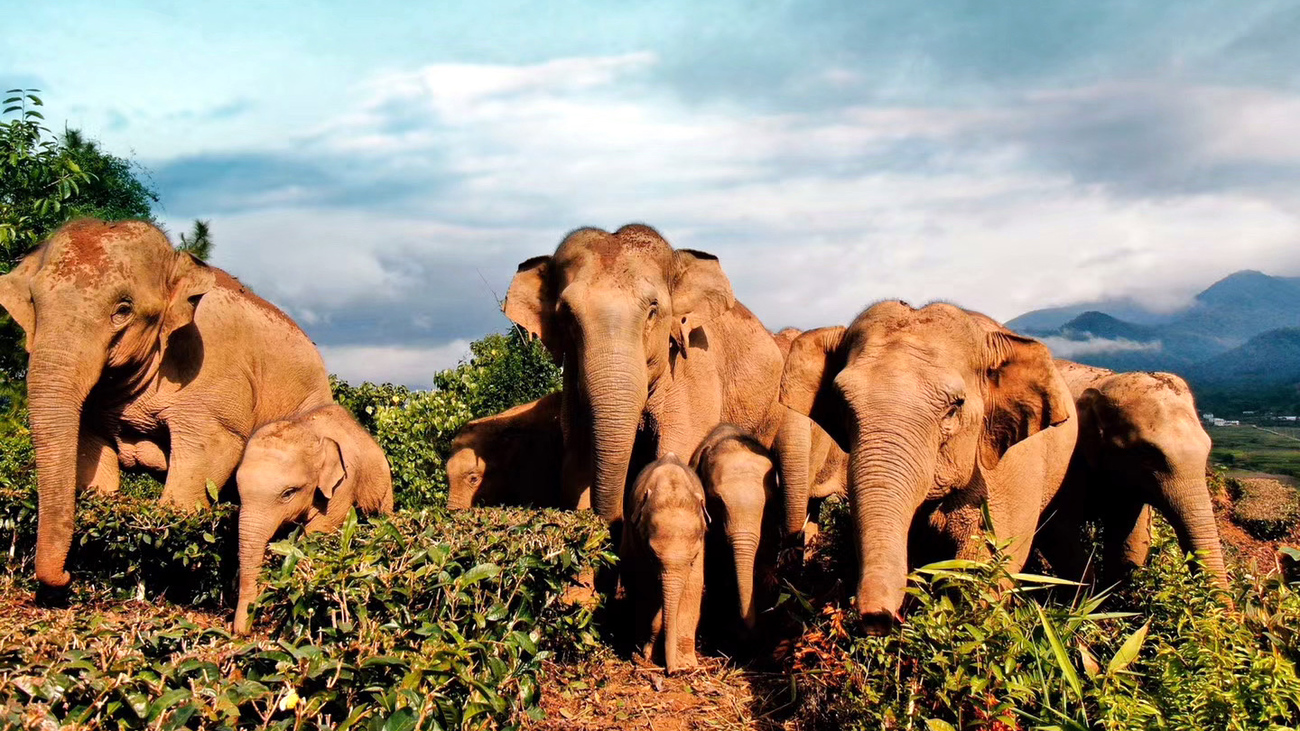
A drone photo of an Asian elephant herd in a field in Meng'a Town, Menghai County, Xishuangbanna Dai Autonomous Prefecture, Yunnan Province, China. Photo: © Xuan Zheng
Living in a landscape shared with elephants
Around 300 wild Asian elephants live across Xishuangbanna and surrounding areas of Yunnan. As they move in search of food, water, and suitable habitat, elephants travel through forests, farmland, plantations, and the edges of villages. People farm these same landscapes, collect forest products, travel between communities, and raise families in places where humans and elephants have lived alongside one another for generations.
Sharing a landscape with elephants brings challenges for both people and wildlife. Encounters can put people at risk, while conflict can lead to elephants being injured or killed. Crops and property may also be damaged, leaving individual families to bear significant economic costs.
For more than two decades, IFAW has worked with government agencies, local partners, and communities in China to help people and Asian elephants live safely alongside one another. Since 2000, IFAW’s Asian Elephant Protection project has combined scientific research, community engagement, environmental education, livelihood initiatives, and technology to address both the immediate risks of human-elephant encounters and the longer-term conditions needed for coexistence. Today, IFAW's Community Ranger Network Initiative supports 22 community rangers across Jinghong and Mengla, helping strengthen coexistence efforts that reach 717 villages.
At the centre of this work are people like Niu and fellow community ranger Ai Hanhuai.
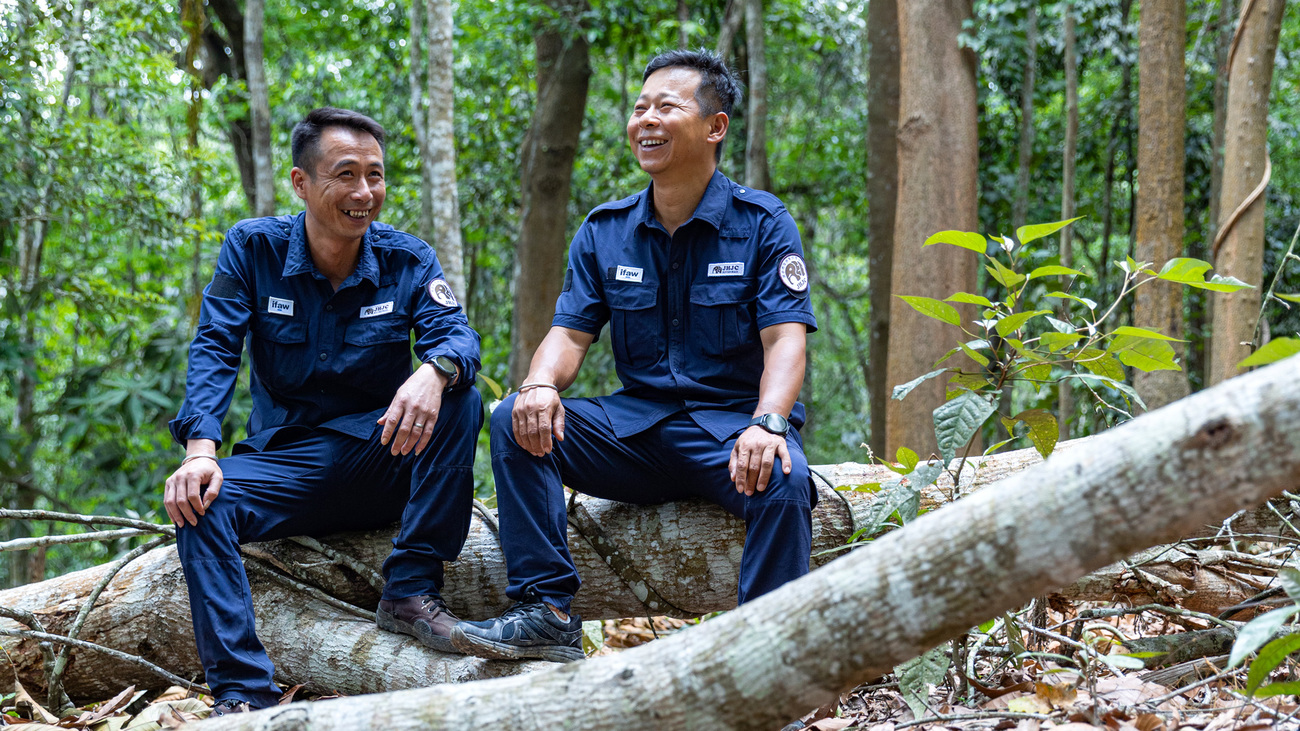
Community rangers, Niu Jiancheng and Ai Hanhuai monitor Asian elephant movements and conduct public outreach to help reduce the risk of human-elephant conflict and promote community safety in China. Photo: © IFAW
The people behind the early warning network
Niu and Ai are part of IFAW’s Community Ranger Network Initiative, launched in 2021. Each is responsible for monitoring elephant activity within a designated area, although the movements of elephants frequently bring the rangers together. Their role is to understand where elephants are, anticipate where they may move next, and ensure that reliable information reaches people who can use it to make safer decisions.
On the morning after Niu’s late-night patrol, he and Ai set out together. At the time, 11 elephants were moving around Puwen, including four adult males that usually travelled alone. The males were in musth, a period when their movements can become more active and less predictable, requiring additional attention from the rangers.
They travelled by motorbike until the track became too difficult to ride, then continued on foot. Fresh signs of elephant activity were scattered across the hillside, and the rangers slowed down to examine the terrain. Years of field experience have taught them to interpret tracks, disturbed vegetation, soil conditions, wind direction, and other details that can indicate where elephants have been and where they may be heading. What might look like an ordinary patch of disturbed earth can reveal the direction of travel, how recently a herd passed, and whether the elephants are likely to return.
Field knowledge is supported by equipment that extends the rangers’ ability to monitor a large and complex landscape. Niu carries a torch, first aid supplies, measuring tools, community outreach materials, food and water, and a drone. Infrared cameras and other monitoring technologies also help provide information about elephant movements across forest edges and farmland.
The tools matter, but technology alone cannot build trust. That depends on people like Niu and Ai, who understand elephant behaviour, know the landscape, and have built relationships with the communities receiving their warnings. They provide the connection between information gathered in the field and decisions made by families at home.
Turning information into action
As elephants move through the landscape, Niu and Ai update their locations through an early warning system and share information with relevant community messaging groups. They also visit households to explain what the updates mean and help families make decisions that reduce the risk of an encounter.
A warning might mean delaying work in a field, avoiding a particular road, or waiting before entering the forest. At other times, an update reassures residents that elephants have moved away and normal activities can resume. During the rainy season, when elephant activity increases along forest edges and people spend more time farming, collecting mushrooms, and travelling through forested areas, this flow of information becomes especially important.
Technology can locate elephants and communicate information quickly, but coexistence depends on people who know how to interpret that information and are trusted to act on it. Niu and Ai are field monitors, educators, messengers, and neighbours. Their knowledge of elephant behaviour and relationships within the community turn data into practical decisions that help keep people and wildlife safe.
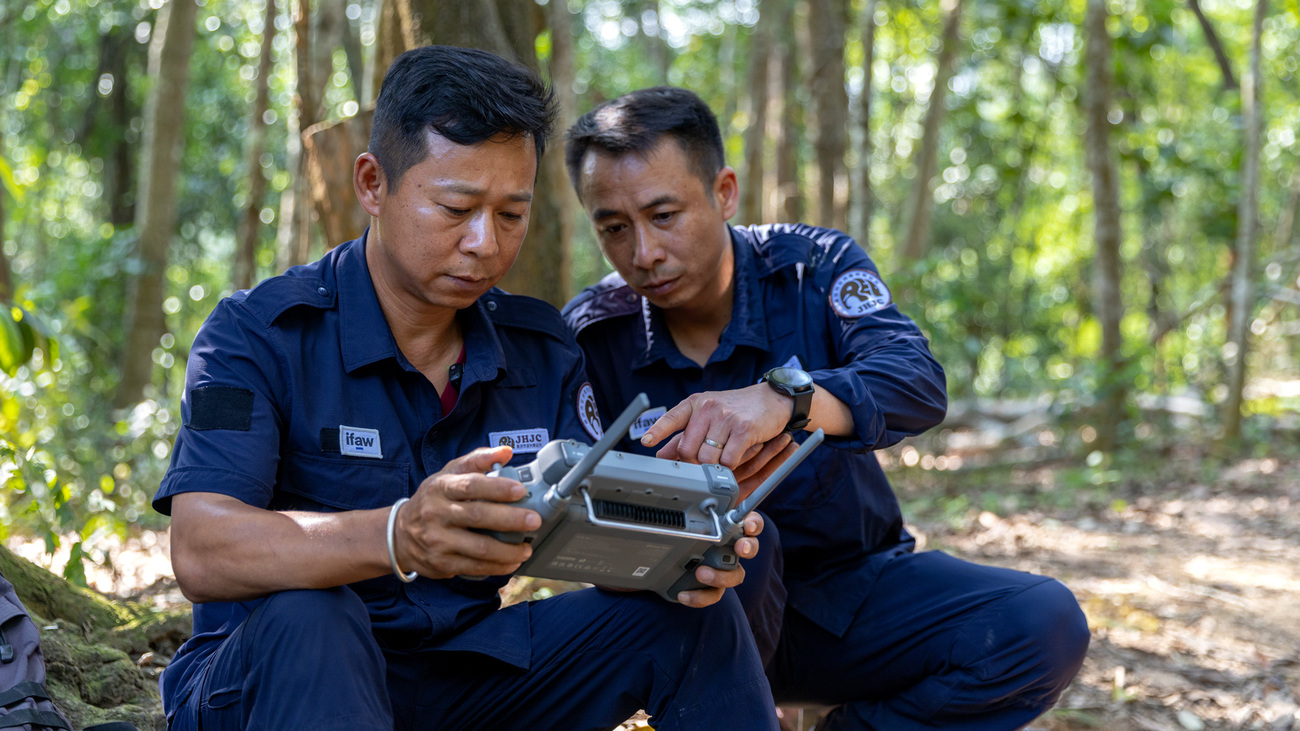
Community rangers Niu Jiancheng and Ai Hanhuai operate a drone to monitor Asian elephant movements and provide early warning alerts to nearby communities in China. Photo: © IFAW
Across the two project sites, community rangers monitor elephant activity for at least 250 days each year, contributing to more than 500 recorded elephant activity reports and community early-warning notifications annually. While every notification is different, each one helps families make informed decisions and gives elephants the space to continue moving safely through the landscape.
Helping individual elephants in need
The rangers’ presence in the landscape can also help identify individual animals that need assistance.
Ai remembers encountering a young elephant that had fallen behind its herd and could no longer keep pace. It was unclear whether the elephant was injured or ill, but the herd had moved on, leaving the young animal alone.
Ai followed at a safe distance, staying close enough to monitor the elephant while remaining alert to the possibility that the herd might return. Whenever the elephant stopped, he climbed a nearby tree and waited. When it began moving again, he returned to the ground and continued following. He maintained this pattern into the night until rescue personnel arrived the following morning and took the young elephant to safety.
The incident shows another dimension of the community rangers’ work. Their consistent presence in elephant habitat enables them to identify animals in distress, monitor situations until additional help arrives, and connect local observations with wider wildlife rescue and response networks.
At IFAW, protecting individual animals is fundamental to how we approach conservation. Every elephant matters, not only because each life has intrinsic value, but because every individual contributes to the social structure, health, and resilience of the wider population.
Coexistence must work for people too
Preventing dangerous encounters is only part of the challenge. Families living alongside elephants may lose crops or property, and repeated losses can undermine livelihoods and change how people perceive wildlife.
Communities should not be expected to carry the costs of conservation alone. Alongside elephant monitoring and early warning systems, IFAW and its partners support initiatives that address the social and economic realities of living with elephants. Changes in agricultural practices can reduce the vulnerability of crops near forest edges, livelihood programmes can help families diversify their income, and compensation mechanisms can ease the financial burden when wildlife damages crops.
Together, these interventions reflect an important principle behind IFAW’s approach: coexistence is not achieved by simply asking people to tolerate wildlife. It requires practical solutions that help communities become safer and more resilient while creating space for animals to survive.
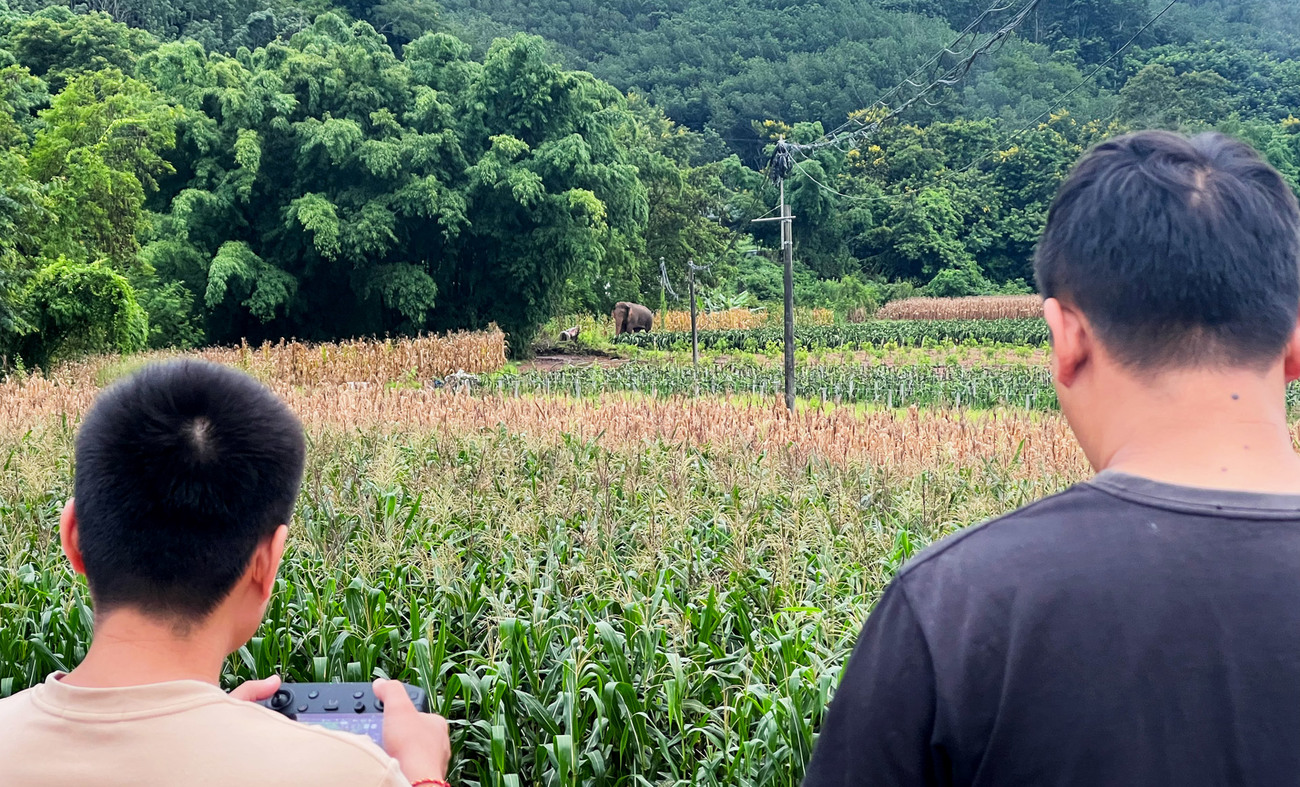
Ranger Li Jie conducts field monitoring of wild Asian elephants in Mengla County, Yunnan Province, China. Photo: © IFAW
Building coexistence that lasts
As evening approaches in Puwen, elephant activity often increases. The community rangers' work follows the same rhythm. Coordinates change, movements are confirmed, and information passes between rangers and households. Niu may launch the drone to establish the location of a herd while Ai updates the early warning system and shares information with communities. Families adjust their routines based on the information they receive.
This daily coordination reflects what IFAW has learned through more than two decades of working to protect Asian elephants in China. Coexistence cannot be achieved through a single intervention. It requires scientific knowledge and local experience, technology and trusted relationships, immediate responses and long-term investment in communities.
Most importantly, the future of elephants is inseparable from the future of the people who share their landscapes. Protecting elephant populations must go hand in hand with helping communities stay safe, sustain their livelihoods, and participate in the conservation of wildlife around them.
For Niu and Ai, the work continues long after daylight fades. They monitor movements, share information, and respond as the landscape changes. Often, the results are visible in the ordinary moments that continue because the right people and systems are in place. Families begin their day safely, people go about their work, and elephants move through the landscape without being harmed.
That is the work that happens before anything happens. It is the quiet work that makes coexistence possible.
Related content
Every problem has a solution, every solution needs support.
The problems we face are urgent, complicated, and resistant to change. Real solutions demand creativity, hard work and involvement from people like you.