Asian elephant protection – China
Conserving Asian elephant populations through coexistence initiativesStronger together: An elephant community rebuilding after the storm
Stronger together: An elephant community rebuilding after the storm
22 April 2026
By Juan Li, coordinator for IFAW’s Asian Elephant Protection project
It was mid-March when the message arrived, at a time of year when spring usually settles gently over Daotangqing village in Xishuangbanna.
After more than 20 years working with IFAW in this landscape, seasonal changes become familiar. The air softens, blossoms bring a faint sweetness, and mango and macadamia trees begin their annual cycle of growth. It is typically a period of quiet renewal for the community.
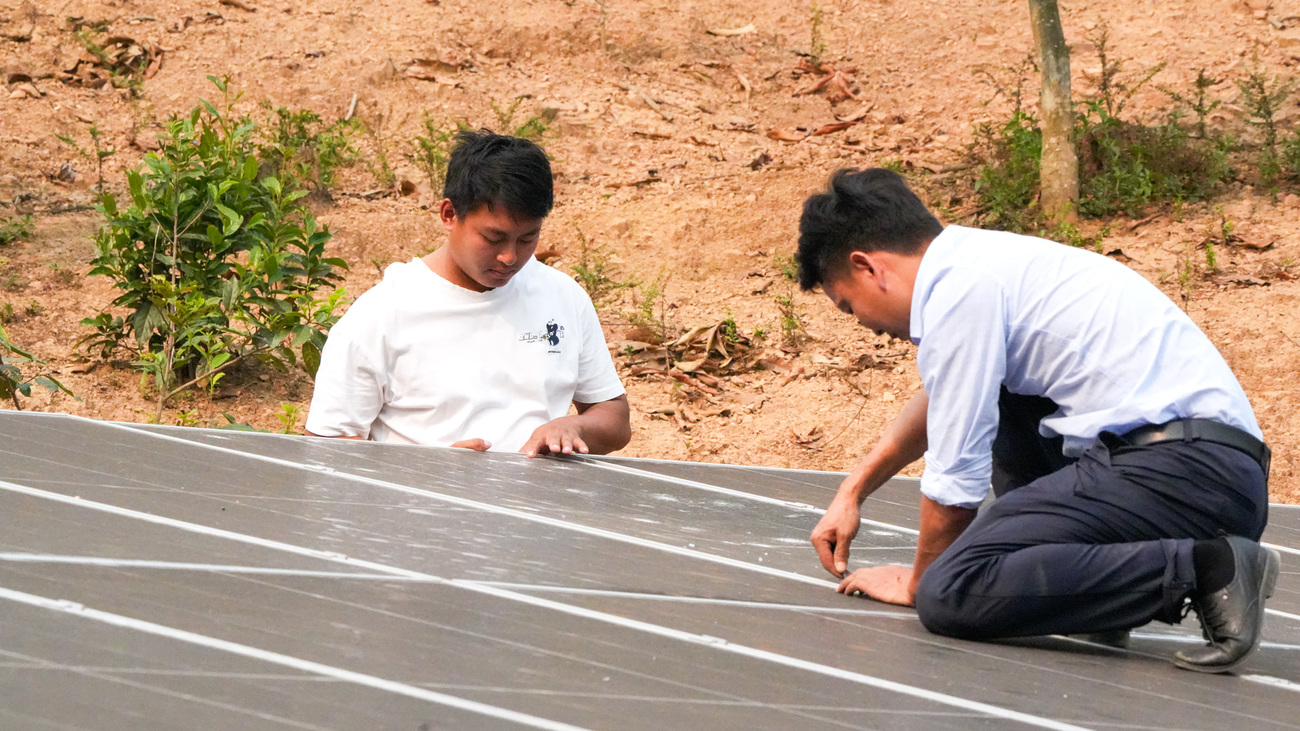
Electricians repair and replace solar panels damaged by hailstones in Daotangqing Community. Photo: © IFAW
Earlier that day, I thought it would be the same.
When Shaokuan Wang messaged with a photo, I felt the impact immediately. In his hand lay a hailstone the size of an egg. Behind it, the damage was clear: cracked photovoltaic panels, shattered rooftops, and young mango fruits scattered across the ground. A single storm had undone months of careful work.
A community adapting for people and wildlife
Daotangqing sits on the edge of Mengyang Town, within the natural range of one of the last remaining populations of Asian elephants. In recent years, the village has been part of IFAW’s Carbon Sequestration Community project, which supports sustainable livelihoods that benefit both people and wildlife.
The shift has been gradual but meaningful. Farmers have reduced their reliance on rubber plantations, introducing mango and macadamia trees instead. Beehives have been established across the landscape, and solar panels now line rooftops, generating clean energy for households and additional income for the community.
These changes are not only economic. By diversifying livelihoods, promoting ecological farming, and adopting alternative income sources, the village has reduced pressure on nearby forests and lowered the risk of encounters with wildlife, including elephants. At its core, this work is about mitigating human-elephant conflict and helping people and the land find a more balanced way of living together, where protecting livelihoods and protecting wildlife begin to feel like the same act of care.
A storm that changed the season
Shortly after the photo arrived, Jiangmei Zhang, the village head, also shared an update. Typically steady and direct, her voice now carried unmistakable concern. The storm had damaged solar infrastructure and severely impacted crops. Mango trees had lost much of their early fruit, and macadamia blossoms had been stripped away.
“The seasons here seem harder to read,” she said. “We once understood our weather. This year’s harvest may be cut in half.”
The urgency was clear. Damaged solar panels needed to be replaced quickly before further rain could cause additional losses. Within days, arrangements were made with technicians, and a team set out for the village.
Where recovery begins
When we arrived, Shaokuan and Jiangmei were already waiting. Work began immediately, with villagers helping carry equipment and prepare the rooftops.
Up close, the damage to the panels was striking. Cracks spread across their surfaces like webs, rendering them unusable. For households like Shaokuan’s, these panels are more than infrastructure. They power daily life, and the surplus energy provides income that is shared across the community.
That shared income has become something people rely on. It supports daily needs and strengthens community life. Last year, the village used this income to hold a gathering where people came together to talk, laugh, and reconnect—an important reminder that these solutions are as much about people as they are about infrastructure.
Jiangmei moved constantly between the yard and the orchard, handing water to workers, checking on tools, and returning to inspect the mango trees.
“The trees are still standing. We just need to get this fixed,” she said. “Then we can breathe a little easier.”
Repairs were completed quickly. As new panels were installed, the system came back to life. A small green light on the inverter signalled that electricity was once again flowing. On the monitoring app, the numbers returned.
While the lost harvest cannot be recovered, the restoration of the solar system ensures that a vital source of income remains intact. Sunlight is once again turning into electricity, electricity into income, and income into something the village can depend on.
Measuring loss, building resilience
Walking through the orchards afterwards, the scale of the storm’s impact was visible. Fallen fruit lay scattered beneath the trees, alongside broken branches and stripped blossoms. Yet many trees remained standing, with a few small fruits still clinging to their branches. No one in the village had been injured. That alone brought a sense of relief.
In communities like Daotangqing, where livelihoods are closely tied to the land, loss is understood in practical terms. Crops can fail, seasons can shift, but resilience is built through preparation, diversification, and collective effort.
With support from IFAW and its partners, the village has been strengthening that resilience. Beekeeping, alternative crops, renewable energy, and sustainable land use are helping to create a more stable balance between people, wildlife, and the environment.
These solutions do not prevent extreme weather events. However, they change what happens afterwards. When one source of income is affected, others remain. When damage occurs, communities are better equipped to recover.
Looking ahead
As we left Daotangqing, the repaired solar panels reflected the afternoon light. Around them, the village continued its daily rhythm. The fields were quieter than usual, but not defeated. The fallen fruit will not return this season, and the harvest will likely be smaller. Yet the foundations of the community remain strong.
Resilience here is not about avoiding hardship. It is about responding to it—repairing what can be repaired, adapting where necessary, and relying on shared systems that support both people and nature.
In Daotangqing, the trees are still standing. The community is still here. And with continued support, they are not only enduring change, but continuing to grow.
Related content
Our work can’t get done without you. Please give what you can to help animals thrive.