Matt Collis
Policymakers’ decisions about wildlife have to be seen as an integral part of governance—not just an add-on.
The surprising role dugongs play in fighting climate change
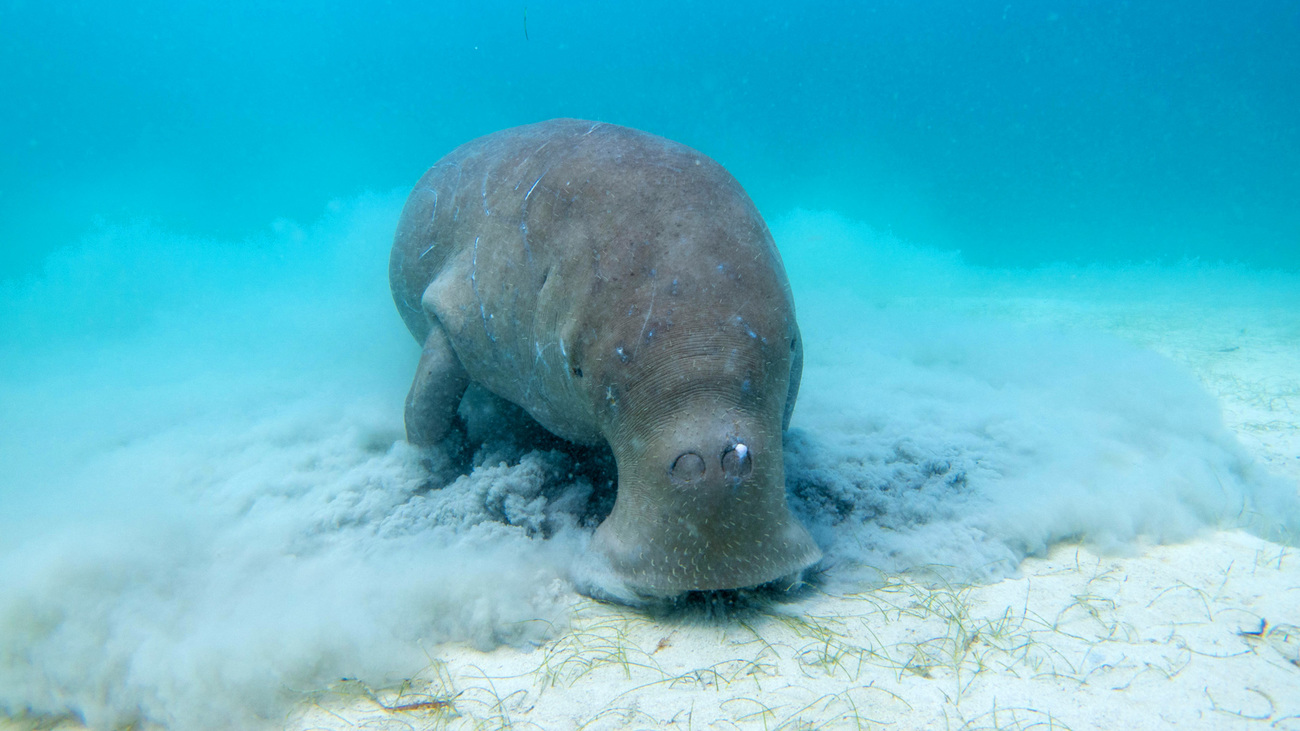
Dugongs, often called "sea cows", spend their lives grazing seagrass meadows in shallow coastal waters. While they are best known as gentle marine mammals, new research suggests they may also be powerful allies in the fight against climate change.
Research supported by IFAW and partners has revealed that dugongs can more than double the amount of carbon stored in seagrass ecosystems, strengthening one of nature's most effective tools for tackling climate change.
The findings, published in Frontiers in Marine Science, add to growing scientific evidence that wild animals play a vital role in helping ecosystems function, and that protecting wildlife can also help strengthen natural climate solutions.
Seagrass meadows are among the world's most powerful natural carbon sinks. Although they cover just 0.2% of the seafloor, they can capture carbon up to 35 times faster than tropical rainforests and are estimated to store between 10% and 18% of all carbon buried in ocean sediments globally.
This makes seagrass one of the most important blue carbon ecosystems on Earth. By capturing and storing carbon beneath the seabed, healthy seagrass meadows help slow climate change while also supporting marine biodiversity and coastal communities.
The new research shows that dugongs significantly enhance these benefits. The study focused on seagrass ecosystems in Bahrain, home to one of the world's largest remaining dugong populations. Researchers found that seagrass meadows grazed by dugongs stored more than twice as much carbon as comparable meadows where dugongs were absent.
Through their natural grazing behaviour, dugongs influence seagrass growth, nutrient cycling, and sediment processes in ways that increase long-term carbon storage.
Their grazing stimulates new seagrass growth, while nutrient recycling and interactions with seabed sediments help create conditions that support greater carbon capture and storage over time.
The findings highlight that protecting dugongs is about more than conserving an iconic marine mammal. It is also about safeguarding the health and climate benefits of the ecosystems they help maintain.
The dugong findings add to a growing body of evidence that wildlife is a key actor in regulating Earth's carbon cycle. Scientists estimate that natural climate solutions could provide around one-third of the emissions reductions needed to avoid the most severe impacts of climate change. Yet ecosystems do not function independently of the animals that inhabit them.
From grazing and seed dispersal to predation, migration, and nutrient cycling, wild animals influence the processes that keep ecosystems healthy, resilient, and capable of storing carbon. Despite this, the role of wildlife is often overlooked in climate policy and climate modelling.
This week, as climate discussions continue in Bonn, Germany, more than 260 leading scientists launched the Scientific Consensus on Wildlife and Climate, a major synthesis of research examining the links between wildlife, ecosystem function, and climate change mitigation.
The Consensus brings together evidence from hundreds of studies showing that wild animals influence carbon storage and climate resilience through their natural behaviours. The authors argue that climate policies and nature-based solutions are incomplete if they fail to account for the role wildlife plays in maintaining healthy, functioning ecosystems.
The scientists are calling on governments to explicitly recognise wildlife within climate policies and frameworks, helping strengthen both climate action and biodiversity conservation.
The Scientific Consensus is accompanied by case studies from around the world, highlighting how species ranging from forest elephants to sea otters contribute to climate resilience and carbon storage.
The new dugong research adds another compelling example. From the seagrass meadows of Bahrain to ecosystems around the world, wildlife is doing far more than simply surviving within nature. Animals help ecosystems function, adapt, and deliver benefits that people depend upon.
For too long, these contributions have been underestimated or ignored. Yet the evidence continues to grow that protecting wildlife is not only essential for biodiversity—it can also help strengthen the natural systems that support climate resilience.
Protecting species such as dugongs means protecting the natural processes that keep ecosystems healthy, resilient, and capable of storing carbon for generations to come.
Read the full report: Integrating megafauna into blue carbon strategies: dugongs could enhance seagrass carbon storage
Read the full Scientific Consensus on Wildlife and Climate
Matt Collis
Policymakers’ decisions about wildlife have to be seen as an integral part of governance—not just an add-on.
Every problem has a solution, every solution needs support.
The problems we face are urgent, complicated, and resistant to change. Real solutions demand creativity, hard work and involvement from people like you.
Unfortunately, the browser you use is outdated and does not allow you to display the site correctly. Please install any of the modern browsers, for example:
Google Chrome Firefox Safari