Saving the North Atlantic right whale - North America
Don't fail our whaleIFAW response to proposed amendments to North Atlantic right whale speed rule
IFAW response to proposed amendments to North Atlantic right whale speed rule
March 4, 2026
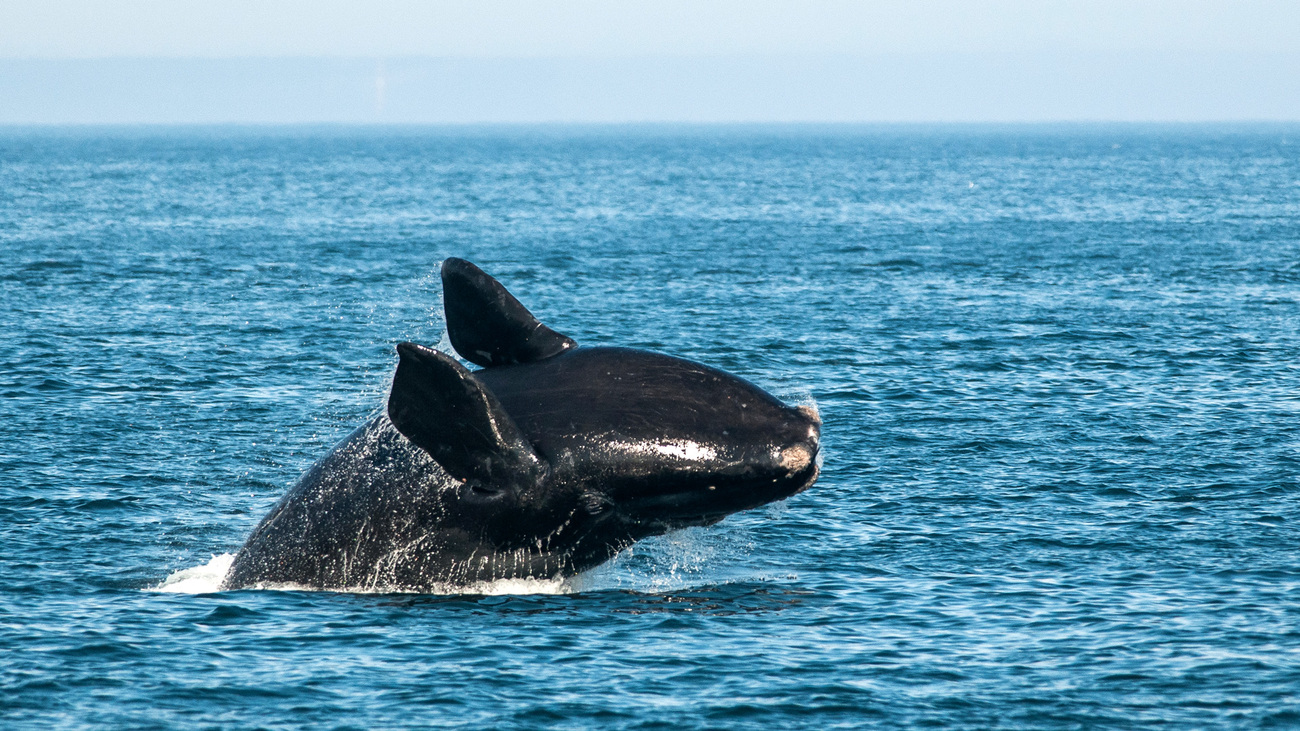
A North Atlantic right whale (Eubalaena glacialis) breaching in the Bay of Fundy, in New Brunswick, Canada Photo: © Nick Hawkins
(March 4, 2026 – Washington DC) — The National Oceanic and Atmospheric Administration (NOAA) just published a notice of proposed rulemaking to ‘modernize’ the 2008 vessel speed rule, proposing a shift away from mandatory speed reductions in favor of technology-based measures.
In its statement, NOAA said the agency is focused on “implementing new technologies, engineering approaches, and other advanced tools” to protect whales from vessel strikes. The proposal would affect the North Atlantic right whale, for which vessel strikes are the leading cause of death, accounting for 58% of documented mortalities over the past nine years.
“We know for a fact that reducing vessel speed saves lives,” said Kathleen Collins, Senior Marine Campaign Manager. “The current speed rule is widely supported by responsible mariners who care about ocean safety and stewardship. But what we are seeing now is growing political pressure for change from interests that are not even subject to the regulation. Rolling back proven protections would undermine effective conservation policy and place the North Atlantic right whale on an even more precarious path.”
North Atlantic right whales are one of the most endangered whales in the world, with only about 380 remaining and fewer than 70 reproductively active females. The International Fund for Animal Welfare (IFAW) has campaigned tirelessly to safeguard the future of this species. While IFAW acknowledges that technology can be a force for good, it warns this move could jeopardize their survival, as an increase in speed, even with advanced technology, would put them in harm's way.
“We are fully on-board to support innovation and the use of technology to help mariners navigate whale habitat safely,” said Greg Reilly, retired Coast Guard officer and commercial mariner. “But relying on unproven concepts as a substitute for established protections is a high-stakes gamble we simply cannot afford. With so few North Atlantic right whales remaining, there is no margin for error. Slower vessel speeds remain the only measure proven to reduce deadly vessel strikes and weakening that safeguard now would put this critically endangered species at even greater risk.”
IFAW urges NOAA to uphold proven conservation practices that include enforced slow zones where right whales are known to congregate and travel in. Technology can be an incredible tool to aid in the conservation of a species, but it is not a standalone solution.
NOAA Fisheries has opened a 90-day comment period on the advance notice of proposed rulemaking.
Sign IFAW’s petition to support North Atlantic right whales here.
ENDS
Press contact:
Stacey Hedman
Senior Communications Director, IFAW
m: +1 508 737 2558
e: shedman@ifaw.org
Related content
Every problem has a solution, every solution needs support.
The problems we face are urgent, complicated, and resistant to change. Real solutions demand creativity, hard work, and involvement from people like you.
DonateIFAW affiliates are registered as tax-exempt nonprofit organizations in several countries. Depending on where you reside, your donation may qualify for a tax deduction or benefit. See the pull-down menu at the bottom right of this page to see how IFAW operates in your country.