Centre for Wildlife Rehabilitation and Conservation - India
Near Kaziranga National Park, animals are being threatened by a single highwayA fragile start for a young rhino in Kaziranga
A fragile start for a young rhino in Kaziranga
January 30, 2026
Update: Despite weeks of dedicated care, the calf’s underlying challenges proved too great. After 40 days of care, he passed away.
On the afternoon of 21 January 2026, forest staff in Kaziranga National Park, Assam, spotted a rhino calf alone in the tall grass. Barely a week old, the male calf showed no visible injuries, but no mother was in sight.
A search began immediately and continued through the night, as frontline teams administered rehydration solutions and warm blankets to keep him stable. By morning, no mother had been located. The decision was made to transfer the calf to the Centre for Wildlife Rehabilitation and Conservation (CWRC), where his health could be closely monitored and managed.
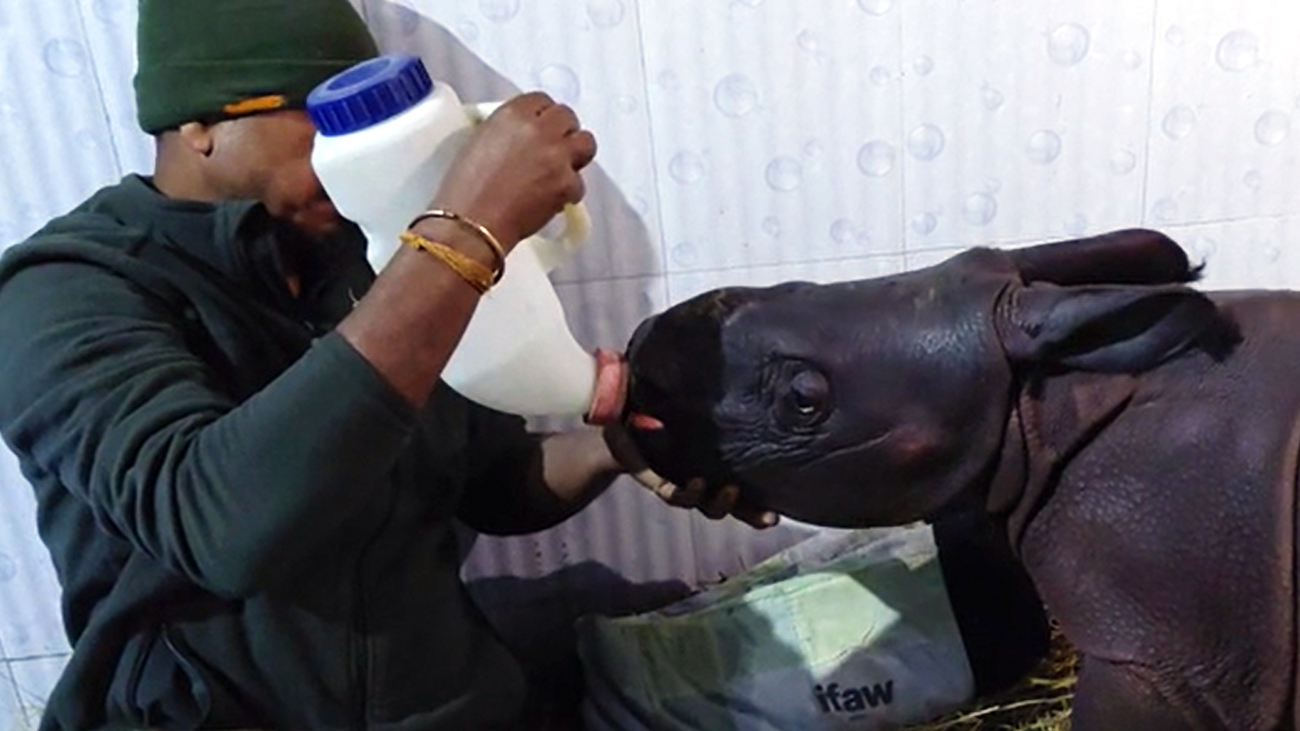
A male rhinoceros calf undergoing rehabilitation under the care of the Wildlife Trust of India at Kaziranga, Assam. Photo: © IFAW-WTI
CWRC is a joint initiative of the Wildlife Trust of India, IFAW, and the Assam Forest Department. For more than two decades, it has served as India’s only facility for rescuing, rehabilitating, and—when possible—returning displaced wild animals to their natural habitats.
Early days of care
On arrival at CWRC, the calf appeared alert but soon became dull and showed signs of incomplete feeding. Closer veterinary assessment confirmed his age at approximately 3 to 4 days old, based on the condition of a nearby placenta and the state of his umbilical cord, which had not yet dried. He weighed just 58 kilograms.
Critically, calves this young often do not receive adequate colostrum—the nutrient-rich first milk required for early immunity. Without it, newborns are left highly vulnerable to infection and illness. The CWRC team began urgent supportive care, including adjusted feeding routines, temperature regulation, and medical support.
Signs of resilience
Just days after his rescue, the calf demonstrated a small but powerful milestone, consuming 1.5 litres of milk in just 28 seconds. For a young rhino that initially struggled to feed, this moment marked a meaningful step forward.
It is too soon to know his long-term outcome. But each hour of strength gained reflects the dedication and expertise of those working at CWRC—and the importance of giving individual animals a second chance.
One life, part of something bigger
This calf’s story is not an isolated one. In Assam, greater one-horned rhinos continue to face pressures from flooding, habitat loss, and other threats. Though the first goal is always to reunite displaced calves with their mothers, that is not always possible. CWRC exists to respond to those emergencies, with a long-term goal of returning healthy animals to the wild.
Each rescue is a beginning. Some calves go on not only to survive, but to thrive in the wild. Each animal rehabilitated at CWRC is part of a broader conservation picture—one that connects individual welfare, species recovery, and community-led stewardship.
In fact, rhinos Chandra and Kanai are taking their first steps back to the wild this month. And over the past two decades, Ganga—the first rehabilitated and released rhino in India to give birth in the wild—has become an important matriarch and grandmother.
As we continue to follow the progress of this newest arrival, we hold hope that his story, too, will one day be part of that future.
Related content
Every problem has a solution, every solution needs support.
The problems we face are urgent, complicated, and resistant to change. Real solutions demand creativity, hard work, and involvement from people like you.
DonateIFAW affiliates are registered as tax-exempt nonprofit organizations in several countries. Depending on where you reside, your donation may qualify for a tax deduction or benefit. See the pull-down menu at the bottom right of this page to see how IFAW operates in your country.