Whale Watching Promotion - Global
Watching is better than whalingFrom harpoons to ship strikes, global whale summit tackles the threats facing whales
From harpoons to ship strikes, global whale summit tackles the threats facing whales
15 September 2026
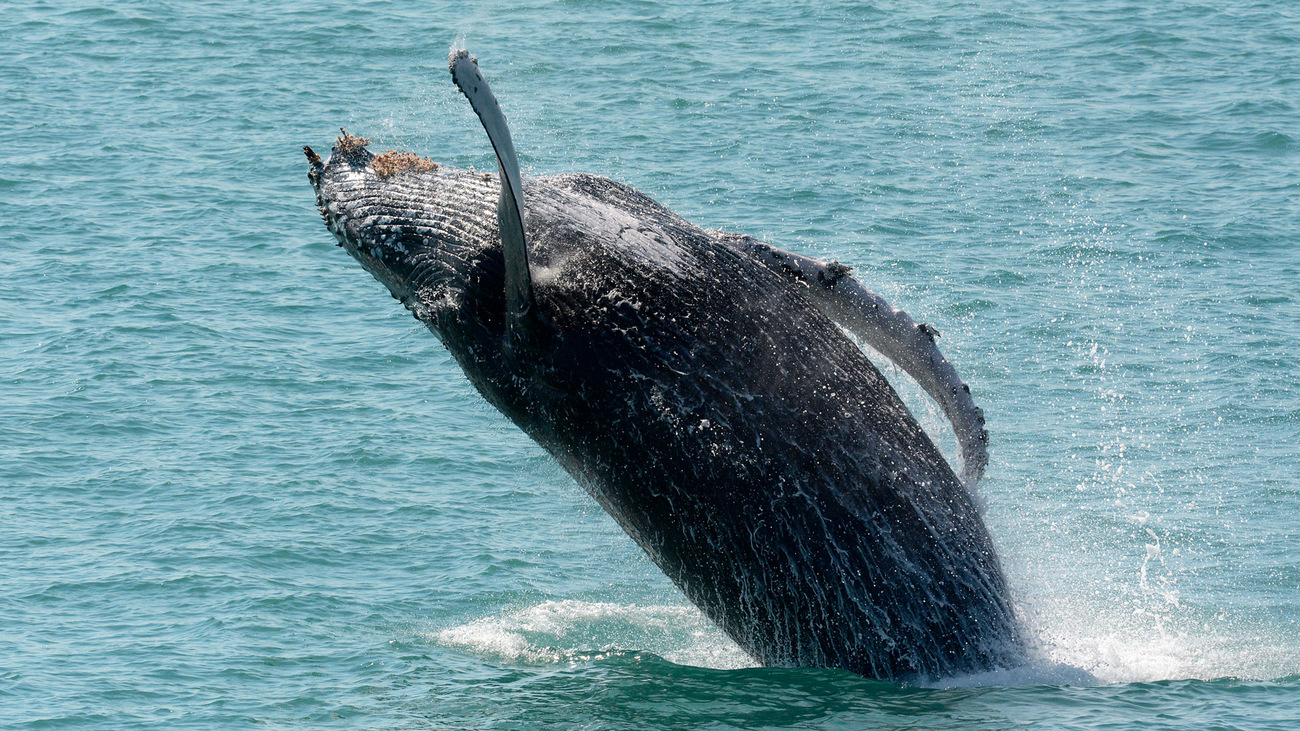
A humpback whale breaching. Photo: © Greg Lecoeur
Australia’s whale conservation success story will take centre stage as governments from across the world meet in Tasmania to defend the ban on commercial whaling and confront the increasing threats facing whales.
IFAW will join governments, scientists, and conservationists in Hobart from September 27 to October 2 for the International Whaling Commission's 70th meeting (IWC70). The IWC is the global body responsible for whale conservation and the regulation for whaling.
The meeting comes at a landmark moment for whale conservation, marking 40 years since the global moratorium on commercial whaling took effect. Despite this, Norway, Iceland and Japan continue to disregard the ban and have collectively killed an estimated 45,000 whales since 1986. This year alone, Japan has authorised the hunting of more than 400 whales, while Norway has already killed more than 400 whales.
This year’s meeting comes at a pivotal moment, with the Icelandic government expected to introduce legislation that could finally bring an end to whaling in its waters.
“The fin whale hunt is both an economic and ecological dead end for Iceland. Continuing to allow these iconic animals to be hunted undermines the country's reputation as a progressive ocean nation and is increasingly out of step with public opinion,” IFAW director of marine conservation Sharon Livermore said.
“All eyes will be on Iceland and the decisions that follow this IWC meeting. A move to end whaling would mark a historic turning point – one that has been a long time coming. It would send a strong signal to the other rogue commercial whaling nations to follow suit and put an end to this prehistoric practice once and for all.”
Australia's coastline offers one of the clearest examples of the moratorium's success. Humpback and southern right whales were driven close to extinction by decades of commercial whaling.
Today, thousands of whales migrate along Australia's coastline each year. Recent sightings of southern right whale mothers and calves, along with extraordinary drone footage capturing a humpback whale giving birth off the New South Wales (NSW) coast, have highlighted the remarkable recovery of whale populations if given the chance to rebound.
"Australia shows what is possible when whales are protected, but it is also a reminder that those hard-won gains must be defended," Mr Collis said.
"These giants of the ocean now face increasing threats from vessel strikes, entanglements, bycatch and strandings. While not as visually appalling, they're just as deadly. We need to make sure whales are protected not only from harpoons, but from the modern threats putting their recovery at risk."
Alongside defending the commercial whaling moratorium at IWC70, IFAW will advocate for stronger international action to protect whales from the plethora of dangers they face.
Ship strikes are among the leading causes of death for some whale populations. As a global leader in efforts to reduce vessel collisions, IFAW is urging governments to back an IWC70 resolution calling for safer shipping routes away from key whale habitats, rerouting and reducing vessel speeds in high-risk areas, and greater cooperation with the shipping industry and maritime authorities to help protect whales.
The meeting will also discuss efforts to improve responses to whale and dolphin strandings. More than 80% of Australian strandings occur in Tasmania, while Farewell Spit in New Zealand’s South Island is one of the most notorious strandings hotspots in the world.
"This is an opportunity to celebrate how far whale conservation has come and decide what happens next. The lesson from Australia's waters is simple. When we stop hunting whales and protect them from human-caused threats, they can recover. The challenge now is making sure that we don't jeopardise that recovery and instead make our oceans a safer place for all marine life," Mr Collis said.
To coincide with the 40th anniversary of the whaling moratorium, IFAW and partner organisations launched a global petition calling for the complete abolition of commercial whaling. The petition will be presented to delegates in Hobart.
ENDS
Media contact:
Dominica Mack
+61 460 432 901
dmack@ifaw.org
Notes:
- The establishment of the South Atlantic Whale Sanctuary will once again be up for discussion at IWC70 after repeatedly being blocked at previous meetings by pro-whaling nations. IFAW supports the establishment of the long-standing proposal.
- The expanding international trade in fish maw and the associated increase in bycatch continues to claim the lives of tens of thousands of small whales and dolphins each year. IFAW supports a resolution to reduce these preventable deaths.
- IFAW’s Blue Speeds initiative aims to reduce vessel strike risk globally - calling for a modest 10% reduction in speeds across the global commercial shipping fleet to protect marine life from collisions, lower underwater noise, and reduce greenhouse gas emissions.
- Some species of whale were banned from commercial hunting before the global moratorium came into effect because of the damage already made to populations. Southern right whaling was banned in 1935 while the ban on hunting humpback whales in the southern hemisphere came into effect in 1963 and globally 1966. By the time whaling ceased in Australian waters, the east coast humpback population had been reduced to little more than 100 animals.
IFAW acknowledges the Traditional Custodians of country and their connection to land, waters and culture. We pay our respects to their Elders, past and present.
Related content
Every problem has a solution, every solution needs support.
The problems we face are urgent, complicated, and resistant to change. Real solutions demand creativity, hard work and involvement from people like you.