Stranded Marine Mammal Rescue - Global
When the tide is low, the stakes are high for marine mammalsInside IFAW's response to the largest bottlenose dolphin mass stranding in Massachusetts
Inside IFAW's response to the largest bottlenose dolphin mass stranding in Massachusetts
17 July 2026
Before sunrise on Monday, reports came in of 28–32 bottlenose dolphins stranded along Cape Cod Bay. Over the next three days, IFAW's marine mammal rescue team worked around the clock to monitor the animals through changing tides, provide supportive care, and guide them back toward deeper water.
On Wednesday, the team's efforts brought encouraging news. Using satellite tags placed on two rescued dolphins, responders relocated the group in deeper waters of Cape Cod Bay, where they were swimming alongside additional offshore bottlenose dolphins. Identification tags confirmed that many of the rescued dolphins were once again traveling with other bottlenose dolphins in deeper water, an encouraging sign after days of intensive rescue efforts.
The event became the largest known bottlenose dolphin mass stranding ever documented in the US Northeast and capped one of the busiest weeks in recent memory for IFAW's marine mammal rescue team. Between July 6 and July 14, the team responded to three separate mass strandings involving three different dolphin species, in addition to individual strandings of a harbor porpoise and a minke whale.
A rescue unlike any other
The response began before sunrise on Monday, when reports came in of bottlenose dolphins stranded between Brewster and Wellfleet on Cape Cod. By the time IFAW responders arrived, an estimated 28–32 dolphins had stranded. While many refloated with the incoming tide, five to six animals had already died before rescuers could reach them.
The response continued over the following days as dolphins repeatedly entered shallow waters across a nine-mile stretch of Cape Cod Bay. On Tuesday morning alone, responders located 19 live bottlenose dolphins stranded across three locations—very likely the same animals from the day before. Every animal successfully refloated as the tide returned.
Two dolphins were fitted with small temporary satellite tags at this time, allowing the team to monitor their movements and determine whether groups that had become separated were reuniting. Rescue crews remained on the water throughout the day Tuesday, using vessels to encourage the dolphins away from shallow areas and toward deeper water.
Throughout the response, IFAW staff were supported by interns, more than 50 trained volunteers, and partners from AmeriCorps Cape Cod and Whale and Dolphin Conservation, allowing the team to respond across multiple locations simultaneously.
Unlike many of the dolphin strandings IFAW responds to, this rescue required a different approach. Bottlenose dolphins can measure 9 to 10 feet long and weigh 600 to 700 pounds, with some approaching 800 pounds. In a typical response, stranded dolphins can be transported in IFAW's custom-built rescue vehicle to a safer release site near deep water. With so many large animals spread across multiple locations, that was simply not an option.
Instead, responders provided supportive care during low tide, keeping the dolphins upright, protecting their skin, monitoring their breathing and physical condition, and helping them conserve energy until the tide returned. Once the animals refloated, rescue teams carefully guided them away from the expansive tidal flats and toward deeper water.
"This is a very stressful event," said Dr. Sarah Sharp, IFAW's lead veterinarian. "It's incredibly complex to have multiple groups of animals spread across different locations, and the fact that they're such large dolphins makes caring for them much more difficult. These are long days for our team, but harder still on the dolphins."
The work required constant vigilance. Even after the dolphins refloated, there was no guarantee they would remain in deeper water. The team stayed in the area through successive tidal cycles, ready to respond if the animals returned to shore.
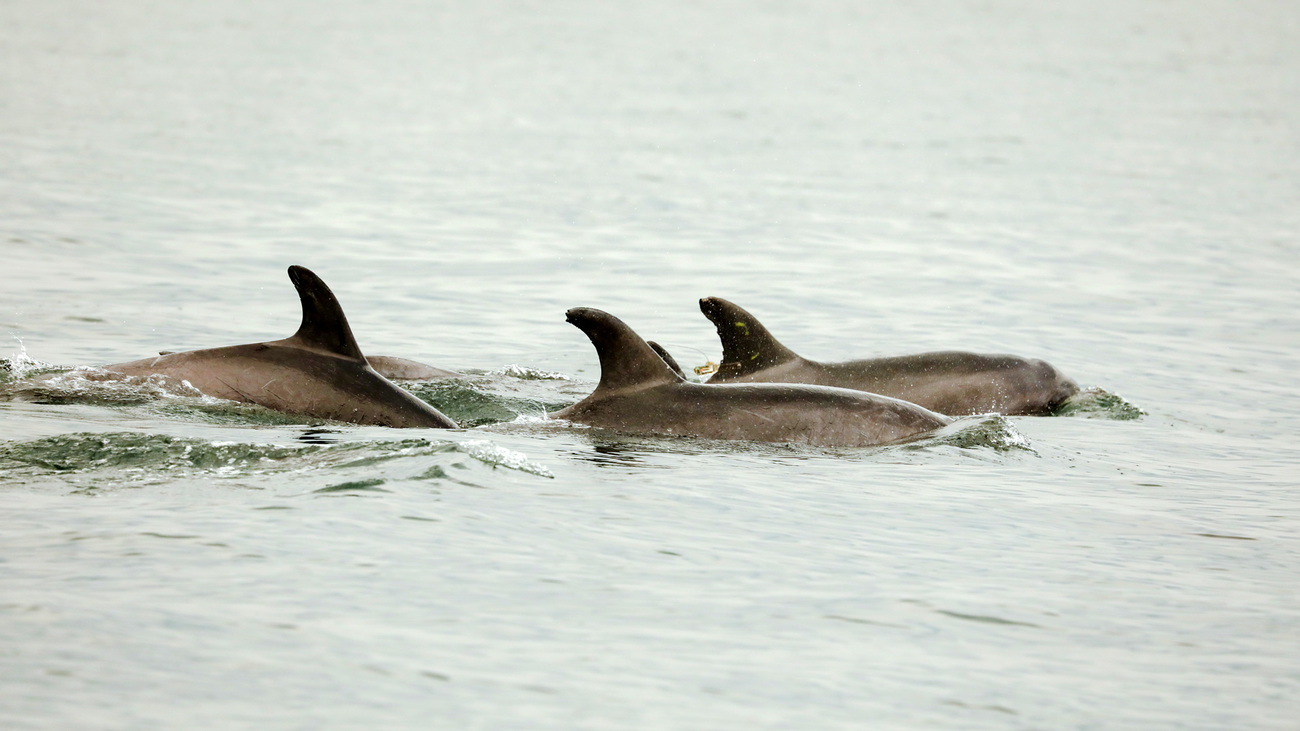
After three days of intensive response efforts, the rescued bottlenose dolphins were observed swimming alongside other bottlenose dolphins safely in deeper waters of Cape Cod Bay. Photo: Stacey Hedman / © IFAW. Activities conducted under a federal stranding agreement between IFAW and NMFS under the MMPA.
Why dolphins strand on Cape Cod
Cape Cod is a globally recognized hotspot for mass strandings. Its distinctive hook-shaped coastline, shallow bays, expansive tidal flats, and dramatic tidal changes can create significant navigational challenges for dolphins.
The area around Wellfleet is often described as a "hook within the hook." Dolphins can enter these shallow waters while following prey at high tide, only to become trapped as the tide rapidly recedes. During this response, the difference between high and low tide reached approximately 13 feet.
These bottlenose dolphins are the offshore ecotype of the species, most commonly found in deep offshore waters, although IFAW has observed them occurring closer to Cape Cod's shores more frequently in recent years. Reports from local fishermen also indicated an abundance of bait fish in the area, another factor that may have drawn the dolphins closer to shore.
Mass strandings are rarely caused by a single factor. Based on what is known so far, IFAW believes these strandings are consistent with the natural ecology of Cape Cod, including its geography, extreme tidal fluctuations, and the availability of prey close to shore.
Throughout the event staff and volunteers have documented the dolphins that were found dead. Two animals received more thorough necropsies, animal autopsies, from the veterinary team.. These assessments help researchers better understand the animals' health, identify possible contributing factors, and continue improving future rescue and conservation efforts.
Three species mass strand in one week
The bottlenose dolphin response was the third mass stranding involving three different dolphin species in just over one week.
The first involved seven common dolphins on July 6 that were relocated and released in Provincetown and are now swimming over 90 miles east of Cape Cod. Several days later, the team responded to 11 Atlantic white-sided dolphins, several of which stranded, then refloated, and were herded to safer waters. The bottlenose dolphin event followed on July 13-14, involving an estimated 28–32 animals.
During the same period, the team also responded to individual strandings involving a harbor porpoise and a minke whale. In all, these animals ranged from newborns to adult age, weighing as much as 700 to 800 pounds.
Each species requires a different response strategy based on the animals' size, condition, location, and behavior. Responders must also account for tides, weather, daylight, public safety, and the likelihood that animals will strand again as conditions change.
Managing three mass strandings involving three different dolphin species in just over one week required sustained coordination across IFAW's staff, interns, trained volunteers, and partner organizations.
![IFAW marine mammal experts and volunteers monitored the long stretch of coastline from Wellfleet to Dennis, MA on day two of the response, while boat teams worked to guide the dolphins toward deeper water. [same credit]](https://d1jyxxz9imt9yb.cloudfront.net/medialib/6458/image/s1300x1300/Photo-Jul-14-2026_-14-51-57_reduced.jpg)
IFAW marine mammal experts and volunteers monitored the long stretch of coastline from Wellfleet to Dennis, MA on day two of the response, while boat teams worked to guide the dolphins toward deeper water. Photo: Stacey Hedman / © IFAW. Activities conducted under a federal stranding agreement between IFAW and NMFS under the MMPA.
A response powered by people
Marine mammal rescue work is physically demanding and emotionally exhausting. Responders often begin before sunrise, work through difficult conditions and changing tides, and remain on beaches or rescue vessels well into the evening.
During the bottlenose dolphin response, teams were spread across multiple locations while monitoring animals that could move quickly or strand again with little warning. The dolphins' size made every aspect of the response more challenging, from conducting health assessments to safely providing supportive care in shallow water.
IFAW's marine mammal rescue team is supported by more than 250 trained volunteers across Cape Cod and southeastern Massachusetts. Volunteers are often the first eyes and ears on the beach. They help locate stranded animals, establish safe working areas, support veterinary assessments, assist with care, collect scientific data, and remain ready as tides and conditions change.
The hours are long, the conditions are difficult, and the outcomes are not always certain. Still, the team continues because every individual life matters.
Every dolphin returned to deeper water has another opportunity to survive, rejoin other dolphins, reproduce, and contribute to a healthy wild population. Every animal that cannot be saved still helps advance scientific understanding through examinations that improve future rescue efforts.
After one of the busiest weeks in recent memory on Cape Cod, the team returned to its regular monitoring schedule knowing the next call could come at any time. Whether responding to a single entangled seal or dozens of dolphins spread across miles of shoreline, the team will continue using science, experience, and compassion to give every stranded marine mammal the best possible chance of survival.
Related content
Every problem has a solution, every solution needs support.
The problems we face are urgent, complicated, and resistant to change. Real solutions demand creativity, hard work and involvement from people like you.