Updates
Pangolins and other wildlife reveal the wider toll of Indonesia’s fires
Read moreEvery tag helps protect whales
IFAW has teamed up with Syracuse University to learn more about the movements and behaviours of two endangered whale species: North Atlantic right whales and sei whales. This multi-year project, funded by Allen Family Philanthropies, uses innovative research to help inform conservation efforts protecting these whales. By understanding whale migration behaviour, we can inform management decisions that more effectively protect whales as they move through the ocean.
For three weeks this past spring, Dr. Dana Cusano and her team surveyed the waters of Cape Cod Bay to tag North Atlantic right whales and sei whales and collect water samples to better understand prey distribution, helping us learn where whales move and why.
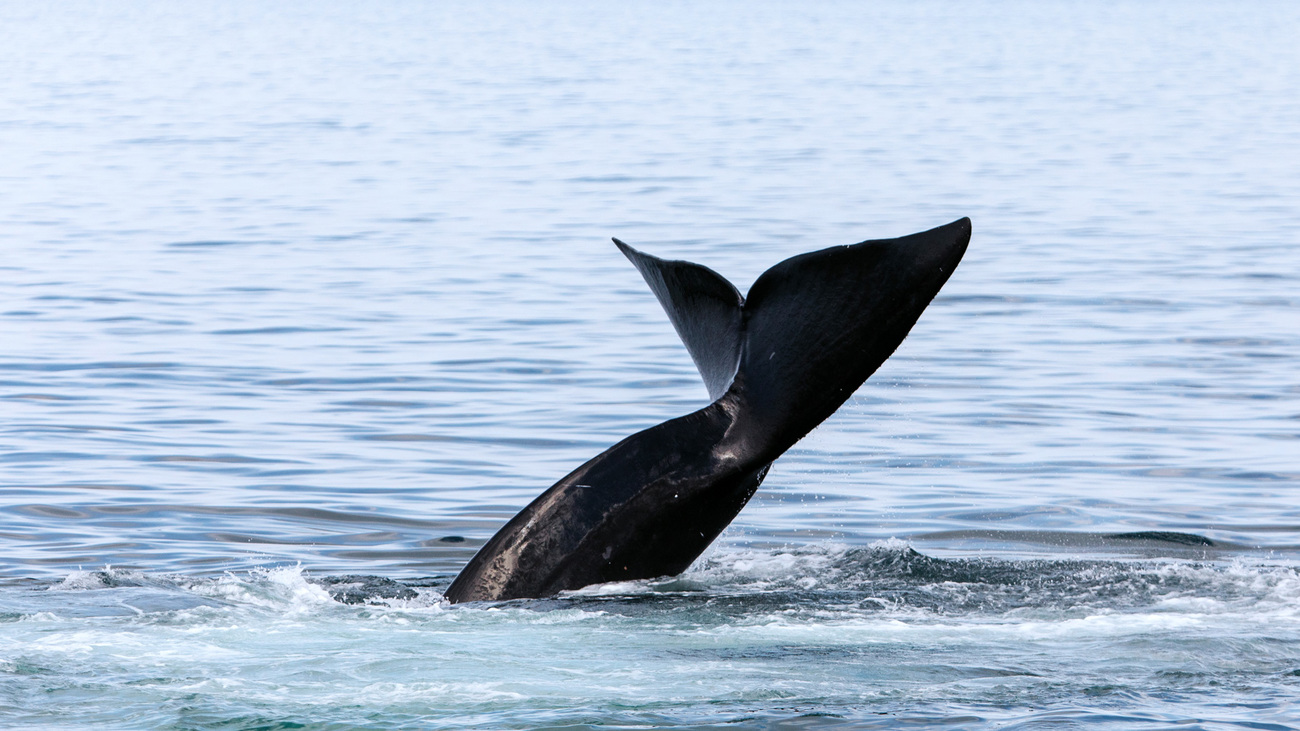
Cape Cod Bay is an important spring feeding habitat for critically endangered North Atlantic right whales. Up to two-thirds of the population is observed there each year before the whales move north along the coast to feeding areas in Canada for the summer and fall.
Sei whales feed on the same prey just outside Cape Cod Bay, and sometimes within the Bay itself, but far less is known about their behaviour and movements.
For both species, what happens after they leave Cape Cod Bay is less clear. And that knowledge gap matters. Busy commercial shipping lanes lie just outside the Bay, making it important to understand where whales go, how long they spend there, and what they are doing along the way.
That leaves scientists with three key questions:
Both North Atlantic right whales and sei whales eat zooplankton, and they often feed near or right at the ocean surface. Understanding where prey concentrates can help scientists understand why whales choose certain areas and, ultimately, better predict where whales may be found.
Research has shown a link between the presence of a gas called dimethylsulfide (DMS), zooplankton, and whales. Through this research, we could use models to predict what levels of DMS are associated with the presence of whales feeding on zooplankton prey at the surface.
The information scientists have about whale movements outside of Cape Cod Bay, including in busy shipping lanes, all comes from observational surveys by plane or vessel. Although this research has provided invaluable information, aerial or vessel survey teams are limited by weather conditions and daylight hours. These observations represent small snapshots in the life of a whale, often less than an hour.
Tags can give scientists a much fuller picture. By putting tags on whales, we can collect data about the animals’ underwater movement—something we could never observe from a boat or the air—and do so for many hours and throughout the night. A tag deployment that lasts 30 hours can show what a day in the life of a whale looks like.
Importantly, tagging shows whether whales stay in one spot or if they move in and around the shipping lanes, where they feed, and whether they feed only at certain times or throughout the night. Much of what we’re observing provides new insight into these whales’ lives—anything we find is exciting and unexpected.
No, many different tags exist, often specific to the animal and tagging purpose. Unlike a plastic tag found on farm animals, the tags used in this research are not permanent and not used solely for identification. These tags track the movements of an individual whale for a limited period.
Tagging large whales requires specific permits, instruments, and procedures. In this research, we deployed SPLASH tags with glue and CATS tags, which stay on via suction. Both tags are non-invasive and impermanent.
Given the endangered status of both species, invasive tags can pose unnecessary risks to individual whales, including infection at the tagging site. In addition, North Atlantic right whales don’t have a dorsal fin, making any invasive, long-term tags difficult to deploy.
These limitations mean that right whales and sei whales cannot be monitored at all times, preventing us from using tagging itself as a solution to mitigate entanglements and vessel strikes. Instead, scientists can use tagging data in predictive models to better inform conservation management decisions.
Each successful tag deployment adds another piece to that picture, helping scientists turn hours of data from an individual whale into knowledge that can better protect whales as they move through a busy ocean.
Our work can’t get done without you. Please give what you can to help animals thrive.
Unfortunately, the browser you use is outdated and does not allow you to display the site correctly. Please install any of the modern browsers, for example:
Google Chrome Firefox Safari