Ocean Noise Reduction - Global
Saving marine life could be as easy as turning down the volumeEuropeans back action to quiet our ocean and protect marine life
Europeans back action to quiet our ocean and protect marine life
20 May 2026
Beneath the surface of our ocean, sound is life. For whales, dolphins, and countless other marine species, it is how they communicate, navigate, find food, and stay safe. But today, that vital soundscape is being drowned out—largely by us.
A new survey conducted across Europe reveals both a challenge and an opportunity: while underwater noise pollution remains widely overlooked, Europeans overwhelmingly support action to address it once they understand its impact.
A hidden threat, brought to light
According to a March 2026 survey conducted by Ipsos for IFAW and supported by KRESK 4 OCEANS, 98% of people across five European countries say protecting marine life is important. Yet only 14% currently identify underwater noise as a threat to ocean biodiversity.
This gap matters, but it is not a sign of indifference. It is a sign that this issue is largely invisible to the general public.
When respondents learned how noise from ships disrupts the ability of marine animals to communicate, feed, and navigate, concern rose sharply. Nearly 9 in 10 people (89%) said the problem should be addressed urgently. This tells us something powerful: when people understand the issue, they care—and they want solutions.
Europeans are ready for change
The survey also shows that concern quickly translates into support for action. A strong majority—84%—support reducing ship speeds to protect marine life. Even more telling, 78% believe this should be enforced through regulation, rather than left to voluntary commitments.
People are also willing to play their part. Nearly 7 in 10 respondents (69%) said they would accept slightly longer delivery times for goods and parcels if it meant reducing underwater noise pollution. This is a clear signal to decision-makers: the public is ready for meaningful, practical solutions.
Slowing ships, saving lives
One of the most effective ways to reduce underwater noise already exists. At IFAW, we call it Blue Speeds, which roughly translates to a modest 10% speed reduction across the global shipping fleet..
This simple change can deliver immediate and measurable benefits. Implementing Blue Speeds worldwide could reduce underwater noise by up to 40%, helping restore the acoustic environment that marine animals depend on. It could also cut the risk of deadly collisions with large whales by half, while reducing greenhouse gas emissions from global shipping by an estimated 13%. In other words, slowing ships is not just good for whales—it is a practical solution for climate, biodiversity, and safer seas.
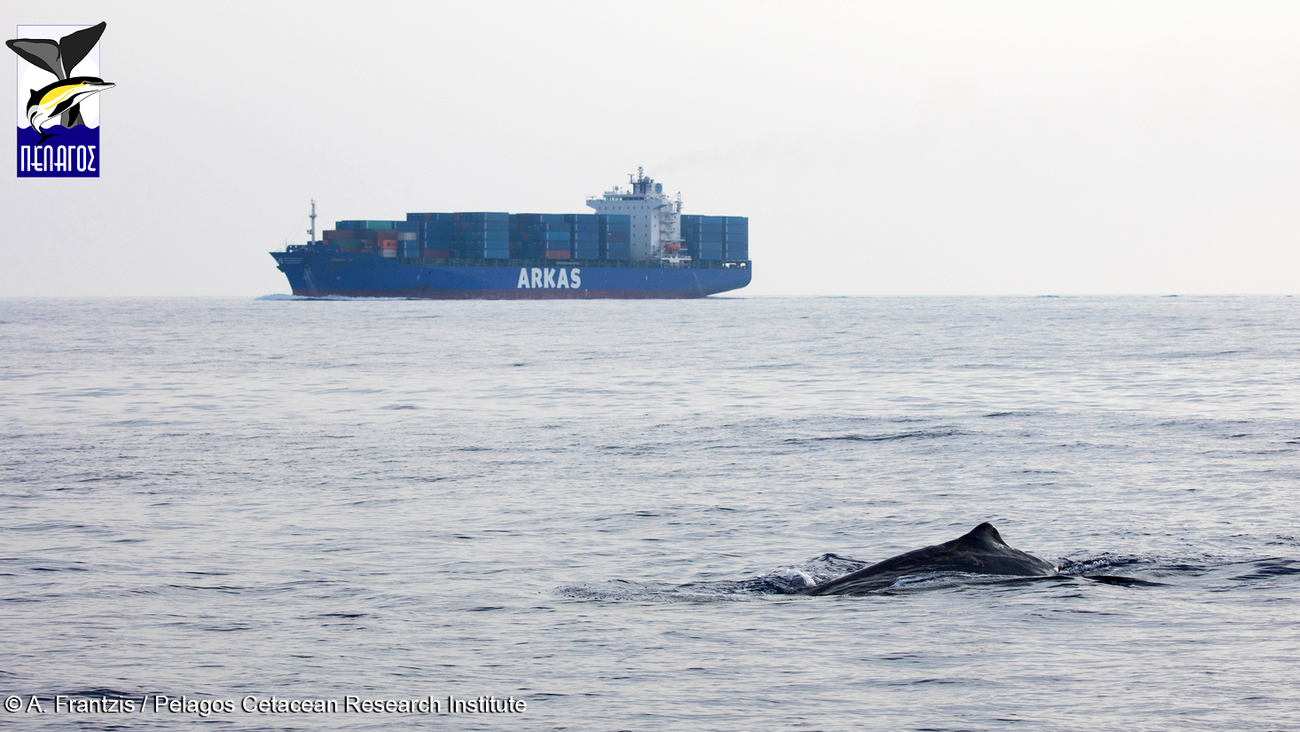
Cargo vessel passing close to a sperm whale Photo: © A. Frantzis / Pelagos Cetacean Research Institute
A critical moment for Europe’s seas
These findings come at a pivotal time. The European Union is currently reviewing its Marine Strategy Framework Directive (MSFD), a key piece of legislation designed to achieve “good environmental status” for Europe’s seas. That goal was meant to be reached by 2020, but it was not.
Among the areas where progress has been most limited is the reduction of underwater noise pollution, around half of which is generated by maritime transport. Without stronger action, this invisible threat will continue to grow.
But the path forward is clear. Europeans support it, the science supports it, and the solution is within reach.
Turning public support into policy
IFAW is calling on EU institutions and national governments to seize this moment. By integrating mandatory ship speed reductions in European waters into a strengthened MSFD, Europe can take an immediate and decisive step for a quieter, healthier ocean.
This is an opportunity to align policy with public will—and to deliver tangible benefits for marine life.
A quieter ocean is possible
Across Europe, people are showing that they care deeply about the future of our ocean. They are willing to learn, to adapt, and to support solutions that protect marine life.
Together, we can turn down the volume on underwater noise and give whales, dolphins, and other species the space they need to survive and thrive. A quieter ocean is not a distant ambition. It is a solution within our grasp—if we choose to act.
This work is generously supported by KRESK 4 OCEANS.
Survey conducted by Ipsos BVA for IFAW between 11 and 26 February 2026 across France, Germany, the Netherlands, Spain, and Sweden, with representative samples of 1,000 respondents aged 18 and over in each country.
Related content
Press releases
Global whale summit marks milestone as whaling nations continue to block progress
Read morePress releases
From harpoons to ship strikes, global whale summit tackles the threats facing whales
Read moreBlog
How underwater noise pollution threatens marine life in the Western Indian Ocean
Read moreEvery problem has a solution, every solution needs support.
The problems we face are urgent, complicated, and resistant to change. Real solutions demand creativity, hard work and involvement from people like you.