Whale Watching Promotion - Global
Watching is better than whalingCountdown begins: Iceland’s controversial whale hunt set to resume within days
Countdown begins: Iceland’s controversial whale hunt set to resume within days
June 10, 2026
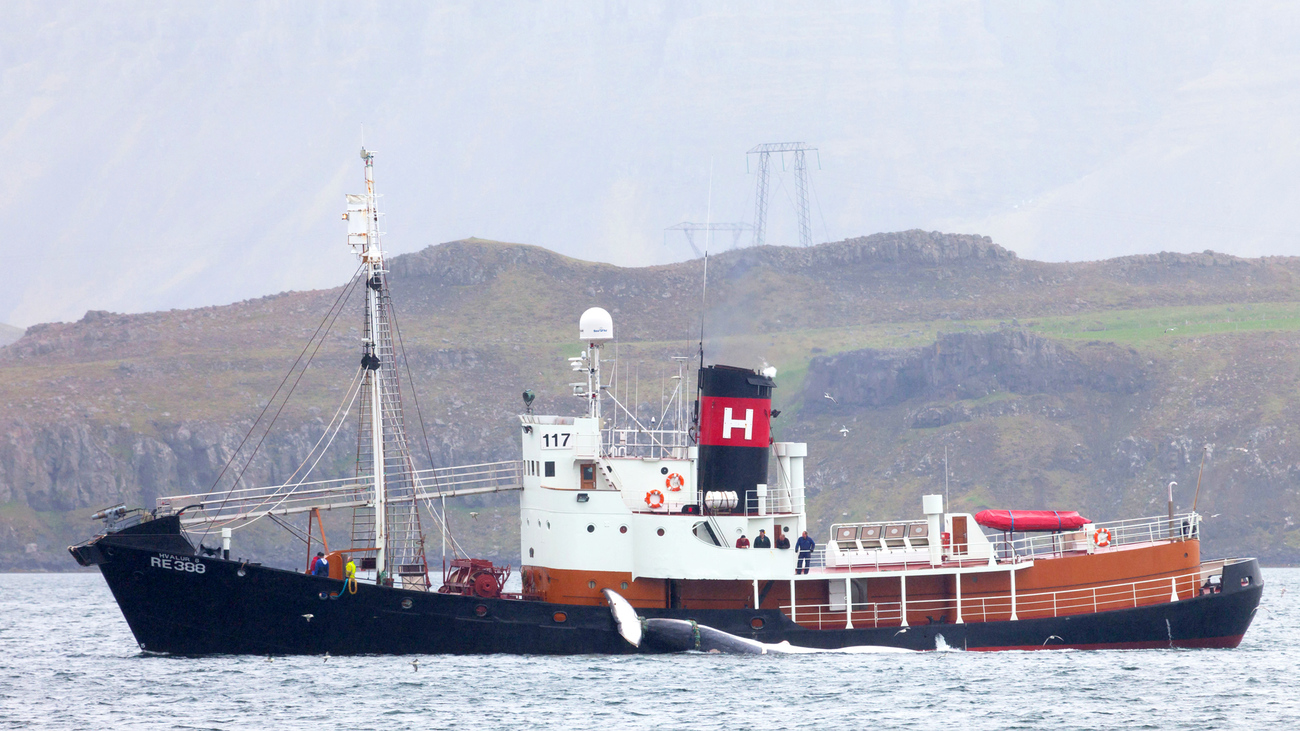
Harpooned fin whale in Iceland arriving at the Hvalfjordur whaling station. Photo: Einar Magnus Magnusson / © IFAW
(Reykjavik, 10 June 2026)—Following a two-year hiatus, whaling is set to resume in Iceland with a quota of 150 fin whales and 168 minke whales, amid controversy and rising political tensions over the industry’s future.
Icelandic whaling company, Hvalur hf. recently confirmed its intention to return to sea to hunt fin whales this summer.
Fin whales are the second-largest animals in the world and are officially considered vulnerable, meaning the species faces a high risk of extinction in the wild.
Conservationists from IFAW have branded fin whaling unnecessary, inhumane, and brutal. For the animals hunted, it often results in prolonged suffering following an exhausting chase and being struck by a harpoon. Official studies show that, in some cases, it can take up to two hours for a harpooned whale to die. Cases have also been documented where severely injured whales managed to escape.
“Tragically, fin whales will be hunted in Iceland as early as mid-June,” says Andreas Dinkelmeyer, Campaign Manager at IFAW Germany. “This is a devastating setback. The government had a clear opportunity to halt—or at least hinder—whaling this season, and it has let it slip away. The unnecessary and brutal hunting of whales is outrageous and cannot be justified under any circumstances.”
Commercial whaling takes place against a backdrop where demand for whale meat is in decline, and a referendum on whether to restart European Union (EU) membership negotiations in Iceland is scheduled for August this year. The EU strictly opposes commercial whaling, but some view whaling as part of Iceland’s national independence. The renewed focus on the issue highlights tensions over practices some fear could be undermined by closer ties with the EU.
“It is perverse that Kristján Loftsson, owner of Hvalur hf. intends to kill fin whales again even though he cannot sell the meat. We question whether he has ulterior motives such as using whaling to inflame political debate, with fin whales ultimately paying the price as collateral damage. One possible aim could be to delay proposed reforms to Iceland’s whaling laws and influence the upcoming referendum on resuming EU accession negotiations,” Dinkelmeyer added.
The current government has announced that it will review its whaling laws in the autumn—with the goal of eventually ending whaling in Iceland. It is possible that any changes will only take effect when the current five-year license expires in 2029. However, clarity on this will only emerge during the legislative process. Responsibility lies with the Minister of Industry, Hanna Katrín Friðriksson, who oversees fisheries.
“Despite the absolutely unnecessary whaling that will likely happen this year, there is hope. Over the past 23 years, since Iceland resumed whaling in 2003, IFAW has worked together with a broad alliance of Icelandic stakeholders—from environmental and animal welfare organisations to the tourism sector, administration, politics, and legal experts—to bring about a societal shift,” explains Dinkelmeyer. “At all levels of society, it is abundantly clear: Icelanders want to end whaling for good—and they will end it.”
The whalers of Hvalur hf. resumed fin whaling in 2009 and have since killed 1,017 fin whales. In the most recent whaling season in 2023, just 24 fin whales were killed, following a much larger catch of 148 in 2022. The whale meat was primarily exported to Japan, although demand there is in decline, and the country has become more self-reliant as its own whaling capacity has expanded, with a new processing mothership launched in 2024.
Minke whaling has almost entirely dwindled in recent years, with just a single minke taken in 2021. Minke whale meat was often falsely touted as a local delicacy to foreign tourists, although as public opinion has shifted, demand has dropped significantly. A fishing company new to whaling, NORA Seafood, is now looking to hunt minke whales but it is still unclear if they will proceed in 2026.
IFAW is calling on the Icelandic authorities to urgently end whaling by passing legislation that bans this cruel practice once and for all, and to ensure that violations of existing regulations are fully enforced and penalised.
Ends
Notes to Editors:
Images are available here.
More than 1,900 fin and minke whales have been killed in Iceland since the International Whaling Commission (IWC) moratorium on commercial whaling came into effect in 1986.
Fin whales are the second largest mammals on earth, growing on average up to 20 metres long and weighing about 38 to 50 tonnes. They are fast swimmers and are only surpassed in size by blue whales. Globally the species is considered Vulnerable on the IUCN Red List of Threatened Species.
In 1982, the International Whaling Commission (IWC) took a decision to set zero catch limits for all commercial whaling (i.e. the commercial whaling moratorium). This came into force in 1986, but unlike other whaling nations, Iceland did not take out an ‘objection’ to this decision – instead, once the ban was in place, it continued a small “scientific whaling” programme until 1989. Iceland abruptly left the IWC in 1992 but re-joined in 2002, this time taking out a ‘reservation’ against the moratorium. Iceland recommenced commercial whaling under its IWC moratorium reservation in 2006, resulting in a self-allocated quota of fin and minke whales.
Further renewals of the five-year whaling licenses could continue to strain Iceland’s international relations including with the US, which has had diplomatic sanctions (so-called Pelly Amendment sanctions) in place against Iceland since 2014 due to its commercial whaling activities and international whale meat trade.
Related content
Our work can’t get done without you. Please give what you can to help animals thrive.