Kathleen Collins
A hopeful season for North Atlantic right whales
A hopeful season for North Atlantic right whales
Kathleen Collins | February 4, 2026
With ten weeks still to go of the 2025–2026 calving season, we’ve reached a milestone I never thought I’d see in the near term: 22 North Atlantic right whale calves documented off the southeastern US coast. It’s the highest total in 15 years, and a rare chance to celebrate a species known more often for the threats it faces than the victories it achieves.
With an estimated 380 North Atlantic right whales remaining, including only about 70 reproductively active females, the addition of 22 calves is significant. Experts have long said that 20 calves in a season would be enough to maintain the population at its current level. So, while we’re not across the finish line, we’re moving in the right direction—and the whales are showing us they’re ready to do their part.
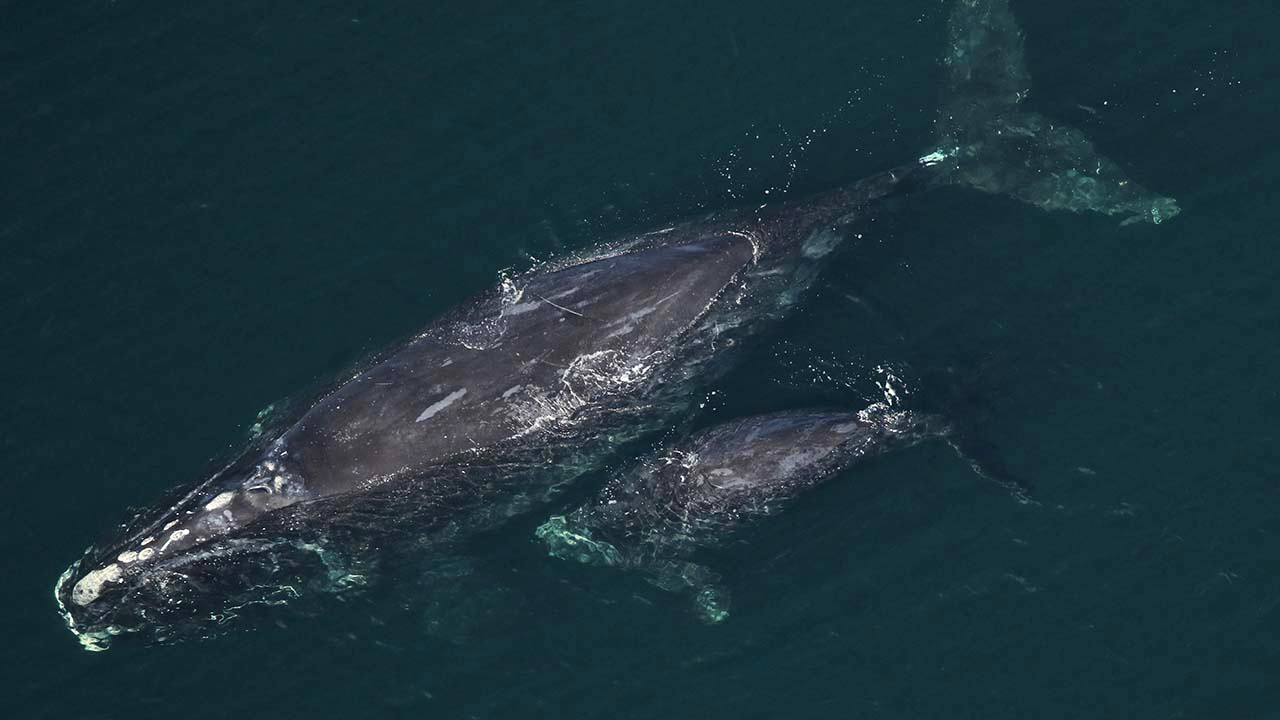
Right whale Catalog #3593 and calf sighted January 6, 2026 approximately 13.5nm off Jacksonville Beach, FL. Photo: © Florida Fish and Wildlife Conservation Commission, taken under NOAA permit #26919
Moments to celebrate
These calves are more than numbers. They represent resilience, determination, and the legacy of decades of conservation work.
A 10‑year‑old right whale (Catalog #4610) became one of the youngest known mothers, a hopeful sign that when threats are reduced, whales may return to more natural reproductive rhythms. Experienced mothers like Magic (#1243) and Slalom (#1245) added to their impressive maternal records—powerful examples of what survival across decades can mean for the species.
We’ve also seen how everyday people are part of this story. Recreational boaters reported a sighting of Giza (#3020) and her calf off the South Carolina coast, highlighting the role of public observation and citizen science in protecting this species.
A species on the move
From Florida to North Carolina, mothers and calves are using nearshore waters throughout the right whale calving grounds. Their presence across such a wide area highlights just how much ocean must be protected to give them a safe start. Seasonal speed limits along the southeastern US coast require large vessels to slow down, and smaller boats are strongly urged to do the same. With at least 22 mother-calf pairs often swimming just below the surface, slower speeds and extra awareness from mariners can make all the difference.
Signs of recovery
After years of worrying trends, it’s heartening to see more mothers calving at shorter intervals. In the recent past, gaps of closer to 10 years between calves became the norm due to the strain these whales face—gear entanglement, vessel strikes, shifting prey, and noise pollution. This season, some mothers have returned to calve within five years or less. It’s a promising development, and one we’ll be watching closely to understand what’s driving it.
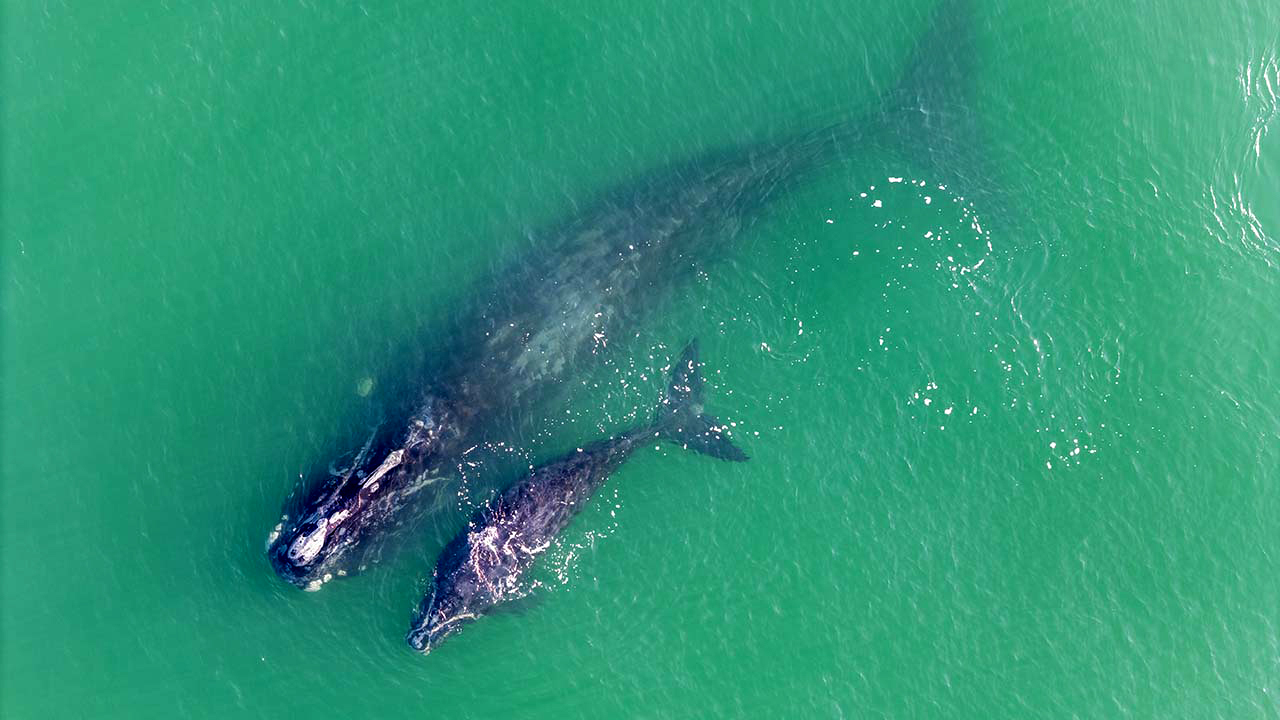
Ghost (Catalog #1515) was sighted with a calf on January 30, 2026 just offshore of Flagler Beach, FL. Photo: © Marineland Right Whale Project, taken by Jeff Greene under NOAA permit #26562
Now it’s our turn
We know what’s holding this species back. The leading threats—vessel strikes and entanglement in fishing gear—are well-documented, and preventable. Since 2017, right whales have been in what NOAA calls an Unusual Mortality Event. Over 20% of the known population has been killed or seriously injured during this time.
Rather than let these challenges overshadow the good news, we can let them drive us to do more. The whales are surviving against the odds. This season proves that when given the chance, they can thrive.
The Marine Mammal Protection Act (MMPA) has been a bedrock environmental law since 1972. It protects all marine mammals in US waters, and it’s no exaggeration to say it has helped prevent extinction and restore populations in more than one case—including for North Atlantic right whales.
But US lawmakers are now considering a draft reauthorization of the MMPA that would undo five decades of progress. If passed, it would make it harder to protect whales from threats like entanglement and vessel strikes. It would shift the burden of proof onto scientists and conservationists and tilt the balance away from precaution and toward industry priorities.
A weakened MMPA would make saving whales harder at the very moment they are showing us they’re ready to rebound. We can’t let that happen.
Keeping the momentum
Despite all this, I remain hopeful. This season’s calf count shows what is possible when we act with urgency, listen to science, and work together. Conservation isn’t just policy and science—it’s people.
It’s the mariner who slows down when whales are nearby. The lobsterman testing on-demand fishing gear. The beachgoer who reports a sighting. The policymaker who champions science‑based protections. The supporter who shows up, signs a petition, and keeps caring, even when things feel bleak.
These 22 calves are more than a number. They’re a signal that recovery is still within reach—and that with enough commitment, this species has a fighting chance.
Let’s make sure that by this time next year, we’ve done even more to turn that chance into reality.
Related content
Our work can’t get done without you. Please give what you can to help animals thrive.