Rescued Dolphins go high-tech!
This section of the post was filed by Katie Moore, the International Fund for Animal Welfare's Marine Mammal Rescue and Research (MMRR) team Manager.
Sometimes, the hardest days really do turn out to be the most rewarding! Winter is our busiest stranding season and this day tested our stamina. Our first stranding hotline call came mid morning- four dolphins stranded in Wellfleet. One common dolphin was found in Chipman’s Cove. The other three were on Mayo beach, one of which had died before being found.
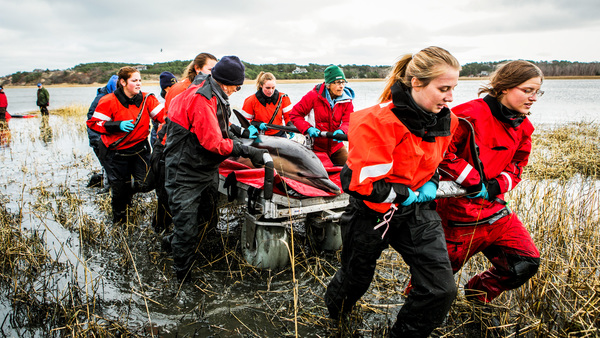
The MMRR team responded rapidly to assess the live animals and provide supportive care and medical treatment. It was phenomenal to realize that all three of these dolphins were fit for release. Our team members and dedicated volunteers cared for these animals throughout transport to a safe release location at the tip of Cape Cod where they could be released into open water. Through driving wind and alternating rain and sleet, we arrived in at Herring Cove in Provincetown.
As we were preparing to release these three animals (one fitted with a satellite tracking tag), we received two more calls- one dolphin stranded in Truro and three more at another location in Wellfleet. Although it was hard, we had to focus on the three animals in hand. While the other staff members and volunteers released these animals, I frantically made phone calls to find more volunteers to respond to the new dolphins. (I am constantly amazed by our volunteers who venture out in terrible weather to provide care while we’re en route).
The release was great but the celebration was short-lived as we turned around and headed back to try to rescue the remaining dolphins. Two animals died due to wounds sustained during stranding. We rescued and transported the two remaining animals to Provincetown hoping to release them both. Unfortunately, one young animal that stranded in Truro took a turn for the worse during transport and had to be humanely euthanized. This left us with one common dolphin – a possible dilemma. Normally, NOAA does not allow single dolphins from social species to be released alone fearing that their social needs will not be met and they will not survive. However, we’ve begun a new project, approved by NOAA, to determine if it is possible to release healthy, single social animals. We satellite tagged this animal as part of that project, allowing us to track its movements. It was wonderful to have the opportunity to release this dolphin.
We initiated another exciting change in our protocols as well. All four of the released dolphins received new, advanced care which included vitamin and steroid supplements to combat capture myopathy which causes muscle damage and can affect long-term survival. We hope these measures will make the dolphins’ transition back to the wild easier and increase their chances for survival.
It was a monumental day for all involved. Of the five possible release, candidates we successfully relocated and released four dolphins. Although we strive to release all live stranded animals back to the wild, this was a great effort by all with wonderful results. I am so proud of my team and all of our outstanding volunteers who give so generously of their time. We made a difference today.
This section of the post was filed by Sarah Sharp, the International Fund for Animal Welfare's Marine Mammal Rescue and Research (MMRR) Stranding Coordinator.
What an exciting few days! On Friday, we successfully deployed our first satellite tags on two stranded common dolphins and released them back to the ocean! As I programmed and prepared the first satellite tag in transit to the release site, it was hard to contain my excitement. These progressive tags are minimally invasive, attaching by only one pin through the trailing edge of the dorsal fin. During the tagging procedure, we took every precaution to ensure that the dolphin was as comfortable as possible, including numbing the fin with a local anesthetic and providing supportive care throughout. At 3pm, from Herring Cove in Provincetown, we released our first satellite tagged dolphin (IFAW10-060Dd) with the two other healthy dolphins that he had stranded with in Wellfleet. We then received a report of another group of dolphins stranded in Wellfleet and headed in that direction.
Unfortunately, there was only one live dolphin when first responders arrived on scene at the second mass stranding. Since dolphins are so social in nature, the current regional protocol dictates that single animals should not be released alone because it is thought that they would not be able to survive without their group. Recently, we were able to get permission from NOAA to release single healthy dolphins back to the ocean as long as we tracked their post-release success to ensure that they did not suffer needlessly – a task made possible by satellite tags donated by long time donors and friends of our organization. These specially designed tags have both a satellite component and a VHF transmitter, so that we can track the animals by boat after the release to conduct health assessments and monitor their success. The second satellite tagged dolphin (IFAW10-063Dd) was released alone just after 7pm that night.
By the next morning, we had received great location data from both satellite tags and got out on the water to relocate the animals using VHF tracking. Unfortunately, the six foot swell in the dolphin’s general location made sighting their small dorsal fins very challenging. We were so close to one of the dolphins that we were able to hear the clicks of the VHF transmitter from his tag, but we weren’t able to see him! We’ll just have to wait for some better weather to be able to monitor their success from the boat.
Today, our satellite tags had a huge surprise in store for us! Although the two tagged dolphins were released more than four hours apart, their satellite tracks have been overlapping all day long. Although it is hard to say for sure, it really seems like the single dolphin may have found the group of dolphins that were released before him! These results, although still preliminary, suggest that healthy single stranded dolphins are in fact capable of finding a social group if released alone. The implications of this are huge for stranded dolphins not only on Cape Cod, but around the globe. We will continue to monitor the satellite tag locations of these dolphins and look for the next good weather window to get back out on the water!
The very next day, another dolphin stranded - Misty Niemeyer, the International Fund for Animal Welfare's Marine Mammal Rescue and Research (MMRR) Necropsy Coordinator shares her rescue experience:
While I am still relatively new at this, I have to say this rescue tops my list, it may be the most memorable, strenuous, stressful and the most rewarding response I have been a part of! The day started off as a typical busy winter day trying to re-organize after a whirl wind week in the stranding world. Around 9 am my co-worker CT Harry received a call on our Hotline from on of our volunteers with a report of a free swimming juvenile common dolphin behind the Wellfleet Town Pier, it was just before high tide and the animal was in deep water. However, we knew that as the day went on and the extreme low tide approached, the dolphin would be in trouble if it didn’t leave the harbor, so we packed up and headed for Wellfleet. When we arrived (around 1 pm), it was still swimming in sporadic circles behind the Wellfleet Pier. We were now just a few hours from low tide and the dolphin did not appear to be trying head for deeper water. We monitored the animal’s behavior and movement but there wasn’t anything we could do while it was still swimming. A local fisherman warned us that the mud below where the animal was about 5 feet thick and not possible to access. So we waited and we watched as the water quickly sucked out of the harbor, crossing our fingers that the dolphin would follow, but we weren’t that lucky. As the water emptied out of the harbor, the dolphin appeared to be stuck, it began to flail and we were concerned it would drown right in front of us, so CT and I quickly swung into action.
We threw on our dry suits and with the help of the Wellfleet Harbor Master (Mike) we lowered his 8ft dingy down the 20ft rock embankment and Mike tied a safety line to our boat and CT and I began paddling slowing but vigorously through the thick mud towards the animal. This was not an easy feat as the oar locks broke and the water below us was rapidly disappearing, leaving us practically stuck in the mud as well. After a great effort we were able to get to a line that was strung across the small channel that the dolphin was in and we were able to pull ourselves toward it. Once we got to the dolphin we had another hurdle to get over, how to get it out! Our initial plan was no longer going to work. At this point the situation became a little dire as CT and I struggled to try to get a hold of the animal with little luck. We weren’t sure if we were going to be able to save the dolphin and feared we may have to just leave it, but we couldn’t accept that, so we kept trying. CT was able to grab on to the dolphin and keep it’s head above the mud and hold on to it while I use the line pull ourselves to the floating dock (however it was really “floating” anymore) in the center of the channel , needless to say my arms felt like noodles on Sunday morning! We were able to get to the floating dock and hoisted the animal into the dingy with all of our strength possible and then we hoisted the animal again onto the dock and I’m still not quite sure how we did that. One more hurdle tackled! With help from two of our volunteers we carried the dolphin in the stretcher across floating docks, through the thick mud on shore and finally we were on solid ground, we took a quick breather and with the help of our volunteers and some local residents we were able to lift the animal up a 15 ft rocky culvert and over a side rail. While our rescue efforts were a bit unorthodox and we were covered in mud from head to toe CT, myself and the juvenile dolphin were out of the mud and that was a start!
For more information, please visit, www.ifaw.org
Comments: 3
From what I understand, it is believed that there is usually maybe just a couple of ill animals that beach themselves and they call out for help and the rest of the pod rushes in....to their death. What rescuers need is time to find the sick ones, isolate them, and return the well ones to the ocean.
Here is my idea: You'll need a refuse type pump to quickly move the volume of water you'll need. A cylinder of compressed gas, like CO2. We have these portable swimming pools over here where the ring is inflated and then the pool is filled with water. As the pool fills, the ring rises. You could position a deflated pool next to a dolphin, lube the edge of the pool and slide the dolphin in. With the compressed gas you'd quickly fill the top ring of the pool. With the pump you could fill the pool with enough water to give the dolphin buoyancy so that it can breathe. Now a vet could have time to examine the animal. When the tide comes in you could then release the healthy animals. The sick ones would have to be put down or taken to a facility so that they wouldn't call the healthy ones back in. In an old episode of Jacque Costeau they captured a dolphin that was "surfing" off the bow of the ship and kept if for a few days in a floating pen made up of netting.
While the kids pools would work if you were going to wait for high tide, if you could get some used Zodiac type inflatable boats to use instead of the pools you'd have something sea worthy that you could tow the dolphins back out to sea with. I would imagine that military surplus would be a good source for the Zodiacs. .....
How I would imagine this set up working is that the Zodiacs/pools and air tank could be air dropped in the area for first responders to set up. You could probably even air drop the pump set up to the beaching. If you fitted the pump with a small single cylinder diesel engine it could run for hours with very little fuel. Or if you could get a fire truck/pumper truck to respond to the beach you could really get set up quickly
If your Coast Guard or Navy could air drop the supplies you could set up so quick and save many dolphins' lives.
What do you think???
What an awesome job you guys did in Wellfleet. The people and volunteers that worked through the mud and cold to save our marine "friends" are my heroes.
Mark Gaulin
Lunenburg, MA
It feels good to know there are still people who really care to the animals. May God Bless you and may you continue to help those beautiful creatures.